

Close Up
Cr)
LU
z
C/1
LU
CC
LL,
CI
LL,
50
Everyone from former Presi-
dent George Bush to the United
Nations and the Arab League
have called the Jewish settle-
ments "an obstacle to peace." Po-
litical activists on Israel's left
agree. Opponents of the move-
ment say that the expansion of
Jewish settlements in the West
Bank jeopardizes the peace
process. Peace Now says that
every house built over the green
line is a step backwards for the
peace process and a move for-
ward to conflict. The movement's
official statement reads, "the
building of settlements on Pales-
tinian lands is another example
of the injustice of occupation and
hinders the possibility of co-exis-
tence."
Ms. Tayar says, "Everything
changed with the signing of the
Oslo Accords in 1993. Sudden-
ly, Rabin divided our communi-
ties into those he regarded as
important for security and those
that were not. He regarded the
settlements along the eastern
border with Jordan as vital to Is-
rael's security and those in Judea
and Samaria as a political liabil-
ity." (In November 1993, Mr. Ra-
bin told an audience of Jewish
leaders in New York that settle-
ments such as Ariel and Em-
manuel were not necessary in the
new Middle East equation.)
In pre-State Israel, a string of
kibbutzim popularly known as
"the Gush" was founded 15 miles
south of Jerusalem, in a heavily
Arab-populated area. The group
of pioneering immigrants that
settled there in the mid-1940s
was cut off from any major cen-
ter of Jewish population. During
the 1948 War of Independence, a
group of 35 Haganah soldiers set
out from Jerusalem with the in-
tention of assisting in the defense
of the Gush. They were am-
bushed on the way by Arab ma-
rauders, and the kibbutzim were
destroyed. After Israel captured
the West Bank in 1967, the adult
orphans of the massacre returned
to the area and founded, for the
second time, Kibbutz Nir Etzion,
along with many other rural and
urban communities.
The history of the modern set-
tlement movement began in 1967
as a national consensus, while
their future has grown into one
of the country's most divisive and
hotly contested issues.
After the Six-Day War the La-
bor government, under Prime
Minister Levi Eshkol, developed
a policy of encouraging the
reestablishment of a Jewish pres-
ence in the Etzion block.
Settlements were developed
and expanded under subsequent
Labor and Likud governments.
During the intifada uprising in
the late 1980s, Israel built roads
to bypass Arab villages, mini-
mizing the dangers of traveling.
Today, the geopolitical lines sep-
arating Gush Etzion from areas
where consensus does not exist
is less clear.
Detroit-born Josh Kamins, an
observant 30-something com-
puter analyst, and his Montreal-
born wife, Tamar, have just
moved into their new house on
the Gush Etzion settlement of
Elazar, across the road from
Efrat. Mr. Kamins, who grew up
in Southfield, says initially it
wasn't religious ideology but eco-
nomics that drew him out of
Jerusalem and over the green
line: He and his wife
were looking for an af-
fordable religious com-
munity where they
could raise their two
small children.
"We were renting in
Efrat but couldn't find
anything to buy in our
price range," he says.
"Then we heard about
this project in Elazar,
and it was important
to us to buy out here
before the 1996 Israeli
election. We were
afraid how the out-
come of the national
elections would affect
our ability to purchase
a home."
Elazar offers private
or semi-detached homes with
a front and backyard on paved
streets — at a cost of about one-
third their market value in
Jerusalem or Tel Aviv. In a
normal situation, this region
would be considered suburbia.
Real-estate agent Shelly
Levine works largely with
properties in areas considered
over the green line.
"Today, a three-bedroom
home with a yard in a place
like Nazar will cost somewhere
in the $150,000 range, com-
pared to twice that in Efrat,
just across the road," she said.
The cost of housing in Efrat is
considerably higher because
the town of 25,000 offers a va-
riety of amenities and services.
Elazar has no post office, bank,
supermarket or schools.
A comparable property in
Jerusalem would list for some-
where in the half-million dollar
range.
A recently published survey of
prices of homes in the Jewish set-
tlements indicates a correlation
between place and price. But
here, location means more than
how far one has to commute to
work. It means the distance from
medical facilities, schools, cul-
tural activities and shopping. It
also could mean daily travel ad-
jacent to Palestinian villages.
"You ask me about our securi-
ty?" Mr. Kamins says. "You can't
let terrorism rule your life. To tell
you the truth, what concerns me
more is the way Israelis drive on
the roads."
Although Josh and Tamar
Kamins did not come to Elazar
for ideological reasons, he says,
"I wanted a place where I could
make a contribution. The ideo-
logical stuff sort of grows on you.
Today, I take part in nonviolent,
peaceful demonstrations protest-
ing certain government policies
which could jeopardize the future
of the settlements."
North Americans such as the
Kamins take seriously their po-
ish character to be maintained.
The newcomers are not looking
for a mimicry of McDonalds or
Toys R Us.
"Our reason for coming here is
our history. It did not begin in Tel
Aviv or Ashkelon but in Hebron
with Avraham Avinu at the Cave
of the Patriarchs, in Nablus-
Schem, the sit of the Tomb of
Yosef." (According to rabbinic
sources, Joseph died in Egypt at
the time of the enslavement. He
asked his survivors to rebury his
remains in Eretz Yisrael One set-
tler quipped that Judea and
Samaria read like a AAA guide
.
litical and social involvement. to the Torah.)
Even though official figures have
For British-born Marc and
the number of North American Michelle Kam, coming to live in
settlers as between 5 and 10 per- Israel means pioneering and ful-
cent of the total pop-
filling a dream.
ulation, Yehudit
They started their
Top
and
right:
Tayar said their rep-
Residents of
life in Israel in the
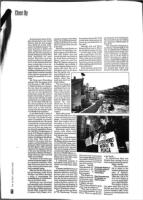
resentation is dis- the territories continue to
northern development
proportionate to build, despite their
town of Karmiel.
uncertain Tutu re.
their numbers.
Michelle recalled that
"The Western im- Above: Peace
migrant understands the settlemen Now labels "Marc got a job in Tel
"an
Aviv, so we ended up
involvement, every- obstacle to pe is ace."
on a very small settle-
thing from the PTA
ment called Nachliel.
to politics," she says.
The
mother of three
`They've been educated to speak
teen agers noted that only 10
up for what they believe in."
"They have an idea of what families were there when they
this country should be," she con- moved to Nachliel in 1987. "A few
tinues. 'There is a specific Jew- houses on a mountainside and
that was it."