
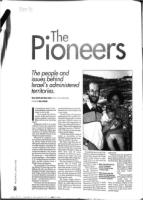

The people and
issues behind
Israel's administered
territories.
NEAL DUCHIN AND IDELE ROSS SPECIAL TO THE JEWISH NEWS
PHOTOS BY NEAL DUCHIN
(J)
CID
LU
- 3
0
CC
LLJ
LU
54
t constitutes some of the
most politically contested real
estate in the world.
Even using the Ilebrew
names, Judea and Samaria,
means making a statement.
Most call the area "the West
Bank."
Supporters refer to it as part
of Eretz Yisrael, the Land of Is-
rael. A senior U.S. diplomat in
Tel Aviv labeled the region pop-
ulated by 1.2 million Palestini-
ans and 160,000 Israeli Jews
"Israel-occupied territory."
Whatever it is called, it is un-
der constant international scruti-
ny. Every clump of soil in the
100-square-mile area is the focus
of media attention, evinced by the
current building at Har Homa,
which is within Jerusalem's mu-
nicipal boundaries. Any Israeli
government decision changing
the status quo — with bulldozers
or tree plantings — often triggers
U.N. condemnations and care-
fully worded rebukes from a
White House spokesman.
The prototype of the pioneer-
ing Israeli 50 years ago was the
kibbutznik who saw Zionist re-
demption through cultivating the
land. Today, some see the settlers
as Israeli idealists connected to
the historical heartland of greater
Israel — and driven by their na-
tionalism to reclaim it.
"You know how the permanent
status line will be drawn demar-
cating Israel from the Palestini-
ans?' one settler said. "Wherever
■ hith..14,
we don't build increases the like-
lihood that it will be handed over
to the Arabs."
Yehudit Tayar, Chicago-born
spokesman for the Council °New-
ish settlements in Judea, Samaria
and Gaza (YESHA) spews out
facts about the communities as
if she was reeling off batting av-
erages: 'There are 23 regional and
municipal councils in YESI IA,"
with "144 cities, towns and agri-
culture-based villages.
"A little-known fact is that as
much as two-thirds of the
160,000 residents identify them-
selves as secular," she says.
Ms. Tayar said that non-ob-
servant Jews often are drawn to
Maaleh Adumin and Ariel, grow-
ing towns that have attracted
thousands of families. "Most of
them have sold off small,
cramped, two-bedroom apart-
ments in the major cities and
moved to large, often single-fam-
ily or semi-detached homes."
Ms. Tayar boasts of a 3 percent
growth rate in Judea and
Samaria in the last year. She
says that despite a partial gov-
ernment freeze on new building
and the uncertainty resulting
from the Oslo agreement, there
is a clear demand for housing
that exceeds supply.
Ms. Tayar, a pony-tailed for-
mer Israel Army officer, came on
aliyah as a child. She has lived
in the settlement of Beit Haron
since 1980 and is passionate
about the cause.
In speaking tours in the Unit- agreement.
ed States, and when briefing jour-
Criticism from the United Na-
nalists from abroad, she works tions doesn't bother Ms. Tayar.
hard to make listeners under- Being abandoned by her own gov-
stand what is at risk when the ernment does. She recalls bitter-
world exerts pressure
ly how in late Prime
on Israel to "take a Above: The Ka mins did not Minister Yitzhak
chance for peace."
come for ideal ogical
Rabin tried to isolate
At her settlement, reasons, thoug h he says,
the settlers in 1993,
in the Samarian "it grows on y ou."
call them "cryba-
foothills, she has a
bies."
view of Ben-Gurion Right: Houses where the
Kamins live co st about one-
"Can you imagine
Airport to the west third
of compa rable facilities if President Clinton
and the Palestinian in Tel Aviv or J erusalem.
would have re-
town of Ramallah to
nounced responsi-
the north. Ramallah is under bility for Harlem, Watts or any
Palestinian Authority control, other urban area?" she says,
and many in Beit I laron are con- shaking her head in disbelief.
cerned where they will be left un- "That to me is the most unfor-
der a future permanent status givable thing."