
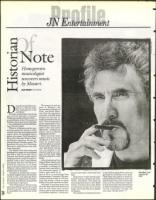

PH O I 0 BY DAN IEL L IPPI TT
Homegrown
musicologist
uncovers music
by Mozart.
JULIE WIENER STAFF WRITER
D
avid Buch describes him-
self as an "obscure histo-
rian working out in the
cornfields."
But after accidentally uncovering
new work by legendary composer
Wolfgang Amadeus Mozart, Buch —
a musicologist at the University of
Northern Iowa and native Detroiter
— has suddenly found himself bask-
ing in Mozart's glow.
While in a German archive con-
ducting research for a book on 18th-
century fairy-tale and supernatural
operas, Buch, 46, stumbled upon a
section of an opera, The Philosopher's
Stone (Der Stein der Weisen), bear-
ing Mozart's signature. He also un-
covered pieces of another opera, The
Beneficent Dervish (Der Wohltatige
Derwisch), which Mozart also may
have composed.
The details of his discoveries are
discussed in a paper to be published
this fall in the Cambridge Opera
Journal. But Buch's paper has al-
ready garnered a storm of media at-
tention, both in the United States
and abroad. The New York Times re-
ported the discovery on its front
page, and record companies are call-
ing Buch, asking if the music can be
performed and recorded.
The pieces in question are not par-
ticularly lengthy (about 20 minutes'
worth in all), and although Buch
says they are "good pieces of music,"
he thinks that Mozart himself did
not find them important.
"[The Philosopher's Stone] is one
opera that Mozart wrote a few small
parts for," he said. 'The second opera
is a possibility, but not as sure as the
first."
The pieces do not ap-
pear in Mozart's own
handwritten catalogue of
work, and Buch specu-
lates that the legendary
composer omitted them
because he was only ca-
sually involved in the op-
eras. "Five composers in
all are attributed to [The
Philosopher's Stone]. The
others were well below
[Mozart's] professional
status. I see it as Mozart
helping his friends." .
Buch has been inter-
ested in music since his
childhood in Oak Park,
when he studied piano
and was taken to concerts
by his mother, Mildred Ja-
cobs. But Buch's interest
was not limited to the
classical realm: as a stu-
dent at Oak Park High
School, he played in a cock
band.
After graduating from
Wayne State, Buch went
to Chicago and worked as
a musician. In Chicago, he
became more interested in
the historical aspect of
music, and went on to
earn a Ph.D. in musicology from
Northwestern University. His pub-
lications include a book on 17th-cen-
tury lute music, a book on early
ballet music and numerous articles.
Although it has been more than
25 years since Buch left Detroit, he
says he still comes back several
times a year to visit his brother Lar-
ry and other relatives. "I always en-
joy my time when I come here," he
said.
And Iowa's "weak Jewish com-
munity" pales in comparison to De-
troit's, said Buch, who grew up
attending Beth Aaron (now Beth
Achim). Living in Iowa City, Buch
occasionally travels down to the
larger city of Des Moines to attend
synagogue.
The professor is looking forward
to the hubbub dying down so he can
get back to working on his book.
"This story has gotten so much at-
tention because of Mozart, and I was
just the guy that came across the
score, put the information togeth-
er and showed how the scenario was
so likely that [Mozart] was involved.
I'm not a superstar," he said, "I'm
just a guy who got lucky." El
David Buch:"Just
a guy who got
lucky."