

STN Entertainment
Master Of
His Cave
Batty for comics as a kid, Michael Uslan turned his hero into
filmdom's great success story.
But the two job offers he re-
ceived in reply decidedly lacked
glamour: become a production as-
sistant (read: shlepping coffee) at
Universal Studios in L.A., or join
a big talent agency in New York,
which entailed six years of train-
ing before he might become an
agent. He passed on both.
It was 1973, and the 21-year-
old had a few choices; one of them
was being drafted. So he opted for
law school.
"I couldn't figure out any other
way to get a foot in the door. I
thought maybe I could get a job in
the legal, business side of it, and
SUSAN BERNSTEIN SPECIAL TO THE JEWISH NEWS
Susan Bernstein is arts and
culture editor at our sister paper
the Atlanta Jewish Times.
the 1960s, Uslan began seriously
collecting serials in the 7th grade.
He managed to hoard 30,000 com-
ic books, some dating back to
1936.
"My dad built shelves, lining
the walls of the garage," says the
producer. "I mean, you can't imag-
ine 30,000 comic books, and my
folks never once were able to get
the car in the garage."
What possible good could this
obsession with comic books have?
Uslan later sold 20,000 comics
(keeping his 10,000 faves), gar-
nering enough money to pay for
his wife's engagement ring, a hon-
eymoon in Europe and law school.
And he became such an expert
on everything from The Thing to
Captain Marvel that he taught
the first accredited college course
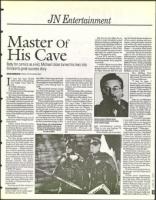
George Clooney, left, follows Michael
Keaton and Val Kilmer in the role of
Batman in the latest sequel, Batman
and Robin. Chris O'Donnell reprises
his role as Robin.
in comic books (as an art form and
social commentary) at Indiana
University, his alma mater. He
also worked for a while at DC
Comics, one of the main comics
publishers.
But becoming a film producer
was a lot tougher than taking the
Batmobile out of first gear.
"I didn't go to film school, I ma-
jored in history. I didn't go to
UCLA; I went to Indiana Univer-
sity," says Uslan. "I didn't have
any relatives in the business; my
last name was not Warner. I
didn't come from money. I had to
figure it out the hard way."
His path was heading to the In-
diana U. library every Friday af-
ternoon, reading the latest issue
of Variety, Hollywood's version of
a trade paper. Making a list of
every name of every film produc-
er, director, agent and studio offi-
cial he found — 375 in all — he
sent resumes to each name on the
list.
After he and Melniker
purchased the rights to
Batman from DC Comics,
they approached every
studio in Hollywood to
produce the film. The re-
sponse was derisive laugh-
ter that would have made
the Joker cringe.
"I was told I was crazy;
Batman producer Michael Uslan
I
was
told
it was a terrible idea.
showed Hollywood that comic books
I was told that no one had ever
weren't just for laughs.
made a movie based on old TV se-
take entertainment courses. ries. Now they're doing every old
When no one was looking, I'd series ever made," Uslan says.
sneak in the back door."
By 1986, Uslan was still trying
Uslan landed a job as an attor- to get his hero to film. One friend
in the film industry told him,
" 'Give it up, Michael, everyone
knows that movie is not going to
be made. It's a joke.' Sometimes
negative reinforcement can be a
strong driving force as well," he
recalls. Shortly thereafter, he got
his backing to make the film.
Warner Bros.'s Batman, star-
ring Michael Keaton as the Caped
Crusader and Jack Nicholson as
Joker, broke box office records. Di-
rector Tim Burton and set de-
signer Anton Furst spun Uslan's
comic book vision into epic pro-
portions. The subsequent films
were also huge hits.
Of all the comic book heroes in
his garage, what did Uslan see in
Batman?
ti
"Unlike many superheroes, g;
Batman wasn't super. He couldn't —
fly, or lift trains. If he was shot, he c
could bleed," he recalls. "I could
relate to Batman easier. I can re-
member thinking, 'If I can do
what Bruce Wayne did, study real
hard, and train, I could do this! "
Of course, having a really cool
utility belt couldn't hurt, either. ❑
PHOTO BY CHRISTINE LOSS
I
f your kid kept 30,000
comic books in the garage,
you might worry that he
was:
A) A little obsessive;
B) Avoiding reality;
C) Going to live in that garage
for the rest of his life.
But what if your kid grew up to
be Michael Uslan, who sold some
of his suddenly desirable comics
for enough money to pay for col-
lege and an engagement ring, be-
came an entertainment attorney,
then convinced the Hollywood es-
tablishment that cartoon heroes
could be screen gods by producing
some of the highest-grossing films
of all time?
Butch??? Where'd you put all
those comic books I bought you for
Chanukah?
Uslan, whose love for comic
books and the movies led him to
co-produce Batman and its three
sequels (the latest, Batman and
Robin, opens today) is now sitting
in the catbird seat. Or should we
say, the Batmobile?
The New Jersey native held
firm to his belief that his favorite
comic hero, the "dark knight" who
fought evil with only his human
ingenuity and strength, was made
for the screen — despite the deri-
sion of show business insiders.
Batman busted box office records
in the early '90s, and the series
has sustained its momentum de-
spite a leading man switch
(George Clooney will follow
Michael Keaton and Val Kilmer
in the role) and a sudden burst of
films based on comic book heroes
and"60s TV shows.
Entering the movie industry
through a circuitous route, Uslan
credits his achievements to per-
sistently believing in his own
ideas, and never believing what
anybody in Hollywood says —
good or bad.
Growing up in New Jersey in
ney for United Artists studios out
of law school, dealing with pro-
ducers, entertainment lawyers
and writers. He used it as good ex-
perience until he could pursue his
dream — to produce films based
on the comic book heroes he loved.
In the late '70s, he secured the
rights to the old Batman comic
book character, wanting to rescue
the shadowy, somber hero of the
comics from the campy mire of the
1960s TV series. Joining with Ben
Melniker, an executive at MGM
for 30 years, they formed their in-
dependent production company,
Batffims, on Oct. 3, 1979.
But shifting from
dreamland to celluloid re-
ality meant 10 more years
of bumpy highways.
"I was so sure, I
thought, 'Boom! I'll take
these rights and make a
serious, definitive Batman
movie,' " Uslan recalls. "I
wonder if it was this total
belief in myself, or a stub-
bornness born in stupidi-
83