

lenge. After a downturn during the '70s and '80s at
Tamarack and in the entire business, Mr. Finkel-
berg sees a change.
Today, Tamarack averages between 1,800 and
1,900 participants. Five years ago, that number was
1,500. There are 400 counselors, including several
from Israel employed for this summer.
These days, camps are offering specific programs,
such as golf camp or tennis camp, as well as oppor-
tunities for children with special-learning needs.
Tamarack can have all the water skiing courses
in the world, but if the Jewish programming is
weak then the camp can't succeed, Mr. Finkelberg
insisted.
"We need to offer a first-class program," he said.
"If we don't do Jewish programming, there's no rea-
son to exist.
"Talk to 100 Jews of Detroit, and I bet 90 of them
have come to Tamarack at one time or another.
Tamarack is a jewel of our community."
1902 -- Miss Blanche Hart
and Miss Ida Koppel saw the
need to provide recreational ac-
tivities in the out-of-doors to im-
migrant women and children.
They brought people to Belle
Aisle for a day in the "Fresh Air."
1924 — Campers paid $7 a
week to go to camp.
1925 — Edwin and Edna
Rosenthal donated 80 acres of
land in Brighton. This expanded
to 200 acres.
1950 -- Ortonville camp pur
1908 -House rented and then
purchased in Roseville, on Lake chased.
St. Clair for $150. Accortamodat
ed 50 guests. Counselors were
called "chaperons."
1912 -- Camp, set up at Venice
Beach on Lake St. Clair.
1971 — The Charles N. Agree
Outpost Camp in Wawa, Ontario,
was a gift of the Agree family.
One-third of the campers are not affiliated with student Marla Jablonowski to return for her eighth
a synagogue or temple; one-third are on scholarship. year of camp is complex.
Every day, Mr. Finkelberg said, something Jewish
"I think it's just beautiful here," she said. "When you
is going on at camp. Tamarack has kosher supervi- think you've seen it all, there's something different to
sion under the Council of Orthodox Rabbis.
do."
"We're not Orthodox, we're not Reform," he said.
Marla's mother, Evelyn Wolff, is volunteering this
"We're what moves us."
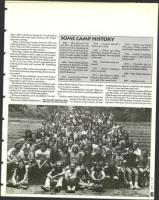
What moves Abbott Middle School Scene from 1975. Counselors at Camp summer in the office. She calls the camp
Maas pose for the annual camp photo. "an extension of ones family. It's that
1974 — Nathan and Esther
Silverman Village opened for
emotionally impaired children.
1975 — Butzel Conference
Center begins to offer Jewish
family camps.
1981 -- Ortonville site re-
named Camp Maas, in honor;of
1993 --- Brighton closes.
bonding experience that is so important. My daughter
is driven to come back here each year."
`Tm a camper at heart," longtime counselor Jill Bruss
said. Ms. Bruss, a 21-year-old University of Michigan
English major, has come back to camp every year since
she was a third-grader. Wye made my closest friends
here. I've always felt that being a counselor means giv-
ing back to the camp. This is a community get-away