

111
PHOTOS BY DANIEL LIPPITT
lielf()Ild
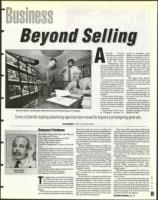
Solomon Friedman's Terry McCarthy, Michael Bislin and Dean Friedman discuss a TV campaign.
A
lthough Detroit
bounces in and out of
the top six in nation-
al population rank-
ings, the area's
advertising com-
munity is rated as the third
or fourth largest in the coun-
try. It has been called by one
of its key participants "the
richest, most striving adver-
tising community in Ameri-
ca."
Is it the vast talent pool
available? Or is it the solid
business management of the
agencies themselves that is
responsible for this dynam-
ic, stimulating, creative and
financially succesfu.1 growth
market?
What makes these agen-
cies even more remarkable
is that in the world's auto-
motive capital, many agen-
cies have become successful
without a lucrative carmak-
er account.
Regrettably, W.B. Doner
& Company declined to
make' its president Alan
Kalter or any lower echelon
officials available to be in-
terviewed. It is doubly un-
fortunate because so many
of those who did consent to
be interviewed came up
through the ranks of Doner,
fondly regarded in past
decades as arguably the De-
troit area's most creative ad
shop.
We began each agency
mini-profile by asking what
was new on the ad world
horizon as we approach the
millennium.
Originally, we planned to
include a comment or two
from each agency's major ac-
count. Not surprisingly, all
we heard from the clients
was praise.
Many of the statistics pre-
ceding each mini-profile are
taken from lists of leading
advertising agencies, ranked
by 1995 revenue. Whenever
possible, the figures were up-
dated for 1996.
Some of Detroit's leading advertising agencies have moved far beyond just designing great ads.
ALAN ABRAMS SPECIAL TO THE JEWISH NEWS
Solomon Friedman
Main office: Bloomfield Hills, with offices in
San Diego and Phoenix.
Dean Friedman, president and CEO
Chato Hill, creative director
Billings: $44 million-plus.
Number of employees: 70-plus in three of-
fices
Sampling of major accounts: (Film & En-
tertainment) Dreamworks; Columbia/Tri
Star Pictures; Paramount Pictures; Walt
Disney Studios; Universal Pictures; Warn-
er Brothers Pictures.
(Retail/Consumer) Detroit Pistons basket-
ball team; KFC Co-ops in two states; Qual-
ity Farm and Fleet stores; Tuffy Auto
Service Centers. (Business-to-Business) The
Franklin Bank.
(Live Events) Great Lakes Chamber Music
Festival; The Parade Company.
Also agency for Temple Beth El.
T
he biggest buzz in Detroit's advertis-
ing community this year was created
when Dreamworks, the movie studio
organized by Steven Spielberg, David
Geffen and Jeffrey Katzenberg, announced
they had chosen Solomon Friedman as their
agency.
While that was great news for both par-
ties, the agency's president, Dean Friedman,
feared it would only serve to reinforce the
once widely-held misconception that Solomon
Friedman is a movie agency, the living lega-
(7 of the former Robert Solomon Agency.
But there's a lot more to Solomon Fried-
man than just their lucrative movie business.
It is one of the most well-rounded creative
shops in the area.
'When I joined the agency in 1992," ex-
plained Dean Friedman, "it was to create the
next generation of leadership for the agency,
and to create the third leg of the stool.
"The first leg was the movie tradition,
started in 1954, which has become one of the
nation's largest field service agencies for most
of the leading motion picture studios." They
place advertising and handle publicity for
film studios and their products in a specific
geographic area — for the most part, met-
ropolitan Detroit.
"And we've only continued to get better at
that, as shown by our recent addition of
Dreamworks.
"In the 1960s, we became a field service
agency for Kentucky Fried Chicken Co-ops,"
said Mr. Friedman. "That means we repre-
sent the franchisees, who create an adver-
tising co-op in a local market to generate sales
and increased results for their special mar-
ket situations. We now represent seven KFC
co-ops, primarily in Michigan and Indiana,
and we've been told we're one of the coun-
try's best KFC field agencies.
"Also since 1992, we've been building the
third l eg , which is traditional consumer goods
advertising accounts. We have about 40
clients, from banks to manufacturers to re-
tailers. We've had extraordinary growth and
have been announcing new clients at an in-
creasing pace because they seem to want our
brand and style of creative."
Mr. Friedman listed three primary ex-
amples: Tuffy Auto Service Centers, the
second largest after-market automotive
franchise; Quality Farm and Fleet, a 108-
plus chain in 29 major markets; and
Franklin Bank.
Solomon Friedman generated one of
America's most successful bank advertis-
ing campaigns on behalf of Franklin. It in-
cluded three humorous spots: "Mr.
Employed," "Big Bank Fees" and "Man's
Relationship."
The latter mimicked the "Dr. Laura" ra-
dio show, where a caller complains about
his relationship with a bank instead of a
wife or lover.
In the last three years, the Franklin cam-
paign has received two American Market-
ing Association awards. On May 13, the
agency was presented the Financial Com-
munications Society of America's FCF Port-
folio Award for the Best Business to Business
Radio Campaign. It was the second win in
as many years for the agency.
SOLOMON FRIEDMAN page 100