

U_I
U)
w
CC
F-
LU
LU
04
college, yet I was still in the same place — not know-
ing how to get from Oak Park to Broadway," he re-
members. "I had no money, no resources or connections
— only a strong desire to make it in New York."
Seller's first job was writing press releases for a small
PR firm promoting soap operas and a couple of Broad-
way shows. His salary was too meager to live in Man-
hattan, so he lived in Brooklyn.
"In the evenings after work, I started directing and
producing shows for a little community theater in Brook-
lyn," he says. "I also produced a family musical based on
five Yiddish folktales at a Jewish congregation on the
Upper West Side.
"By day I was continu-
ing to get around in the
business world, and by
night and in my spare
time, I was doing shows
and developing relation-
ships with artists, com-
posers, lyricists, etc."
He then joined Nation-
al Artists Management
Company, where he be-
came a theatrical agent,
arranging national tours
of Broadway musicals, in-
cluding Fiddler on the
Roof and Cabaret. "That
became my bread and
butter," says Seller, who
started to build a reputa-
tion for himself on the
Broadway circuit.
It was around that time that
Seller met Jonathan Larson. "I
met Jonathan in 1990 when a
friend invited me to hear an au-
tobiographical rock monologue
called Tick, Tick ... Boom! in a
tiny theater on the Upper West
Side," he recalls. "This guy
comes out in front of a bare
stage and performs a cycle of
songs about turning 30 and try-
ing to make it.
"He asked a lot of questions
about life that touched me
deeply, as did his music. I
didn't know this guy, but after
I saw his piece I wrote him a
letter. I said I thought he was
amazing, and I wanted to pro-
duce his shows.
`The guy was Jonathan Lar-
son. I was 25 years old and he
was 30, and that was the be-
ginning of our professional relationship."
Larson wanted Seller to produce a full production of
Tick, Tick ... Boom!, but Seller felt it wasn't viable for a
commercial run. At the same time, Larson had started
to develop Rent, and in 1993, Seller attended a reading
of the play at the New York Theater Workshop in the
East Village.
Seller expressed his interest in producing the play and
encouraged Larson to further develop the plot. In 1994,
Larson presented his reworked script again at the New
York Theater Workshop, this time as a bare-bones pro-
duction with actors, a director, rudimentary sets, light-
ing and costumes. That's when Seller made a firm
commitment.
"I brought my business partner, Kevin McCollum, and
our business associate, Allan Gordon, to see the play,"
recalls Seller, who co-founded the Booking Office, a the-
atrical booking agency, with McCollum in 1991. "We all
absolutely loved what we saw and heard, and said we
would produce it."
Although Seller recognized Rent's great potential, he
to be absolutely the right uptown theater for our down-
town show."
The proudest moment in his career, says Seller, came
weeks after winning the Tony Award. "It was during
the summer, at 8 o'clock at night, and I was walking to
my Upper West Side apal tment wearing tennis shoes
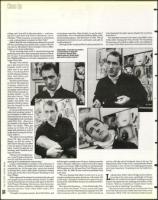
Jeffrey Seller: "If you give your children
a choice between an easy path
or a hard one, they will likely
take the easy one. But the harder
path results in greater rewards."
Attl,
still thought it needed more of a focus. Arduous rewrites
made a dramatic difference, evident when Rent began
previews in January 1996, and had its world premiere
Off-Broadway at the 150-seat New York Theater work-
shop on Feb. 13, 1996. No one could have predicted what
came next.
"We were hoping that [Rent] would move to an al-
ternative performance space downtown, with maybe 400
or 500 seats. I [thought it would be] just a part of my pro-
fessional life. Instead Rent became my professional life,"
says Seller.
Rent moved to Broadway — to the Nederlander The-
atre on West 41st Street. "It was a warm and happy
coincidence that the Nederlanders [originally from De-
troit] wound up with it," says Seller. "And it turned out
gn i V"
and my old high school backpack when it hit me: I'm
doing exactly what I want to do. I just produced a Broad-
way musical; I won a Tony; I'm making good money,
and, most important, I'm getting to do my hobby for a
living."
L
ooking back, Seller acknowledges some ambiva-
lence about his early years, specifically at Temple
Israel. He credits the temple for instilling a love for
theater and appreciates the teaching and wisdom of Rab-
bi Syme. "[But] as wonderful as Temple Israel was for
me, it was also a mixed bag," he confesses.
"I felt isolated and outside of the crowd because I was
from Oak Park and more middle class than many of my
classmates. While I felt very embraced inside my pub-
4-4