
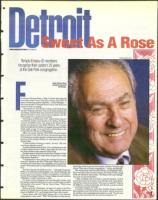

LYNNE MEREDITH COHN STAFF WRITER
PHOTO BY DANIEL LIPPITT
Temple Emanu-El members
recognize their cantor's 25 years
at the Oak Park congregation.
Cantor Norman Rose:
Chanting at Emanu-El
for 25 years.
or Cantor Norman Rose, a May 3 tribute honoring his
cantorial career was a long time coming. But after 40
years of chanting Judaic melodies — 25 in Michigan —
the vocal leader of Temple Emanu-El in Oak Park just
wants to keep on singing.
"As long as my voice keeps in shape, and I keep doing
the job I'm doing, and they want me to keep doing the job
I'm doing," Cantor Rose says, he'll stick around. Temple
Emanu-El's first cantor, he has been singing at the Re-
form temple for a quarter of a century.
Growing up in Rochester, N.Y., Cantor Rose was sur-
rounded by Judaic tunes thanks to his father, Sol Rose,
a tenor and Reform Jew who sang in the choirs of Or-
thodox synagogues on the High Holidays. The younger
Rose accompanied his father on singing ventures at those
shuls until, at age 17, he received a scholarship to the
Curtis School of Music in Philadelphia.
After two years of study, World War II sent Cantor
Rose to duty in the 15th Air Force. He served more than
50 missions as a radio operator and gunner in Italy, and
because of his musical ability, he was selected to learn
Morse Code.
"I had no plans of being a cantor," he says. "My aim
was for an operatic career."
And he almost attained that. On a scholarship to the
La Scala Opera House in Milan, Italy, after the war, Can-
tor Rose studied under soprano Gina Cinia.
He then sang as lead tenor at the Roxy Theater in New
York City. He spent 15 weeks there as part of a vaude-
ville act but "hated it."
"Congregations were looking for someone to lead ser-
vices as a cantor in the New York area. What I knew of
Jewish music at the time was negligible, but I could read
music." So he took a job as a cantorial soloist in Fair Lawn,
N.J.
The Rose family has Reform roots — although his grand-
father was Orthodox and his father was raised Orthodox, the
cantor's parents joined a Reform synagogue in Rochester.
Cantor Rose entered Hebrew Union College-Jewish Institute
of Religion in 1952, finishing in 1955.
For many of his colleagues who had beautiful voices, says
the cantor, cantorial school was "a way out of [having to make]
a living [for a few years]." Not for Cantor Rose. "I fell in love
with it," he says.
Before coming to Michigan, he spent 11 years as the first
cantor for Temple Israel in Akron, Ohio, and the next seven
years in Buffalo, N.Y., as Temple Beth Zion's first cantor.
Cantor Rose calls Oak Park's Emanu-E1 a "very heimish
congregation, very warm." With 700 families, he says the op-
portunity exists to get to know people, let them "become part
of you. They are not only congregants — many are friends."
The cantor lives with his wife, Eunice, in Southfield. Mrs.
Rose was half of the musical troupe, the Tracy Twins, ailing
with her identical twin sister. The Roses have two daugh-
ters and two grandchildren.
"I like working with my choir," says the cantor, "and of
course the music of services, but I also like very much teach-
ing bar/bat mitzvah students. This year we had 62. They're
all different, various interests, but there's a goal involved
— and they all come through."
A teacher of Hebrew and other Judaic classes, Cantor
Rose explains that the Reform movement wants cantors to
be teachers and congregational leaders as well. "It isn't just
being in the sanctuary for the service anymore." ❑