
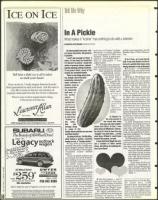

In A Pickle
What makes it "kosher" has nothing to do with a heksher.
ELIZABETH APPLEBAUM ASSOCIATE EDITOR
Tell him a little ice is all it takes
to melt your heart.
Pour on the ice. Coolly elegant diamond jewelry
that's guaranteed to melt your heart. Ask the man in
your life to come in and see our selection of
exquisite diamonds from the Ice On Ice Collection.
They're sure to have temperatures rising.
A DIAMOND Is FOREVER.
30400 Telegraph Rd., Suite 134, Bingham Farms • 642-5575
SUBARU®
TheBeauofAll-WheelDrive!
Le • a cy
New '97
AU Wheel Drive!
=
=
LLJ
t4z•sr k
iva
DWYER
* AND
SONS
VOLVO/SUBARU
LLJ
Since 1959
only
F-
per mo. plus tax, well equipped
cC
36 months
248-642-0400
F-
Lu
=
3055 E. Maple Rd. (west of Haggerty), Commerce Twp. 48390
LLJ
50
Due at inception: First lease payment, acquisition fee of S495 security deposit,
capitalized cost reduciton of S1,365 plus applicable tax and license. Security
deposit is monthly payment rounded to the next S25 increment. Purchase option
negotiable at lease inception. Total obligation is monthly payment x 36. 36,000
miles allowed 15 cents per mile over 36,000. Due to advertising deadlines lease
offer may vary. Offered by Subaru American Credit. Offer expires 5/31/97.
Q: Some people love wine, oth-
ers fancy chocolate. My passion
is pickles.
I can't get enough of them. I
mean, I'd eat them for breakfast
if it weren't- so weird. I cruse the
aisles of grocery stores, inspect-
ing the amazing variety of pickles.
To my great relief, many of the
brands are certified kosher.
There is one thing about pick-
les, though, that I find quite
perplexing. Among the
many varieties of
pickles, such as
bread-and-but-
ter, sweet and
half-sour, is
the kosher
I
pickle.
don't mean
a pickle that
complies
with Jewish
dietary laws;
I mean a pick-
le flavor that
is said to be
"kosher" on
the label.
the
And
strange thing
is, some of the
kosher-flavor pickles are not even
certified kosher!
So please tell me, Tell Me Why,
what makes a pickle, certified
kosher or not, a "kosher pickle."
A: You seem to have gotten
yourself into quite a pickle over
what "kosher" means. (Ha! Ha!
Ha! Tell Me Why's thoroughly
wonderful humor strikes
again!)
As far as pickle makers are
concerned, the word "kosher"
has nothing to do with a hek-
sher (kosher certification). In
the pickle trade, "kosher"
means simply that garlic is
among the ingredients used to
pickle the cucumbers.
Before grocery stores carried
mass-produced pickles in jars,
people generally bought pick-
les from delicatessens. For the
most part, Jewish deli owners
made their pickles with garlic.
Unlike today, the Jewish delis,
by and large, were certified
kosher (or at least they didn't
serve treife), and usually were
referred to as "kosher" delis.
Hence, the pickles served in
such establishments came to
be known as "kosher" pickles.
Moveover, to many gentiles
any food made by Jews was
"kosher." Thus, a pickle pro-
duced in the Jewish style —
that is, with garlic — was
called kosher.
When large-scale commer-
cial production of pickles be-
gan, manufacturers labeled
their pickles by already
established names.
Practically • every-
one knew that a
"kosher" pickle
had a garlic fla-
vor. Pickle mak-
ers unfamiliar
with the term
"kosher" la-
beled their
product
"garlic
dills."
Thus, it
is entirely
possible
that a
"kosher"
pickle is not
kosher.
Q: Maybe I'm
the only person in
the world who feels
this way, but I just couldn't
stand Love Story. In fact, I was
glad when Ali McGraw's charac-
ter died (if I had to hear her say
"preppie" one more time ...); I only
wish Ryan O'Neal's could have
kicked the bucket, as well.
I know that Erich Segal has writ-
ten a number of other novels
since, but did he do anything be-
fore Love SW?
written one screenplay, for the
Beatles film, Yellow Subma-
rine.
Q: Is it true, as I once heard,
that it was'only thanks to the ef-
forts of a gentile that Jews were
finally allowed to live in Norway?
A: It is true — a bittersweet
story of a man who never lived
to see his life's work come to
fruition.
Henrik A. Wergeland was
born in Norway in 1808. The
son of a minister, he became
friendly with a number of Jews
while studying theology in
France. He later returned
home, where he became a poet.
When Norway separated
from Denmark and was de-
clared an independent country
in 1814, the new nation in-
cluded in its constitution a ban
against Jews and Jesuits. Not
only were Jews and Jesuits not
permitted to live in Norway,
they weren't even allowed to
enter as visitors. So when
banker Salomon Heine (author
Heinrich Heine's uncle) came
to deliver a loan to help build
the country, he had to have a
special pass.
In 1841, Wergeland wrote a
pamphlet decrying Norway's
attitude toward Jews. One
year later, and largely because
of his efforts, the parliament
took up the question of allow-
ing them residence. No change
was made in policy.
So Wergeland came up with
a petition, which he circulated
among government officials.
He also wrote numerous po-
ems about the virtues of Jews.
One, "Christmas Eve," is the
story of a Jewish peddler
who dies trying to save
the little girl of a family
who had, only hours be-
fore, refused him entry to
their home.
Jews were finally ad-
mitted to Denmark in
1851, though Wergeland
did not live to see it. He
died, of tuberculosis, in
1845.
❑
A: He did indeed — and it
was quite different than Love
Story, which so many of us find
insufferable. (And what about
that "Where Do I Begin?" song.
O000hh, positively ghastly!)
Mr. Segal published Love
Story while he was working as
professor of classics at Yale
University. Before that, he had
Send questions to Tell Me Why,
The Jewish News, 27676
Franklin Road, Southfield, MI
48034, or fax to (248) 354-6069.
All letters must be signed and in-
cluck the writer's address. Ques-
tions answered in the column will
feature only the writer's initials
and city of residence.