

nt
M
University life
like America
itself — can be
a melting pot
for assimilation
or a crucible
for Jewish life.
LINDA BENSON
SPECIAL TO THE JEWISH NEWS
58
.
ost Jewish college stu-
dents learn very
quickly that blending
Jewish identity, Jew-
ish observance and college life falls
somewhere between being a chal-
lenge and a dilemma:
There are exam schedules that
invariably conflict with holidays
like Rosh Hashanah, Yom Kipper
or Passover. Friday night social
events and Saturday football
games conflict with Shabbat.
Roommates may come from
Pakistan or the Phillipines, as well
as Michigan's Upper Peninsula
and know nothing about Jews and
Judaism. Added to the mix is the
pressure from most Jewish par-
ents, who want their kids to meet
and date other Jewish men and
women.
For a long while, many college-
educated American Jews have
been guided by the concept of the
"melting pot" — the best way to
get ahead in the secular world was
to adapt and blend in. The "melt-
ing pot" worked; as long as syna-
gogue affiliation was high, Jewish
community and family life was 50 years. Is this an exaggerated
strong, and Jewish marriages exercise in worry, personal disap-
were the norm.
pointment and hand-wring-
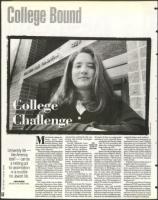
Li sa
Jewish lifestyles have
ing? Or is he sounding the
changed. Today, many Jews Claybo n had alarm fora cultural and spir-
no longer live in predomi- to see k out itual wake-up call?
nantly Jewish neighbor- other Jews.
Three students, from dif-
hoods or attend high schools
ferent Jewish backgrounds,
with large Jewish populations. attending three different Michi-
Synagogue affiliation is flat and gan universities, offer some of
the rate of intermarriage with their observations. "We're not in
non-Jews has been on the in- danger of vanishing," says Lisa
crease. Furthermore, with the Claybon, in response to the Der-
success of federal affirmative ac- showitz premise. Claybon, a ju-
tion programs, Jews are one of nior communications major at the
many minorities on college cam- University of Michigan, is co-
puses. These days, they are often leader of the Reform Chavurah,
one of the quietest.
one of more than 25 student
Instead of adhering to the groups operating at U-M Hillel.
"melting pot," many minority stu-
"Our goal is to try to tell people
dents have chosen to make a noisy that there is a community here to
celebration of their diversity and welcome them. We're people ori-
ethnicity.
ented. We make it our business to
In his latest book, The Vanish- get to know everyone."
ing American Jew, Harvard law
Claybon, who was recently
professor-author Alan Dershowitz elected to the U-M Hillel govern-
writes of his fears that American ing board, feels that her Jewish
Jews are in danger of assimilat- activism comes from her own com-
ing to the point of becoming a his- fort level and her childhood expe-
torical curiosity within the next riences in an extended family that
valued holidays and tradition.
`This has been a leadership op-
portunity for me," says Claybon,
who grew up in Cincinnati. The
high school I attended was high
powered and very academic. You
had to take an admission exam to
get in. There were 2,500 students
from all over Cincinnati, a mix of
Protestants, Indians, blacks and
Catholics, but very few students
were Jewish.
"I had to seek out other Jews. I
couldn't take it for granted."
For dating, she looked primar-
ily to people from her religious
high school that met on Sunday
evenings and drew its students
from all of Cincinnati's Reform
congregations. "I felt most com-
fortable with them and they un-
derstood me."
The large population of Jewish
students at U-M, more than 6,000,
was an important factor when she
began looking seriously at colleges.
She recognizes that her Jewish
activism is not the norm for many
college students, and she has had
her share of negative feedback.