

For Hope
Beth El's
Congregational
educator is working
to create a vital and
comfortable
community.
JULIE WIENER STAFF WRITER
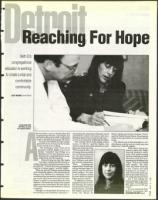
Joyce Seglin with
Alan May, an adult
bar mitzvah student.
fter less than a year as Temple Beth El's
congregational educator, Joyce Seglin says
she knows 99 percent of the congregants
at this 1,400-family synagogue. By name.
It's part of her efforts to make congre-
gants feel more at home in the temple.
And it seems to be working.
"It's working so well, we're all ex-
hausted," said Ms. Seglin, who was of-
ficially "installed" last Friday at a
Shabbat service that featured a per-
formance by a nationally known a cap-
pella group, the Persuasions.
Since arriving last July, Ms. Seglin
has been working double-time to re-
vitalize education and programming at Tem-
ple Beth El. "I think this was a synagogue
waiting to happen again," said Ms. Seglin.
When she arrived, Hebrew school students
were chronically absent, with sometimes only
three or four children in a classroom. Now,
enrollment has increased so much that stor-
age rooms have been converted into class-
rooms in order to accommodate the new
students. The temple has temporarily capped
religious school enrollment for next year at
750, to give teachers and students a chance
to regroup.
Changes at Temple Beth El include a re-
structuring of the children's education —
eliminating the separation of Sunday school
and Hebrew school curriculum and stan-
dardizing topics to be covered in each year—
as well as an expansion of offerings for adults.
"Our current rule is, if five people want a
course, we offer it," said Ms. Seglin, who
wants to ensure that adult education is more
than just programming.
'We're trying to offer a lot
of courses in areas adults
are not feeling adequate
in," she said. Course of-
ferings include Jewish his-
tory, Hebrew and adult
bar mitzvah preparation.
"Most [congregants]
stopped their Jewish edu-
cations between [ages] 13
and 16, and it's not a pe-
diatric religion. You real-
ly can't conquer a whole
lot more than the basics
before you're an adult."
In addition to increas-
ing opportunities for Jew-
ish learning, the temple
has launched several out-
reach projects, including
Ms. Seglin's personal fa-
vorite, the "Reach for
Hope" suicide prevention program. Devel-
oped by Rabbi Daniel Syme, the program
trains teens and adults to counsel suicidal
youth.
"Our thrust on it is that [suicide] is a cur-
able disease, and the cure is a really easy one
called love," said Ms. Seglin.
With a flurry of new pro-
grams in place, Ms. Seglin
says the temple is rarely
quiet. She recalls coming
out from teaching an adult
education class at 9 p.m.
expecting the building to be
empty. "And it was loaded
with people," she said.
"This very little child said
to me, 'I know, you want
everyone to go home.' I
said, 'On the one hand, yes,
and on the other hand, no:
rm really glad they're here
... but I was hoping for
some quiet time to get some
work done.' [The child] said,
The joke's on you! We are
home!' "
It's not surprising that
Reform synagogues feel
REACHING FOR HOPE page 8