

4
.e*
1 4
WV:CMMEM.KI:M=ISKUM,...VASIMMUMMKIMMAVSZW&WVSKWAMMOrr:aMMOM,.
ajR
Challenging
Thole
Psychotherapist
Leonard Felder
pushes past the
Thou Shalt Nots
and finds a route to
r personal growth.
I
)
man, complaining of back
pains and stomach trouble,
once came to Leonard
Felder's psychotherapy
practice. In the course of his
treatment, the man told Dr.
Felder, "I'm juggling two
women right now."
Dr. Felder, a Los Ange-
les psychologist and De-
troit native, responded by
talking about the Seventh
Commandment, "Thou
shalt not commit adul-
tery: ,
The patient was not
married, but Dr. Felder
says the message still
made therapeutic sense.
"Look at what adul-
tery is doing to your
health, and how it's clos-
ing your heart off," he told the pa-
tient.
It's easy to do quickies, Dr.
Felder says. The real challenge
is putting "energy into one per-
son and finding out what it real-
ly is to know and be known by
one person."
Similarly, Dr. Felder takes the
long view in his new, The Ten
Challenges (Harmony Books). He
examines the Ten Command-
ments, views them through both
a therapist's lens and the words
of Jewish sages, and argues how
the ancient decrees can be ther-
apeutic and lead to personal
growth.
"I grew up like most people,
thinking the Ten Command-
ments were harsh and rigid," the
43-year-old Dr. Felder says.
"They've lasted for 3,500 years
because they hit on the 10 tough-
est issues for people."
Stress, anger, sex, limits, inti-
macy, envy and gossip — these
are all '90s words for issues that
have been around since ancient
times and whose solutions, Dr.
Felder argues, are implicit in the
Ten Commandments.
Dr. Felder avoids the word
"commandment" because it is a
mistranslation of the Hebrew
David Holzel is managing editor
of our sister publication, The
Atlanta Jewish Times.
Commandments
DAVID HOLZEL SPEC A 0 HE EW SH NEWS
original — "The Ten
Words" or "The Ten
Things" is better — and
because "an even greater
number of individuals
would be open to appre-
ciating the wisdom of
these 10 insights if they
were presented in a less
authoritarian fashion,"
he says.
Those trying to follow
the Ten will find the
toughest to put into prac-
tice is No. 5 — honoring
parents, Dr. Felder says.
`The parent-child re-
lationship has tension
built into it. If you have
a troubled or a seriously
ill parent, there are dif-
ficult decisions to make.
Maimonides [the me-
dieval Jewish thinker
and physician] said sometimes
you have to delegate the task.
People feel guilty if they have to
put their parents in a nursing
home, but it's halachically cor-
rect to do so."
Can an adult child be expect-
ed to honor an abusive parent?
"A lot of people have resent-
ments toward their parents that
make it hard to honor them with-
out whitewashing over it," Dr.
Felder says. The goal, he ex-
plains, is forgiveness, not forgive
and forget.
Before writing this book, his
seventh, Dr. Felder needed to
confront the impact his own par-
ents made on him.
"I knew for years that I want-
ed to write about this, but I kept
chickening out. My dad is a Holo-
caust survivor and he had two
rules: Don't be too Jewish in pub-
lic and don't talk about religion
in public." The book does both. So
finally Dr. Felder contacted his
father, explaining why he want-
ed to write it.
Dr. Felder says his Detroit up-
bringing had a hand in his ap-
proach to the book.
"I went to my grandfather's
synagogue, Beth Abraham, on
Saturdays. It was Conserva-
tive/Orthodox. My family's tem-
ple was Temple Israel," he says.
control anger, insecurity and
self-righteousness, particularly
in encounters with loved ones.
So he offers suggestions like tak-
ing "time outs" during argu-
ments and "maintaining
awareness of the other person's
humanity."
Solutions like these don't get
near the source of anger or inse-
curity, but Dr. Felder regards
them as potentially effective.
"I'm not a strict Freudian, who
says you have to back into your
past. Sometimes you can manu-
ally defuse the rage or, if you no-
TEN COMMANDMENTS page 90
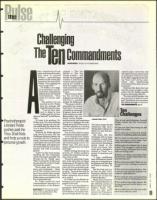
Leonard Felder, Ph.D.
"So I have respect for the
traditional side, and a
strong urge to discuss Ju-
daism in a way that peo-
ple can use."
He wrote The Ten
Challenges with two types
of readers in mind: those
comfortable with Torah
and midrash (homiletical
stories based on the
Torah) and those "who
never gave a thought to
looking to Torah" as a
source of meaning and
growth.
"I hope unaffiliated
Jews will discover Jewish
texts are as interesting as
the Eastern and New Age
stuff they're reading," he
says.
But the book isn't just
for Jews, he adds. "Jews,
Christians, Muslims and
atheists all use the Ten
Commandments."
Moses did not find the
Ten Commandments in
the self-help section of
Mount Sinai. But in Dr.
Felder's hands, "You
shall not take God's
name in vain" becomes a
chapter on learning to
Here is how psychotherapist Leonard
Felder retools the Ten Command-
ments:
1) I am your God: Discovering the still
small voice within.
2) You shall not worship idols: Break-
ing free of =fulfilling paths and habits.
3) You shall not take God's name in
vain: Learning to control anger, inse
curity and self-righteousness.
4) Remember Sabbath Day to keep
it holy: Theli ,
. le to unhook from
your everycti
tilkiSt and connect
with sornethMI,
5) Honor yo
do you honor;'
sion beqkt*
liow
*Ott ere's ten-
6) You shalthOttriurder: What can you
do to prevent the crushing of a person's
spirit?
7) You shall not commit adultery: How
to elevate your sexuality to greater sa-
credness and fulfillment.
8) You shall not steal: Accomplishing
your goals without mistreating others.
ti
-
9) You shall not bear false witness: Re- "
ducing gossip and hurtful talk in your
c -=j
daily life.
a-
Q
10) You shall not covet: The way to feel
good about what you have.
89