

THE JEWISH NEWS
p FRONT
This Week's Top Stories
Bringing The Seder Home
A Shaarey Zedek workshop shows how to personalize the Passover celebration.
LYNNE MEREDITH COHN STAFF WRITER
t David Hermelin's seder, purpose is to enable us to have em-
you've got to pay atten- pathy for all who are oppressed, to be
tion. He calls on every per- grateful for our freedom and to work
son at the table to read a for the liberation of humanity."
Rabbi Groner suggests that intro-
portion of the Passover
story, but he does it ran- ducing familiar melodies "that have
domly, so you never know been adapted to the seder adds to the
when your turn will come. spirit of the evening. Enabling peo-
Inviting the participa- ple to share their experiences of the
tion of every person there seders of their own youth adds a di-
is part of his family's way of person- mension to the experience as well."
At the Hermelin table, toasts are
alizing the seder, the subject of an
April 10 workshop at Congregation made in honor of any simchah in the
coming year. The children invite their
Shaarey Zedek in Southfield.
Mr. Hermelin, a Shaarey Zedek in-laws and friends, and the entire
family tries to come on the
congregant and local entrepre-
same night. The greatest
neur, presented the seminar
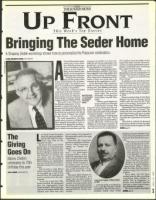
with Cantor Chaim Najman, David Hermelin: challenge "is having your
"It's a II bundled family there," says Mr. Her-
Rabbi Moshe Tutnauer and ed- and
pa ckaged
melin.
ucational director Michael Wolf. aroun d the
'We're a great religion be-
"The seder is the reliving of family •"
cause [Judaism is] centered
the Exodus experience. It is in-
in the home," he says. The
tended to connect the past, the
present and the future of the Jewish Passover story emphasizes the col-
people," says Rabbi Irwin Groner. "It lective past with "a prospect for the
is not that our ancestors were slaves future. It's all bundled and packaged
in the land of Egypt but rather around the family — and it's fun."
Another challenge is working each
avadim hayenu — we were slaves.
"In every generation, the Hag- person's skills into the seder. "[It] is
gadah says, a person is obligated to a time for generation-to-generation,"
view himself as though he were re- says Mr. Hermelin. Every year, the
deemed from Egyptian bondage — children do what they've learned. "If
which means that the seder is a dra- six kids learned the Four Questions,
ma in which everyone has a part. Its then all six do the Four Questions."
The
Giving
Goes On
Moies Chetim
celebrates its 75th
birthday this year.
JULIE EDGAR SENIOR WRITER
evi Smith heard the stories
about his great-grandfather
and the red wagon so many
times, they took on the
character of myth.
He knew that Louis Smith
hailed from a town along the
Minsk highway in Belarus, that
he ran a produce stand at the
Eastern Market in Detroit and
had fathered 10 children. He
also knew that his father's
grandfather was the founder of
Moies Chetim, an organization
that provided Passover food to
Detroit's needy Jews way back
when.
But he had no idea Moies
Chetim was still in existence un-
til he picked up a copy of The
Jewish News 10 years ago and
read an article about the orga-
nization.
"It hit me in the face," Mr.
Smith recalled. He recognized
that the organization Louis
Smith started in 1922 with noth-
ing but a red wagon loaded with
matzah and wine was very
L
much a reality, very essential to
the community, and on the verge
of extinction.
Since then, Mr. Smith has
served as president of Moies
Chetim, which translates
loosely as "money for
wheat."
"He would send his chil-
dren — my great-aunts
and great-uncles — with a
little red wagon filled with
food to people in the neigh-
borhood who he knew need-
ed help. Various people in
my family, some [of Louis
Smith's] children, kept it go-
ing, as did members of Ann
Kaplan's family," Mr. Smith
said.
This year, Moies Chetim cel-
ebrates its 75th birthday. It no
longer sets up shop inside a
Southfield shul to distribute
matzah, wine and a small check
for extras, but it is still commit-
ted to serving the less fortunate
among Detroit's Jewish com-
munity.
The children lead the seder at the
head of the table with Mr. Hermelin,
and the youngest participants put to-
gether a makeshift choir, reminding
him when it's time to sing.
To the extent that they can, the
Hermelins invite the participation of
friends. "One friend is studying with
a rabbi — he gives an introductory
D'var Torah."
In addition to the standard seder
text, the Hermelins have added po-
ems and songs over the years, some
of which were written by the children
or their friends. The family Hag-
gadah features a "modern Dayenu"
written by the Hermelins' daughter
in 1972.
Everyone gets a drop of wine from
Elijah's cup, with a blessing. At the
seder's end, the time for the "Next
year in Jerusalem" sentiment, the
Hermelins sing "Hatikvah."
Appreciation for everyone's part in
preparing the seder is crucial. "Be-
cause the men to a great extent sit
back like k'nockers and come on stage
for a performance," Mr. Hermelin em-
phasizes the importance of women's
roles. -
"The food is cooked, the house is
kashered to whatever level, the table
is set and the house is special. It's like
SEDER page 30
Smith's in Eastern Market back
in the '20s and joined him in his
Passover food distribution pro-
ject.
"We hope to do something
later on in the year as a com l.
memorative type of thing,
but we haven't had a chance
to get to that. It's been so
crazy gearing up, with so
many families in need this
year," Ms. Kaplan said.
When the kosher food
bank Yad Ezra was estab-
lished, one of its founders,
Rabbi A. Irvin.gSchnipper,
approached 1Vlbis Chetirn
with the idea that the organi-
zations merge their Passover
projects.
CD
Since then, the two have
worked side by side, providing
everything from chickenApA aD
Louis Smith, founder of Moles Chetim
gefilte fish to Haggado
in 1922.
onions. Last Sunda y was
: ms
a_
And the need is as great as first d day in they
ever, said Ms. Kaplan, whose aay
0 " •
- : \
Mr . Sp3i,
grandfather Morris Dorn ran 'a
produce stand near Louis • GIVING pait
•
3