

\s%
...'‘,R.MMUMW.W.MWM.WW:M=2)
'<aZMAUSK,.
,.
k.
•
Chronic
PHOTO BY DANIEL LIPPITT
IN
Audrey Kron has put
44 years of experience
into her two books on
chronic illness.
EDITH BROIDA
SPECIAL TO THE JEWISH NEWS
hat do you do when you can't sleep
night after night because you are in in-
explicable, excruciating pain?
If you're Audrey Kron, age 60, who
was first diagnosed with inflammato-
ry bowel disease 44 years ago, you sit
down at your computer and you compose
page after page on ways to cope with it.
And as you write, you confide in your
reader.
You tell how, after years of battling this
disease, you have found ways to lead not
just a normal life, but a happy life. And
then, finally, when one more trip to the
hospital and one more series of treatments
restores you to health, you finish the book.
Ms. Kron's first book, Ask Audrey, was
published in 1994 and is now in its fifth print-
ing. It was designed for inflammatory bowel dis-
ease patients and their families. Encouraged by
the favorable response and increasing demand for
more copies, Ms. Kron decided to write a more gen-
eralized version for anyone facing a long-term ill-
ness.
Her new book, Meeting the Challenge: Living
with Chronic Illness, applies to more than 50 dif-
ferent illnesses, ranging from AIDS to Tourette's
syndrome. "Each illness, whether it's arthritis, di-
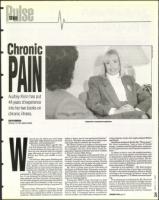
Audrey Kron: Learning from experience.
abetes or lupus, has its own particular features,"
she says, "but they are universal in many ways
and cause similar problems for everyone."
Ms. Kron's career as an author is just one more
accomplishment, despite a life beset with illness.
As a teenager, she was a B'nai B'rith Youth Or-
ganization regional president and honor student
at Detroit Central High School.
She became chagrined and frustrated when, at
age 16, the then undiagnosed Crohn's disease re-
peatedly disrupted her school and social life.
Lengthy hospital stays became routine. During
remission periods, she struggled through classes
but still qualified for a Chrysler scholarship.
Ms. Kron's college years at the University of
Michigan and Wayne State University were also
interrupted by recurrences of debilitating illness.
She frequently negotiated with the schools or re-
sorted to correspondence courses in order to com-
plete her teaching degree.
During her BBYO years, she began to date
Lawrence Kron, a former AZA regional president.
They fell in love and married, living in Ann Arbor
while he finished law school. The couple moved to
Oak Park and, despite Ms. Kron's frequent hos-
pitalizations, risked having a child. Michael was
born in 1961. A Caesarean section, according to
the new mother, was child's play compared to pre-
vious surgeries. Later, the couple adopted Robert
and Karen.
But illness shadowed family life. "Those years,"
Ms. Kron remembers, "were a time of limited
energy, constant need for bathrooms, numerous
doctor appointments and frequent hospitaliza-
tions."
In efforts to find a cure, she studied nutrition,
tried every new drug regimen and treatment, and
in desperation consented to an ostomy when this
was still considered a radical procedure. She be-
came president of a local ostomy organization and
was instrumental in obtaining a grant for the first
stoma therapist in Michigan.
And then a new ambition — Ms. Kron became
enamored with the idea of marriage counseling.
Somehow she found strength to return to school,
enrolling at the University of Detroit. Along with
an excellent program, U-D offered convenient park-
ing.
Even during her invalid periods, Ms. Kron had
led a full life. She had played in bridge tourna-
ments, co-founded a book club and participated in
organizations, always scouting bathroom facili-
ties and parking areas wherever she went.
She traveled extensively with her husband,
CHRONIC PAIN page 76