
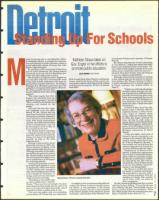

Kathleen Straus takes on
Gov. Engler in her efforts to
promote public education.
aybe it's because she is a grandmother of four,
but Kathleen Straus, a crusader for social jus-
tice and authority on public education, seems to
exude bubbie-like warmth. Of course, Gov. John
Engler might not agree.
As president of the state board of education
and an active Democrat, Ms. Straus doesn't
always see eye to eye with the Republican gov-
JULIE WIENER STAFF WRITER
ernor. Now she's taking him to court.
The lawsuit is in response to Gov. Engler's re-
cent executive order that would transfer niuch kind of supervision than if they're roaming the
of the state board's authority to the state su- streets. And for the future of the country, de-
perintendent of public instruction. According to mographics indicate that [these kinds of kids]
Michigan law, Michigan's governors have the are going to be the majority. We have to educate
authority to reorganize state agencies. However, these kids."
Ms. Straus asserts that the state
board is different from other state
agencies.
"The other boards that [Gov. '4
Engler] has abolished were ap- 2_
pointed by the governor," she said. ,2
'We're created by the [state] con-
stitution and elected by the
people."
Although the executive order
was supposed to" go into effect
March 10, Ms. Straus and the
other three Democratic state board
of education members obtained a
court injunction preventing the
order from being implemented
until the court determines whether
or not it is constitutional. They will
be returning to court on May 14
for a hearing on the case.
Ms. Straus doesn't anticipate
a ruling for several months, and
says that whatever the court's de-
cision, it is sure to be appealed,
possibly as high as the state
supreme court.
Elected to the board by direct
statewide election in 1992, Ms.
Straus became president of the
eight-member board this January.
Although currently on the defen-
sive battling the governor's actions,
Ms. Straus prefers to talk about
the board's proactive efforts to im-
prove performance at Michigan's
low-achieving schools.
Among the proposals current-
ly on the board's agenda is a plan
to significantly reduce class size in
"at-risk" schools and a proposal to
keep school buildings open all day
to be available for recreation, tu-
toring, social services and super-
vised structured activities.
Kathleen Straus: "We have to educate these kids."
"Everybody is not middle class
or upper middle class," said Ms.
In addition to her involvement with public ed-
Straus. "There are lots more people who don't
have resources than people who do, and we do ucation, Ms. Straus is active in Jewish commu-
have to be concerned about those kids, even if nal affairs. A vice president of the Jewish
Community Council, she also is past president
you look at it from a selfish point of view.
"For your own safety, your own protection, of the Detroit chapter of the American Jewish
you're better off if these kids are under some Committee, a life member of the National Coun-
-J
cil of Jewish Women and a member of Temple
Beth El.
Ms. Straus describes her Jewish upbringing
as "very Reform," adding that ethics and social
justice were stressed heavily in her home. "My
view of the Jewish religion is based on 'Do unto
others as you would have others do unto you,' "
she said. "If we don't do that, we're not living up
to our own religious responsibility."
Although many Jewish parents are turning
to day schools and private schools to educate
their children, Ms. Straus continues to believe
in public education and is a staunch opponent
of school vouchers (see related article on
Page 3).
"I think one of the big advantages
of public schools has been the mix-
ing of people from different back-
grounds and learning about each
other and recognizing that we all
are Americans,. We maintain our
own identities, but we still learn
about each other. I think that's part
of education."
A native of New York City, Ms.
Straus came to Detroit with her
husband, Everet, in 1952 and be-
came active in citizens action
groups. After her husband's death
in 1968, she began working full
time, serving in such posts as
deputy director of the Detroit Model
Neighborhood Agency, divisional di-
rector of the Michigan Council of
Governments and lobbyist for the
Michigan Association of School
Boards.
In the late 1960s, when most of
Detroit's Jewish community was
moving to the suburbs, Ms. Straus
opted to remain within the city lim-
its. "I felt an obligation," she said. "I
had worked very hard to keep the
schools integrated and to keep the
city from declining after the riots."
Furthermore, as director of Pro-
Detroit, a temporary organization
that worked to implement desegre-
gation orders in a peaceful manner,
she felt she would lose her credibil-
ity if she left the city. She could un-
derstand the choice of many people
to move to the sulturbs, "but never-
theless I was disappointed."
Ms. Straus is not the only one in
her family to maintain a strong Jew-
ish connection in an area with a
small Jewish population. Both her
daughter in Lincoln, Neb., and her
son in Chico, Calif., are active in
their synagogues.
But Ms. Straus emphasizes that she is not the
only Jew living in Detroit. "It's not like the last
Jew in Berlin," she said. "I have friends who live
here; a number of them live downtown. We're
fine. When people [from the suburbs] come here,
they're surprised at how nice it is." El