
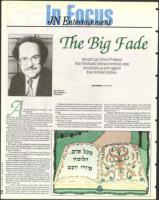

Harvard Law School Professor
Alan Dershowitz believes American Jews
should take up arms against
their imminent demise.
JULIE EDGAR SENIOR WRITER
Alan Dershowitz:
"We can't blame it
on the goyim."
lan Dershowitz is worried — pro-
foundly so.
The Harvard Law School pro-
essor, who is as vilified as he is cel-
ebrated for the legal causes he's championed, has taken
on the role of town crier: He is convinced that unless we
do something now, the American Jewish community
will disappear into the oblivion of history books.
And being what some would call an egomaniac, he is
offering to help us save ourselves.
In a recent Jewish News interview, Professor Der-
showitz said The Vanishing American Jew, issued
last month by Little, Brown and Company, is the
most difficult and most important book he's written.
It is certainly his most personal. One can imagine
him standing on a rooftop entreating passersby to
heed his warnings.
Although he had already started researching his
book, the 1995 assassination of his friend, Israeli
Prime Minister Yitzhak Rabin, intensified his desire
to start writing it.
"It moved me so much. It confirmed my thesis so
strongly that our problems are coming from with-
in, not without," he said.
And while The Vanishing American Jew touches
on the heightened tensions between secularized and
religious Jews in Israel, its premise is that assimi-
lation- that has come through the virtual disappear-
ance of institutional anti-Semitism, coupled with
intermarriage and low birth rates among non-Or-
thodox Jews, is threatening our very existence.
By the year 2076, Professor Dershowitz writes,
being Jewish will be a matter of historical curiosity.
The children and grandchildren of his 33-year-old
son Jamin, who- married a Catholic, most likely won't
identify asJews, although they might know of a dead
relative who did.
"... Jews will become more like other ethnic
groups," he writes, "with descendants proudly point-
ing to their partial Jewish heritage in the way some
Americans today identify themselves as part Scot-
tish, part Irish, part Navajo, part French, and so on."
THE DETRO
•
Professor Dershowitz's book is meant as a wake-up
call: He would like to convince us that we no longer need
persecution or a collective memory of oppression and
marginalization to maintain our distinctiveness as a
group.
"We have to show that Judaism, which is remark-
ably adapted to tsuris, can be equally adapted to good
times, to being welcome. So far, we haven't been able
to do that," he says.
One of the best prescriptions for maintaining Jewish
continuity? A solid Jewish and secular education.
`q talk about the competitive advantage any Jew can
get by studying Judaism. My students who attended
yeshiva are much better law students, and I've been
told they're better in medica?school, they're better as
literary critics ..."
Professor Dershowitz, not surprisingly, had the ben-
efit of both. He was reared in an Orthodox home, at-
tended yeshiva and later Brooklyn College, and davened
every day. At the age of 25 or 26, when he had children,
he realized he wasn't a "religious person."
"I realized I was a skeptic. I had to define my Judaism
differently. If anything, I became more Jewish, more
politically Jewish. Most of my legal career was devot-