

aMISMWMIMKOWSMS:40.:*3,=====',WAVA,,,i5 ,, ,■ ,, M04
:..
Egm
eat
Lowering The Odds
Breast cancer is the second lead-
ing cause of cancer death among
women. Each year there are
183,000 new cases reported and
48,000 deaths.
Early detection, surgery,
radiation therapy and
chemotherapy have resulted in
improvement in survival in pa-
tients with early stage breast
cancer.
In the 1980s and during the
last few years, the paradigm for
treatment changed. Previously,
there were few who thought
chemotherapy would help node-
positive breast dancer and not
much progress was made in the
metastic disease. Today, re-
searchers have demonstrated
treatments that do make a dif-
ference.
"What we're finding is that we
need to take this procedure to
patients with Level II cancer be-
cause we believe a woman's
chances for survival are better
the earlier we provide the ag-
gressive treatment, especially
for younger women," says Dr.
Jared Klein.
"Sometimes our treatment for
Level IV cancer patients doesn't
work; it's too late. This means
another uphill struggle with in-
surance companies. The de-
mands for demonstrating cost
effectiveness and limiting hos-
pital days is always there as
added pressure."
new treatment regimen
is helping women
fight breast cancer.
0
RU1VAN BRODSKY
SPECIAL TO THE JEWISH NEWS
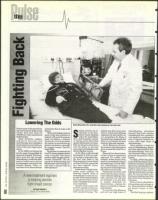
Elaine Weiss talks to Dr. Jared Klein while donating her own stem cells.
S
miling warmly, the re-
ceptionist at the Kar-
manos Cancer Institute
nods to Dr. Jared Klein,
M.D., and his patient. Anoth-
er woman at the front desk
speaks deliberately but cheer-
fully as she gives directions
over the phone on the best
way to get to the facility in the
Detroit Medical Center.
As Dr. Klein walks through
the brightly lit halls, he pass-
es through a large glass dou-
ble door that leads to the
Hematopoietie (human blood)
or Stem Cell Unit, part of the
new Bone Marrow Trans-
plantation facility.
Inside these 19 single rooms,
breast cancer patients are
receiving massive doses of
chemotherapy to wipe out can-
cer cells. Prior to this treatment,
they underwent three or four
cycles of standard chemothera-
py as outpatients.
However, these women with
Level IV metastic breast can-
cer generally are not curable
with standard therapy. The
cancers may show some sensi-
tivity to initial chemotherapy
regimens but then tend to re-
cur. According to Dr. Klein, it
has long been recognized that
there is a correlation between
chemical dose and response.
At the Karmanos Center,
the intensive chemotherapy is
given around-the-clock for 4-
5 days.
Research has demonstrat-
ed that using an aggressive
approach for women with
metastic breast cancer treat-
ment by increasing the dose of
chemotherapy is most effec-
tive. Unfortunately, increas-
ing the dose of chemotherapy
also affects normal cells.
Physicians have been well
aware that the bone marrow,
where infection fighting white
cells, platelets and red cells
are produced, is an area that
is usually destroyed by
chemotherapy, making the
patient susceptible to disease
and infection.
To overcome this dilemma
and still use high doses of
chemotherapy, physicians
learned that bone marrow
transplanted into a patient's
vein tended to accelerate the
rate of marrow function re-
covery after high doses of
chemotherapy.
Bone marrow is removed
prior to chemotherapy, frozen,
and then administered after
the chemotherapy. Over a pe-
riod of several weeks, it can re-
generate the patient's blood
system.
Dr. Klein, of West Bloomfield,
is one of the Karmanos Cancer
Institute's premier transplant
physicians, specializing in au-
tologous bone marrow trans-
plant in which breast cancer
patients donate their own stem
cells. He was recruited to the
Karmanos Institute from Ohio
State University Hospitals in
Columbus.
He is a former chief fellow
of hematology and oncology-at
the Memorial Sloan-Ketter-
ing Cancer Center in New
York.
"Not that long ago, patients