

72a.nuth jhat kanna.te
For collectors of Jewish signatures, there are
plenty of famous folks whose John Hancock does
not demand house-mortgaging levels of com-
mitment. Some of the most valuable Jewish au-
tographs are of those who played a role in
America's Revolutionary War, and even they are
not astronomically pricey, according to Basil A.
Panagopulos, president of Alexander Autographs,
who sells about 7,000 artifacts a year.
Take Haym Solomon, for instance. A financier
of the American Revolution, he handed over hard
currency in exchange for almost $600,000 in
worthless Congressional paper money. His cap-
ital helped the colonists win the war and change
the course of human history, yet you can pick up
a letter in his hand for about $4,000. Other note-
worthy Revolutionary War-era Jewish signa-
921,Stain/24
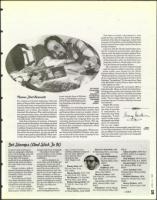
Harry Burstyn
has more than
1,000
autographs in
his burgeoning
collection, one
that includes
Jewish
notables.
tures include those of Michael
Gratz, a Philadelphia merchant;
David Frank, killed fighting Na-
tive Americans; and Aaron Lopez,
a financier.
Of course, it is more than just scarcity that
makes someone's handwriting valuable. First
and foremost there must be a market, which is
driven in part by a person's fame. Einstein's sig-
nature, for example, would be worth a lot more
than an equally rare autograph from, say, the
somewhat less famous Larry Storch. (The sig-
nature of FIrrodp'shapless Corporal Agarn goes
for about $20, compared to Einstein's, which
starts at about $2,000.)
But fame isn't everything either. While every-
one has heard of Saddam Hussein, some peo-
ple would scoff at the notion of paying for his
penmanship on an 8-by-10 glossy.
Then there is context, a key element ir auto-
graph pricing, according to David Lowenherz,
president of Lion Heart Autographs. A letter from
composer Irving Berlin to his landlord has less
historic interest than might a letter from him to
George Gershwin.
Likewise, Theodor Herzl's handwritten laun-
dry list would have somewhat less value than a
note in which the father of modern political Zion-
ism discusses his plans for the return to a Jew-
ish homeland. In fact, Mr. Lowenherz has one
of those himself a letter in which Herzl corn-
pares the need for a Jewish state to the spir-
it of the American founding fathers.
Mr. Lowenherz' favorite artifacts though
(and the ones he collects) come from writers
whose works were banned by the Nazis:
Thomas Mann, Bertolt Brech, Stefan Zweig.
"These names have resonance with me, because
of my own parents having been forced to leave
Germany," he explained. "At the same time, these
were the books we had at home, these were the
works I grew up with."
In his recent catalog, Mr. Lowenherz offers a
letter from Mr. Mann, in which the Nobel Prize-
winning author ponders the meaning of the Holo-
caust. "Six million and two hundred thousand
Jews have been 'liquidated' on the continent," he
writes. "Do we realize what this means? ... How
to picture the sea of human suffering, shoreless
and infinite?"
Despite Mr. Lowen-
herz' interest in this
A=1;E:10=•
era, there is one class
of memorabilia he
won't sell or buy: Nazi
to , ►
autographs. "I don't
)111-1
want to make money
.11111M111 " •■•■
off of people who killed
Jews," he explained.
Yet he can under-
stand the desire of some people, especially Jews,
to own Nazi signatures: "It's the feeling that I
can put Hitler on my bathroom wall, and every
time I go to the toilet I can look at his autograph
and know that we won."
George
Gershwin
(and Stick JD gi)
It doesn't take a fortune to
start an autograph collection:
just a roll of stamps, and a lit-
tle perseverance. Many fa-
mous folks will respond
positively to an autograph re-
quest in the mail, but there
are a few basic rules to keep
in mind:
• Always include a self-ad-
dressed stamped envelope, or
return postage for the items
(baseballs, books, etc.) that
you want signed.
• Be courteous and brief:
Your letter should be polite,
and ought to mention your ad-
miration for the individual
lci his or her work. Celebri-
ties ge ► : ! ,- ts of mail, though, so
keep it short. And be sure to
actually ask for an autograph.
• Be patient: It can take
several weeks or even months
to hear back from some
celebrities ...
• ... and be skeptical, be-
cause when you do finally get
a response, it may not come
directly from the celebrity. It's
one of the down sides of col-
lecting through the mail: the
signature you get might come
from a secretary, or from an
autopen, which can reproduce
a famous moniker at machine
speeds. Professionals usually
can spot the difference, but for
32 cents, you take your
chances.
Below are addresses for
some contemporary Jews of
note. A word of caution:
celebrity addresses change of-
ten, but other collectors
have used the follow-
ing and say they
work. Happy hunt-
ing!
Woody Allen, 930
5th Ave, New York,
N.Y. 10018
Mayim Bialik, 40 W. 57th
St, New York, N.Y. 10019
Mel Brooks, P.O. Box 900
Beverly Hills, Calif. 90213
Rodney Dangerfleld, 530
E. 76th St., New York, N.Y.
10021
Bob Dylan, 29400 Bluewa-
ter Road, Malibu, Calif. 90265
Kenny G (Gorelick), 648
N. Robertson Blvd., Los Ange-
les, Calif. 90048
Steve Guttenberg,
151 El Camino Dr.,
Beverly Hills, Calif.
90212
Dustin
Hoffman, 9830
Wilshire Blvd., Beverly
Hills, Calif. 90212
Martin Landau, 7455
Palo Vista Dr., Los Angeles,
Calif. 90046
Jon Lovitz, 9830 Wilshire
Blvd., Beverly Hills, Calif.
90212
Rob Reiner, 335 N. Maple
Dr., #135, Beverly Hills, Calif.
90212
Adam Sandler, 9000 Sun-
set Blvd. #1200, Los Angeles,
Calif. 90069
Neil Sedaka, 888 7th Ave,
#1600, New York, N.Y. 10106
George Segal, 711 Bedford
Dr., Beverly Hills, Calif.
90210
Jerry Seinfeld, 9830
Wilshire Blvd., Beverly Hills,
Calif. 90212
William Shatner, 3674
Berry Dr., Studio City, Calif.
91604
Henry Winkler, 4323
Foreman, Toluca Lake, Calif.
90049
— A.K.S.