

SIN Entertainment
When The Music's Over
The lights were turned out for 25 years
on Murray Lerner's Message to Love.
LYNNE KONSTANTIN STAFF WRITER
W
ill ya listen a minute!
Now listen. A lot of peo-
ple who get up here and
sing — I know it's fun,
I get my feelings off through my
music, but listen — its like, last
Sunday, I went to a Hopi cere-
monial dance in the desert, and
there were a lot of people there.
And there were tourists; and there
were tourists who
were getting into it
like Indians and In-
dians who were get-
ting into it like
tourists. And I think
you're acting like
tourists, man. Give us
some respect.
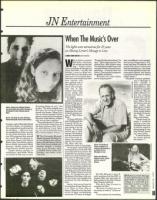
Above: David Lang, Michael Gordon
and Julia Wolfe are artistic directors of
the Bang On A Can Festival and All-
Stars.
Below: The Bang On A Can All-Stars:
Representing the vision of the festival.
PHOTO BY PETER SERLING
driessen, and of Meredith Monk
and Steve Reich, are instilled in
the compositions performed by
the All-Stars — which are writ-
ten specifically for them, not only
by the three directors, but by
over 300 composers from around
the world. The six players in-
clude Maya Beiser, cello; Robert
Black, bass; Lisa Moore, piano;
Steven Schick, percussion; Mark
Stewart, electric guitar; and
Evan Ziporyn, clarinet and sax.
"People always confuse us
with Stomp," says Wolfe. "We're
not theater in that way; no one's
throwing things at you," she
laughs. "We have banged on a
few cans, but we've got music
stands and paper. Bang On A
Can is always notated. All the
players were soloists throughout
the years of the festival, so that's
why we put them together."
The performance in Ann Ar-
bor will include works from the
All-Stars' previous CDs, Indus-
try and Cheating, Lying, Steal-
ing, as well as premieres from
their newest release, Trance. o
e The University Musical
Society Presents the Bang On
A Can All-Stars, who will per-
form with the String Trio of
New York (whose bassist will
perform despite a broken
arm). 8 p.m. Saturday, April
5. $18-$28. Power Center, 121
Fletcher, Ann Arbor. (313)
764-2538.
In 1970, an almost
tearful Joni Mitchell
pleaded with an au-
dience of 600,000 at
the Isle of Wight Mu-
sic Festival, before
segueing into a par-
ticularly potent ver-
sion of "Big Yellow
Taxi."
Of those 600,000,
only 50,000 paid the
3-pound ($7.20) en-
trance fee. And what
was meant to be the
British Woodstock
turned into a clash
between '60s idealism
and the commercial-
ism of the music in-
dustry: the audience
against the promot-
ers, often with the
performers stuck in the middle.
At one point, emcee Rikki Far
harangued the crowd with 'We
put on this festival out of love. We
worked for one year for you pigs,"
followed by Jimi Hendrix's per-
formance of "Message to Love."
And through it all, Murray
Lerner pointed his camera. The
crowd's hostilities and resent-
ment, the backstage conflicts, the
bizarre onstage incidents: Lern-
er and his crew of 60 captured the
Isle of Wight Festival in all its
glory, its strangeness and its
bleakness of lost hope. And now,
25 years later, his struggle has
produced the film Message to
Love.
Lerner, who won an Oscar for
his chronicle of Isaac Stem's vis-
it to China in From Mao to
Mozart, filmed the five-day festi-
val for 10 days, accumulating
more than 175 hours of footage.
"People felt disenfranchised," he
says. 'Their slogan became 'Des-
olation Row,' after Dylan's song.
The kids that [wouldn't] pay were
crowded behind a fence of corru-
gated iron ... it became their own
nation. They painted antagonis-
tic graffiti, swastikas.
"But then the music starts,
and it all goes great."
that was different, not a straight-
forward [rockumentary]. And,
there had been Woodstock, and
people didn't know if there was
room for another one. I also think
a lot of these performers have be-
come great classics, and there's
a renewal of interest in what's
called 'classic.' "
The great "classics" perform-
ing in Message to
Love include a
then-unknown Kris
Kristofferson, who
rendered a soulful
version of "Me and
Le_ Bobby McGee" be-
fore the audience
a forced him off the
stage; Leonard Co-
hen; Miles Davis;
the Doors, just one
year before Jim
Morrison's death;
Jimi Hendrix, just
three weeks before
his death; Donovan;
the Who; Joan
Baez; and others.
"People loved the
music. I would be
willing to bet that
Woodstock had a lot
of similar negative
things going on, but
they weren't opened
up," says Lerner.
"I wanted to show
the drama behind
the scenes." ❑
Above: It took Murray .
Lemer a quarter of a
century to get funding to
complete his film
Message to Love.
Right: Joni Mitchell,
almost in tears, pleads
with the crowd to
behave.
The film Message to Love fi-
nally premiered on the BBC in
August 1995, and will make its
Detroit debut at the DIA's Detroit
Film Theatre April 4-6.
Why did it take 25 years to
complete his film?
"Because you didn't give me
the money to make it," Lerner re-
torts.
"I was trying to do something
e Murray Lerner's Message
to Love will be show at the
DIA's DFT 7 and 9:30 p.m.
Friday; 4, 7 and 9:30 p.m.
Saturday; 4 and 7 p.m. Sun-
day, April 4-6. $5.50;
$4,50/students/members.
5200 Woodward, Detroit.
(313) 833-2323.