

Wrenching PARTINGS, Broken CoNNEcTioNs
JE WISH NEW S
-
Ms. Simova says she met her uncle and aunt at the
Alcron Hotel in Prague after Masaryk's funeral.
(Madeleine was at school in Switzerland.) As she recalls
the conversation, the Korbels talked vaguely about a
"new appointment" and there was no discussion about
whether she should join them abroad.
Ms. Albright says her parents told her explicitly that
they had invited Simova to go with them to America but
that she declined. "rd be very surprised — very, very sur-
prised — if my parents had not offered to bring her," Ms.
Albright says, since they did bring a maid from Belgrade
with them.
In any event, the Korbels left. It would be two decades
before Ms. Simova would see them again. -
"If he had suggested that I go with them, I would have
gone," Ms. Simova says. "He should have been aware
of the dangers of staying here."
Some six months later, after the borders were effec-
tively sealed, Ms. Simova says she received a letter from
Madeleine's mother suggesting that she go to stay with
family in London. "I think it was for the sake of her con-
science," says Ms. Simova. "She told me to go to Lon-
don but did not explain how I was meant to get there."
The Korbel family arrived in America at the end of
1948. In his application for political asylum, Josef Kor-
bel wrote, "I cannot, of course, return to the Communist
Czechoslovakia as I would be arrested for my faithful ad-
herence to the ideals of democracy."
According to Czechoslovak foreign ministry records,
Korbel was formally dismissed by the country's new Com-
munist government on Dec. 6, 1948, "because he resigned
while he was abroad." Four months later, a court for-
mally confiscated all of his property. There is no evidence
that Korbel was put on trial in absentia, as has some-
times been reported in stories about Madeleine Albright's
family background.
Back home, many of Korbel's old foreign ministry col-
leagues were arrested and put on trial and some were
hanged. "If he had not left, the same thing would cer-
tainly have happened to Korbel," says Antonin Sum,
Masaryk's private secretary.
Ms. Simova was thrown out of the Prague universi-
ty where she was studying in January 1949. For the next
12 months, she was turned down for one job after an-
other, in apparent retaliation for her association with
Korbel. "I think she probably had a pretty bad time of
it because of my father," Ms. Albright agrees.
NI
adeleine Albright was 11 when she came
to America. The family language was
Czech. Having been to school in Britain
during the war, her English was very
good, but her accent was English rather
than American. She also spoke French, which she had
picked up in Switzerland.
Josef Korbel continued to work on the Kashmir prob-
lem for the United Nations. From November 1948 un-
til the end of the school year, Madeleine was enrolled
in the sixth grade at a Great Neck (N.Y.) public school.
"By the time she left Great Neck, she had a good taste of
American life," recalls a classmate, Winifred Freund.
"She consciously tried to become an American and to talk
like an American."
In 1949, Josef Korbel was offered a position teaching
international relations at the University of Denver. The
family bought a green Ford and set off for their new life
in the American West. Her parents enrolled Madeleine
in Denver's most exclusive private high school. That led
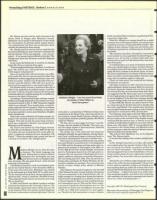
Madeleine Albright: "I am very proud of my family,
my parents, of what I believe in,
what I have gotten."
eventually to a scholarship to Wellesley College and a
vacation job at the Denver Post, where she met her fu-
ture husband, Joseph Medill Patterson Albright, scion
of a prominent American publishing family. Her friends
called her "Maddy."
"By then, she was thoroughly American," says Ms.
Freund, who also studied at Wellesley. "She was a typ-
ical '50s college student in Bermuda shorts, Shetland
sweater and camel-hair coat."
The steady rise of the adult and very American
Madeleine Albright through academia, into the Democ-
ratic Party's intellectual support circles and finally to
the Clinton administration is by now a familiar story.
There seems an obvious parallel between the parties
that Josef Korbel is remembered for in the Belgrade of
the 1930s and the Georgetown foreign policy salon or-
ganized by his daughter in Washington in the 1980s. Af-
ter her 1982 divorce from Joseph Albright, she became
part of a Washington-based circle of foreign policy lu-
minaries. She was renowned in Washington for her en-
ergetic, assiduous cultivation of important Democrats.
Her networking paid off in 1984, when she served as a
foreign policy coordinator for Walter Mondale, the De-
mocratic candidate for president. Four years later she
served as senior foreign policy adviser to Michael
Dukakis.
After Zbigniew Brzezinski brought her onto the staff
of the National Security Council and later she became
Clinton's ambassador to the United Nations, Ms. Al-
bright emerged as a leading hawk during the adminis-
tration's hand-wringing first-term debates over the war
in former Yugoslavia. She saw clear parallels between
the Czechoslovak crisis of 1938 and the West's inabili-
ty to prevent Yugoslavia's chaotic descent into war. The
scale of the two events was very different, of course. But
in 1991, as in 1938, there seemed to be a clear aggres-
sor. The drive by Serb nationalists to create a Greater
Serbia resembled Hitler's insistence on gathering all Ger-
mans into a single state.
While Ms. Albright was turning herself into a model
American, her cousin Dagmar Simova was turning down
invitations to become a Communist Party member. Like
millions of other ordinary Czechs, she survived the years
of Stalinist repression by withdrawing into herself and
her farhily.
"My conscience came first," she recalls in conversation
in her modest two-room apartment in central Prague. "I
regret it now. All my life, I worked under idiots who
earned twice as much as I did, because they were mem-
bers of the party."
In CzechosloVakia, as in many Communist countries,
there was a double system of values. At school, Simova's
two children learned all about Marx and Lenin and the
idyllic life led by workers in the Soviet Union. At home,
Ms. Simova described how the citizens of Western democ-
racies were able to vote for their leaders. Then she would
worry that her children might be indiscreet.
"That's our little secret," she would tell her children.
"It's between you and me."
Life began to improve in 1967, when the Communist
regime gradually relaxed its guard. Early the next year,
the liberal Alexander Dubcek took over from the hard-
line Antonin Novotny as Communist Party chief. Some-
one suggested that Ms. Simova get a job as a translator
for the Czechoslovak news agency that would enable her
to use her English. For the first time, it became possible
to acquire foreign books and travel outside the country.
In June 1968, Ms. Simova was able to travel to Vien-
na, where she met for the first time in two decades with
her uncle, Josef Korbel. Two months later, the Soviet
army invaded Czechoslovakia, putting an end to Dubcek's
experiment in "communism with a human face."
Travel became easier again in the late 1980s, after Ms.
Simova retired from the news agency. In 1988, she trav-
eled to London at the invitation of her English cousins.
Josef had died the previous year, in Denver, but an old
and frail Aunt Mandula brought her up to date with the
family news. (She died in 1989.) It was presidential elec-
tion season in the United States, and Mandula insist-
ed that everyone watch the televised debate between
Michael Dukakis and George Bush.
"She told me that Madeleine was on the Dukakis
team," Ms. Simova recalls.
It was her first inkling of her cousin's political ambi-
tions.
As Ms. Albright looks back on it today, she express-
es no regrets about her parents' choices or her Own. "I
am very proud of my family, my parents, of what I be-
lieve in, what I have gotten —the honor of everything
that has happened to me in the United States," she says.
In the months ahead, the new information about her
family history "has to be dealt with as a personal mat-
ter."
•
Asked if the new evidence might change the way she
looks at the world, she says passionately, "All you have
to do is read my speeches or talk to my friends or as-
sess anything about my public life to know that I have
always believed the Holocaust to be one of the great hor-
rors of history. ... I think if you look at my works, that I
have comported myself in a way that is very much in line
with somebody who has known repression and what it's
like to be a victim of totalitarianism." ID
Copyright 1997 The Washington Post Company
Reprinted with permission of Washington Post Magazine,
where this story originally appeared Feb. 9.