

Wrenching PARTINGS, Broken CoNNEcTioNs
Korbel helped organize radio broadcasts via the British
Broadcasting Corp. to occupied Czechoslovakia. There
were four broadcasts a day, including a half-hour news
program at 6:30 every evening that was widely listened
to in Czechoslovakia.
"He had good journalistic instincts," says Ota Ornest,
one of the editors on the Czech language service and now
a well-known theater director in Prague. "He knew every-
body that was worth knowing."
ILKKA UIMONEN/SYGMA
Prague, in his memoir From Prague After Munich. 'The
motorized units roared over the cobblestone streets ...
the faces of their occupants red with what some thought
was shame but I fear was in most cases merely the cold.
By evening, the occupation was complete."
The Korbel family was now in mortal danger. "My first
thought for safety went to Yugoslavia," Josef Korbel
recalled in his book Tito's Communism, which does not
make any mention of the family's Jewish ancestry but
emphasizes Korbel's vulner-
ability to the Nazis on po-
litical grounds, as a known
and active Democrat.
The Korbels managed to
flee before the Germans
were able to completely seal
the border. Many years lat-
er, Ms. Albright's mother,
Mandula, wrote an account
of their experiences for fam-
ily members — an account
that also makes no mention
of the family's religious back-
ground. She said they
parked 2-year-old Madeleine
with family members and
slept each night at a differ-
ent friend's house, spending
their days in Prague's streets
and restaurants. "It was
mostly in the night that the
Gestapo arrested people,"
she wrote. 'We managed to
get the necessary Gestapo
permission to leave the coun-
try. This happened about 5
o'clock in the evening and by
11 o'clock the same night, we
all three were in a train to Belgrade with two small suit-
cases that we were able to pack in a hurry. That was the
last time we saw our parents alive."
In Belgrade, the Korbels looked up their old friends,
the Ribnikars. Even in Yugoslavia, they were not safe:
The government was pro-German. Jara Ribnikar says
that her publisher husband Vlado helped the Korbels
get to Greece. "It was dangerous. There was a feeling
that all diplomats were spies. But Vlado knew everybody
in town and had friends in the government."
From Greece, they traveled on to Britain. Josef Kor-
bel's older brother, Jan, was already there, having left
Czechoslovakia a few months earlier with his family.
Dagmar Simova, then 11, arrived in July 1939. Her
parents had somehow wangled a place for her on one of
the last trains out of Prague. Across the English Chan-
nel, the fortunate Dagmar joined her cousin Madeleine
and the other exiled Korbels. Her sister, parents and
grandparents remained behind in Czechoslovakia.
C/3
LU
cL) By September, EUROPE was at
LU
1–
ondon was a gathering place for Czechs who had
fled their homeland in the wake of the German in-
vasion. Tomas Masaryk's successor, Ethisrd
LU
Benes, set up a government-in-exile that be-
=
came the focal point of Czech resistance to
the Nazis. Josef Korbel joined the Benes government as
the head of its information department.
o
cc
58
The Korbel family moved around London during the
war. After German bombing raids began, in the fall of
1940, Josef and Jan rented a house together outside the
city. Josef later moved with his family to the London sub-
urb of Walton-on-Thames. A second daughter, Kather-
ine, was born in October 1942.
Financially, the Korbels were better off than many ex-
iles, according to Ms. Simova, due to the proceeds from
the sale of Arnost Korbel's building material business in
Prague — a well-timed deal made a few months before
the disastrous Munich conference. The brothers used
this money to send Ms. Simova to a boarding school for
girls. She came to them for holidays, looking after her
younger cousins.
"Madeleine was a very bright child, very bossy,"
Dagmar Simova recalls. "She is a born leader, you
know."
The Korbels' generally happy family life in London
was disturbed by dark news from home. From late 1941
onward, there were reports of Jews being rounded up
and sent to ghettos and concentration camps.
As head of the Czechoslovak govern-
ment's information service, Josef Korbel
WA R .
would have helped publicize one atrocity
story, which was dismissed as exaggerat-
ed at the time but later turned out to be
tragically understated.
In June 1944, two Slovak Jews escaped from
Auschwitz. According to their information, 4,000 Czech
Jews already had been gassed, and another 3,000 were
awaiting a similar fate. The Jews had been transported
to Auschwitz from a camp called Terezin, in northern
Bohemia.
There is no evidence that Korbel had any specific news
about his family back in Czechoslovakia. In her notes to
her family, Mandula Korbel later wrote, "These were
years of hope, and mainly, we were young, and the hor-
rible news about suffering of so many people in Czecho-
slovakia reached us much, much later."
For a time in Nazi-occupied Czechoslovakia, every-
thing was more or less calm. New laws were passed, oblig-
ing the 90,000 Czech Jews to register property, restricting 7/
their freedom of movement and
forcing them to wear a gold star
on their clothes. The terror be-
gan in the fall of 1941, when
the German authorities de-
clared that Jews would be re-
quired to live in the garrison
town of Terezin, some 50 miles
north of Prague.
Built by the Austrian Em-
peror Joseph II in 1780, -1I
Terezin was more a fortress
than a town. It was surround-
ed by impregnable walls, in the
shape of a huge star. Its pris-
ons had been used to house the
most dangerous criminals of
the Austro-Hungarian empire.
The Germans emptied the
town of its regular inhabitants
and turned it into a holding
camp for people bound for
Auschwitz. Between 30,000
and 60,000 Jews were
crammed into military bar-
racks designed to hold no more
than 5,000 soldiers. Average
living space was 2 square yards
per person.
Arnost and Olga Korbel arrived
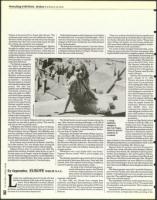
A young
in Terezin on July 30, 1942, on a
Madeleine
freight train from Prague along
Albright in
with
936 other Jews, according to
post-war Prague,
Nazi records maintained and pub-
where her parents
lished by a Holocaust research
raised her as
center supported by the Prague
a Catholic.
Jewish community. The records
identify the Korbels as Jews. The
dates of death in the records correspond to those of Ms.
Albright's grandparents, as corroborated by Czech courts
in inheritance proceedings, Ms. Simova says.
Dagmar Simova's parents arrived at Terezin four
months later, along with their other daughter, Milena,
according to the records. Ms. Albright's maternal grand-
mother, Anna Spieglova, also was brought to Terezin,
along with other relatives, according to Josef Marek and
Ms. Simova. The Nazi records relevant to Ms. Albright's
maternal grandmother are more difficult to evaluate
than those pertaining to Arnost and Olga because they
show that several different Anna Spieglovas died in the
camps.
`The first impression was awful," wrote Ela Fischerova,
who arrived in Terezin a few days after Arnost and Olga
Korbel. "A hundred and even more people were dying
every day. They couldn't keep up with carting them away.
There was a terrible stench."
The inhabitants of Terezin would spend hours every
day standing in line for scraps of food. Thousands died
of malnutrition and gastroenteritis. Their corpses were
burned in furnaces.
Arnost Korbel died less than two months after his ar-
rival in Terezin, in September 1942, according to the