
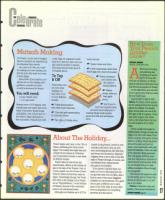

Matzah Making
On Pesach, we are told to imagine
that we ourselves are experiencing
the liberation from slavery
As a way to do this, you could
try making your own matzah, just
like the Jews who were in a hurry
to leave Egypt.
Remember: If you want to actu-
ally eat this on the holiday, all in-
gredients, utensils and oven
should be kashered for Pesach.
You will need:
2 cups matzah meal
1 1 /2 cups water
Preheat oven to 475 degrees. Mix
matzah meal and water. Add more
water if necessary. Knead dough
until pliable, then roll out and cut
into pieces. Make each piece as
thin as possible. Prick all over with
a fork. Bake on ungreased cookie
sheet for 3 minutes, then turn over
and cook for another 4 minutes.
This recipe should make about 8-
10 matzah pieces.
butter and salt.
1 •'' Cream cheese and olives.
A little mayonnaise, sliced hard-
boiled eggs and a touch of mustard.
To Top
It Off
Honey, cinnamon
and crushed nuts,
for a kind of
matzah baklava.
Meanwhile, here
are some tasty
toppings you
may want to try
on your delicious
matzah:
lo' Thinly sliced potatoes
with olive oil and rosemary.
(4,- Chocolate and marshmallow,
for a matzah s'inore.
(or Thin slices of Vidalia onion,
Ar Melted
cheese, salsa and
fresh garlic
pieces.
... And if you've
never had matzah cereal,
you don't know what you're
missing! Simply break matzah
pieces into milk and add banana
slices.
About The Holiday...
Pesach begins each year on the 15th of
Nisan, celebrating the Exodus from
Egypt The holiday lasts eight days and
consists of two Seders (in Orthodox
and Conservative homes) or one Seder
(in Reform homes).
Pesach takes its name from the
paschal lamb, offered as the holiday be-
gan in the days of the Temple. God, of
course, passed over the homes of Jews
when he killed the first-born males in
Egypt. Interestingly, though, the Torah
first refers to the, holiday not as Pesach
but as "Hag HaMatzot," or the Holiday
of Matzah, because of the command-
ment to eat unleavened bread.
Although most families eat A LOT of
matzah during Pesach, (which is why
manufacturers have come up with
some interesting flavors, like deli-style,
and honey and cinnamon), Halachah
obligates Jews to eat it only on the first
night of Pesach (though, of course, one
is prohibited from eating hametz
throughout the holiday).
If you haven't checked them out
lately, or if you're still using that one
you got free with a tin of coffee, take a
look at some of the many Haggadot
available at local bookstores. It's a good
idea to give a different one to each
guest at the Seder table as these often
serve as inspirations for compelling
questions and discussions.
MICHAEL BROWN
SPECIAL TO THE APPLETREE
fter houis of dusting
and polishing and
mopping and search-
-- ling for all those left-
over bits of Cheerios, it will feel
good to sink your hands into some
real dirt as you prepare for Pesach.
At the same time, you can start
now to grow some delicious herbs
for your Seder plate.
A good place to start is with
chives. For many, chives symbol-
ize the spring renewal that accom
panies the holiday The slender
green shoots often are one of the
first signs of life in a garden. It's an
easy,plant to grow, and chives
have a mild onion flavor that can
be used as greens at the Seder
table.
Chives usually are bought as
started plants, though you also can
begin your own with seals. If you
know someone who grows chives,
ask for a cutting. Simply dig down
around the plant and pull out
some of the small bulbs with their
roots still attached. These can easi
ly be replanted. Being perennial,
they will appear faithfully every
year and will produce attractive vi-
olet flowers in mid-summer If left
on, the flowers will go to seed,
adding unwanted chives through-
out the garden.
New shoots will appear in early
2
to mid-spring, and by Pesach they
should be tall enough to cut and
°
m
use at the Seders.
Parsley is beautiful, tasty and
healthy. Most people buy started
PESACH GARDEN page 28
27