
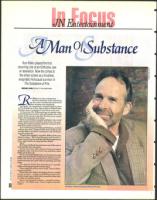

PHOTO BY DANIE L LI PPITT
Ron Rifkin played the first
recurring role of an Orthodox Jew
on television. Now he comes to
the silver screen as a troubled,
enigmatic Holocaust survivor in
The Substance of Fire.
MICHAEL ELKIN SPECIAL TO THE JEWISH NEWS
(/)
•
z
• LU
•
o
80
on Rifkin is a man of substance.
And the substance of the roles firing
up the actor's acclaimed career have
been complex and compelling.
Certainly, the emotionally crippled Isaac he plays
in The Substance of Fire, due to open in Detroit-area
theaters soon, is a splash of cold water on the soul.
In the movie, Mr. Rifkin portrays a troubled, enig-
matic Holocaust survivor who still smells the acrid
smoke of the camps, long after the fires have turned
cold in the memories of so many.
He is an erstwhile successful publisher who would
rather push away his children and cling to the past,
letting the books he prints speak the volumes of ha-
tred that scream in his soul.
It is a harrowing, honorable performance, one that
reflects the Obie, Drama Desk and Lucille Lortel
awards Rifkin earned for creating the role off-Broad-
way five years ago.
"Clearly he's crippled," says Ron Rifkin of the pub-
lisher he plays. "He's lived through such [horror]. I
mean, how do you live with the idea that everyone you
knew and loved for so long has been killed?
How?"
But Isaac Geidhart has survived, even if the sum is
more painful than the parts.
He has survived with a family of two sons and a
daughter, each with his or her own problems; Isaac
fights all of them off.
But it is his publishing house, on its precarious last
pages, that provides the outlet for his passion. It is the
books, the novels, the histories that are his family —
communicating the past without speaking, just like
Isaac.
"It is human frailty that interests me," says Mr.
Rifkin of the gorgon-gone-mad he plays.
"Some families always have 'stuff.' Some hidden,
some not hidden."
What Isaac can't hide is the feeling.that he is stuffed
into the present — leading a publishing empire of un-
realistic regal topics while other companies make book
on what he considers trash.
"Isaac is so damaged, so frozen — incapable of show-
ing love," Mr. Rifkin says. "I can't imagine what that
is like."
Roo Nide! wontio and struggle with God all the time."