

THE DET RO IT JE WIS H NEW S
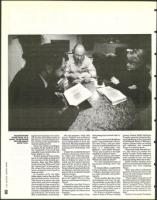
Tanya attracted Rabbi
Herschel Finman, left, to
Judaism. The Oak Park rabbi
often holds classes in
students' homes.
58
highest level of person was a tzad-
dik, but the Alter Rebbe writes of
the benoni, an intermediate per-
son, who has every opportunity to
raise his spiritual level.
Tanya was written, according to
its author, for the "seekers" and for
the "perplexed." It is a book that
ostensibly covers Jewish ethics, the
forces of good vs. evil.
The first section of Tanya, Chap-
ters 1-11, are mostly an analysis of
the structure of the Jewish per-
sonality. Here, the Alter Rebbe
writes about the "divine soul" and
the "animal soul" of each person.
He writes of the nature of evil in
terms of disunity and of good in
terms of unity.
In Chapters 12-17, the Alter
Rebbe takes a look at the role of the
intermediate person, the benoni.
This benoni is a person who uses
self-control, and never commits a
sin knowingly in three areas of hu-
man activity: thought, speech and
deed. The Rebbe feels that this per-
sonality is reachable for an aver
age individual. The bottom line:
Man is essentially a moral being.
The next chapters, 18-25, talk
about a "hidden" love and fear of
God that individuals have, as well
as of a strong desire to be at one
with God. Ensuing chapters talk
of how love and joy are achieved by
realizing this relationship with
God.
Chapter 32, considered the heart
of Tanya, focuses on a Jew's love
for a fellow Jew. Following chap-
ters write about man's inner bat-
tles in finding his place in the
world, and the tension between
man and the world in which he
lives. Again, the bottom line in
Tanya is that the good and the holy
are identical, and that man's pur-
pose in life is to identify himself
with the Creator.
How does Tanya work for peo-
ple in the 1990s? Why is it that
there is a proliferation of classes in
Tanya?
It should be noted that Tanya is
not learned in place of but in addi-
tion to Torah and Talmud. Its force
for some is great, for others not as
dramatic.
Rabbi Finman credits Tanya
with getting him involved with Ju-
daism.
"I was involved with Buddhism
before I was introduced to Tanya.
You read Tanya, and you learn
about your great potential as it re-
lates to a relationship with
HaShem," said Rabbi Finman.
"Tanya puts a person in the right
mindset as to what to learn."
For Chani Finman, the rabbi's
wife, Tanya answers the question,
"What's this [life] all about?"
"It is the metaphysical guts of
the purpose of being a Jew," she
said.
Dr. Simcha Klein, a psychiatrist
living in Franklin, sees Tanya as
a "ticket to learning to heal a per-
son, both spiritually and psycho-
logically.
"Tanya teaches that the source
of all healing is with God," he said.
"As physicians we are able to offer
help to a patient. But as far as real
healing goes, we don't have much
to do with it. Tanya offers a way to
tap into something greater."
Dr. Klein is in good company
when he talks of Tanya's healing
process. Indeed, Rabbi Abraham
Twersky, associate clinical profes-
sor of psychiatry at the University
of Pittsburgh School of Medicine,
author of many books on healing
and addiction, has compared
Tanya to a spiritual jewel.
"Tanya has many beautiful col-
ors, like those of a perfect dia-
mond," he said. "Each reader can
choose which facet he thinks is
most valuable to him, and even
that may change from day to day."
Rabbi Twersky related a story
about several mental-health pro-
fessionals who were studying
Tanya.
'They were able to understand
portions of Tanya the way no one
who is not well versed in neurolo-
gy and psychology can.
"I have taken criminals out of
the Israeli prisons and helped them
discover the beauty within them-
selves," he said of Tanya. "Meticu-
lous study of Tanya with special
attention to every nuance in syn.--
tax can reveal its abundant wis-
dom."
Yeshiva University President