

e
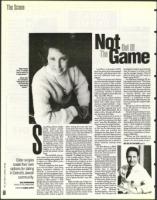
Right: Phyllis
Perry: "A college
town is easier for
a single person."
Below right:
Dr. Eric Baron:
"Past age 35, you
don't have the
same social
access."
C/D
Lu
C/D
CD
CC
LIJ
LLI
r.
50
Older singles
create their own
options for dating
in Detroit's Jewish
community.
JULIE WEINGARDEN
SPECIAL TO THE JEWISH NEWS
PHOTOS BY DANIEL LIPPITT
omething about single
living makes people
groan. And some say
Detroit's decentralized
dating scene tends to get
tougher with age. But
that is no reason for peo-
ple past age 35 to resort
to tagging along with
married friends or sit-
ting home on Saturday
nights in an effort to
avoid the battle of the
bars.
The mid-life, pre-se-
nior years can be the best time
to start meeting new people. All
it takes is a little effort and a
positive attitude.
"People complain that there
is no one out there," says Irma
Starr, executive director of
SPACE, a nonsectarian com-
munity service program spon-
sored by the National Council of
Jewish Women. "We encourage
people to take classes — find
things they are interested in and
do them; then they will meet
people with similar interests.
But people find it easier to
stay with their own couple of
friends," says Ms. Starr, who
found herself a widow at age 48
after losing the man she had
loved since she was 15. She has
since remarried and now helps
others cope with the effects of
bereavement and divorce.
In an effort to meet more Jew-
ish singles, Phyllis Perry, a 40-
something divorced clinical social
worker, launched Second Sun-
day Schmoozers, an Ann Arbor-
based singles group for people
ages 25-55. Schmoozer brunches
attract people from the Detroit
suburbs, Flint, Grand Blanc and
Canada. "A college town is easi-
er for a single person. There is
more tolerance. You don't have
to be part of a couple to go to a
concert or to dinner," she says.
The average age of Schmooz-
ers is 40, and most are divorced
or have never been married. 'To
me, Schmoozers is an extended
family. I have not yet met the
man of my dreams, but I've made
a lot of great friends," says Ms.
Perry.
Eight months ago, Cindy Lev-
en started the Jewish Profes-
sional Singles (JPS) for people
between the ages of 30 and 50
because she didn't feel an exist-
ing group met the needs of the
entire Jewish community.
Lee Winer, co-founder of JPS,
says the group has mass appeal
for people, including those who
are not affiliated with syna-
gogues.
`There are groups and dating
services aimed at people in their
20s or at seniors. The middle
group is kind of invisible because
we are supposed to be at home,
married with kids. But there is
a growing number of people
[who are] single in their 40s and
50s," says Mr. Winer.
If you are not a joiner and fear
you are destined for a future
filled with coffee shops, book-
stores or supermarkets — hop-
ing that "the one" will walk in
— consider tapping into your
friends. Patti Rosenthal, 48, a
widow with a 13-year-old daugh-
ter, has done just that.
"I don't want to sit in a bar. I
never did that before I was mar-
ried, and I'm not going to do that
now," says Ms. Rosenthal, who
has met men through friends.
The prospect of dating later
in life can be daunting, espe-
cially when the protocol has
changed over the years. In com-
parison to her first dating years,
Ms. Rosenthal sees the current
turf as "too free," with immedi-
ate expectations for a sexual li-
aison common among some
singles.
Dr. Eric Baron, a 40ish
internist, says when you
are past age 35, you don't
have the same social ac-
cess you once did.
With a medical practice
to run, "I don't get enough
opportunity these days to
meet Jewish women." Dr.
Baron would like to have
children, which he says re-
stricts him to dating
women between the child-
bearing ages of 27 and 37.
"The problem with dat-
ing in the Detroit suburbs
is that every time you go
to singles parties, you al-
ready know half the peo-
ple, and you don't want to
date them. There is no one
new," says Michael
Raykhinshteyn, who is di-
vorced. The 36-year-old
Southfield resident says he finds
that 35 seems to be the cut-off
age for younger women. "A lot of
girls in their mid-20s want to
meet a guy 29-34."
For Barbara Ginsburg, 63, be-
ing single isn't hard. "You have
to just decide that you are going
to go out and not sit at home and
twiddle your thumbs." A widow
for seven years, she says she has
done some dating and now has
a "special friend" she met
through the Singles Extension
Group — a subsidiary of Tem-
ple Israel that offers dances, lec-
tures and trips for singles older
than 50.
The group claims 250 mem-
bers, 60 percent of which are
women, she says.
Temple Israel's Beshert Con-
nection and Temple Beth El's
Michigan Jewish Singles Net-
work both cater to singles of all
ages — provided they don't mind
having their picture and written
stats — from weight to smoking
preference —put in a binder
along with info on other singles.
Both services are open to Detroit
area Jews, regardless of syna-
gogue affiliation.
"When we first started, we
were worried about the kind of
people we were going to get,"
NOT OUT OF THE GAME page 52