
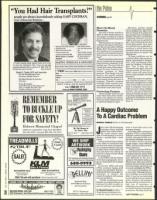

"You Had Hair Transplants?"
people are always incredulously asking GARY COCHRAN,
8
WARNING page 69
ii
owner of Beau Jacks Restaurant...
More On Blood
Pressure
• Advanced micro-graft techniques • Soft, feathered hairline
• Your own living, growing
• Virtually pain free
• Return to work the next day
hair
• Board Certified, American
• Private evaluations and
Academy of Dermatology
procedure performed by Drs.
• 22 Years of expert hair
Martin Tessler and Leonard
Transplant Surgery
Aronovilz
"If I didn't proudly boast, people would never know
I've had hair transplants. Now I have my own hair
growing naturally where I used to be bald. And it'll
-Gary Cochran
be there the rest of my life!"
Martin E. Tessler, M.D. and Associates
The only Hair Replacement Center
Practicing in Michigan Named in:
The Best Doctors In America
MARTIN E. TESSLER, M.D. & ASSOCIATES
EXCLUSIVELY PRACTICING HAIR TRANSPLANT SURGERY
r ED
—. Please send a free video & color brochure.
YE-c!
Name
Telephone
Address
Send coupon to MARTIN E. TESSLER, M.D. & ASSOCIATES
26400 W. 12 Mile Rd. • Suite 150 • Southfield, Ml 48034
Town & Country
April 1996 article on Hair Replacement
listing 14 "Highly Reputable" Hair
Transplant Surgeons in the USA
(TEL) 1-800-531-7117
(Internet) www.tessler.com
REMEMBER
TO BUCKLE UP
FOR SAFETY!
Hebrew Memorial Chapel
INMENW
111111111111111
/11111111M
miwwwwwwwwww
nq•
26640 Greenfield Rd. Oak Park MI 48237
810 543 1622 • Outside MI1-800-736-5033
-
-
TREADMILLS
HERE COMES
HALE-BOPP!
15% OFF TELESCOPES
(All In Stock Models)
. ..... ...
LM
ROCHESTER HILLS
WEST BLOOMFIELD
2680 Rochester Rd.
(810) 299-0456
33010 Northwestern at 14 Mile
(810) 626-7791
FREE $50 mat with purchase "Must mention Ad"
LOOK FOR MY Spotlight COLUMN NEXT WEEK
360-7700
8362 Richardson, West Bloomfield/Commerce Township
Protecting Peepers
Many kids get their first eye
exam when they enter kinder-
garten, but experts now recom-
mend an initial examination by
an ophthalmologist by age 4.
5 159-'595
The Excitement Is
Building About
The Newest
Astronomical
Phenomenon, Comet,
Hale-Bopp.
It will make it's clos-
est pass to our planet
at a safe distance of
123 million miles on
March 23, 1997
Complete Science Center: Projects, Chemistry
Sets, Microscopes, Experiments and more.
lk ZVI 264,&zil
7hy Setairt .54,e
Hours: NJSat:10..5:V,
-
3947 VV. 12 Mile Rd.
Berkley
10..S
(810) 543-3115
WE SHIP
ARTWORK
TRLJE®
NELSON liERSH, DDS. MS
rip
State
City
1996 edition
The chill of winter months is
likely to raise blood pressure in
thin people, according to a recent
issue of the American Journal of
Hypertension.
"Blood pressure can change ac-
cording to the season of the year,"
says the journal's editor, Michael
Weber, M.D. "During the winter,
thin people have to compensate
more for cold weather because
their bodies are the least insu-
lated."
Israeli researchers determined
this by comparing the seasonal
blood-pressure readings of 101
healthy men. The men with the
lowest body mass index experi-
enced the most dramatic win-
tertime increases in blood
pressure. That change was only
found in the systolic reading,
which measures the pressure in
blood vessels when the heart is
pumping. Diastolic pressure
readings, which measure pres-
sure when the heart is at rest, re-
mained the same year-round.
Moreover, parents should
have a pediatrician check baby's
eyes in his first year. Many com-
mon eye ailments, including am-
blyopia ("lazy eye"), crossed eyes,
congenital cataracts and mis-
aligned eyes can be spotted by
age 1 and corrected by the time
Junior starts school. Up to 4 per-
cent of kids have amblyopia, a
condition in which there is di-
minished vision in one eye and
the brain learns to "ignore" the
afflicted orb.
"If these conditions are de-
tected in babies, they can be cor-
rected," says Joseph J. Kubacki,
M.D., of St. Christopher's Hos-
pital for Children in Philadel-
phia. "But if they are not
discovered until age 9, they can
only be treated. In this case, a
child's vision will never be as
good as if the problem had been
corrected."
Early eye exams are particu-
larly important because a child
with poor eyesight has no idea
what normal vision is and won't
know to complain. Clues that a
child may have vision problems
include: rubs eyes frequently,
closes or squints one eye to see
something, complains of eye pain
or frequent headaches and has
difficulty seeing objects at a dis-
tance. ❑
The Packaging and Shipping Experts
Industrial • Commercial • Residential
680-0993
.d
FUg5„U5E
Imported Baby
and Children's Furniture
and Accessories
1875 S. Woodward
Birmingham • (810) 644-0525
A Happy Outcome
To A Cardiac Problem
MARSHALL FRANKLIN SPECIAL TO THE JEWISH NEWS
erry had a life-threatening
coronary artery problem
called "the widow-maker."
He would require some
type of intervention to avoid a
serious — possibly fatal — heart
attack.
If Jerry had had this condition
in the 1950s, he would have had
to retire from work and exercise,
live a protected lifestyle and hope
he didn't have a heart attack. At
that time there was nothing we
could do to keep a heart attack
from happening.
In the 1960s, with the advent
of coronary angiography, we be-
gan to understand the condition
better.
In the late 1960s and early
1970s, coronary bypass graft
surgery was developed. This rep-
resented the first meaningful in-
tervention to improve the
outlook for patients with serious
coronary problems.
Initially, complications were
frequent, as surgeons had not yet
developed the skill to safely op-
erate on patients with obstruc-
tions in more than one or two
coronary arteries.
In the late 1970s, coronary an-
gioplasty (PTCA), using balloon
catheters, made its appearance.
Initially, only patients with a sin-
gle coronary blockage were treat-
ed; all others went to coronary
bypass surgery. In the 1980s and
1990s, operator skills and tech-
niques improved.
Today, multivessel PTCA is
the rule rather than the exception.
It employs balloons, stents, drills,
cutters, lasers and radiation de-
vices delivered on the end of
catheters with relative safety and
effectiveness. More than half the
patients who previously required
coronary bypass operations are
now good candidates for PTCA.
In a manner of speaking, Jer-
ry was lucky. Although his coro-
nary condition was potentially
fatal, it was but one narrowing
on one vital spot in one coronary
artery. However, the location of
the narrowing was known for a
high rate of recurrence, or
restenosis, even after the most
Dr. Marshall Franklin is a San
successful-looking angioplasty
procedures. Stenting would sig-
4611
Diego-based cardiologist who
writes for Copley News Service.
HAPPY OUTCOME page 72
/
c-/