
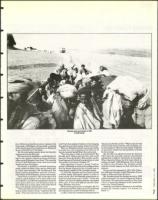

Ethiopian Jews leave Gondar in 1991
for Addis Ababa.
oral Torah that adapted Judaism to the changing
time periods and communities where Jews lived."
When an Ethiopian Jewish woman gave birth
to a baby boy, she would leave her home for 40
days to separate herself from the community.
"This was done in order to purify herself," Ms.
Zevadia said. "After a girl was born, she would
leave her house for 80 days. This practice was fol-
lowed because of the literal interpretation of what
was written in Leviticus Chapter 12."
After spending 10 years in Israel, Yosef re-
turned to Ethiopia to teach at the village school.
But the dream of going to live in Israel was al-
ready firmly instilled in Ms. Zevadia's family.
In 1976, Ms. Zevadia and her family moved
to Addis Ababa, Ethiopia's capital, in order to
make aliyah. But "the Marxist government re-
fused our application to go to Israel." Under that
regime "any type of religious activity was looked
down upon. It was a very difficult time for Chris-
tians, Muslims and Jews."
While awaiting permission to emigrate, Ms. Ze-
vadia graduated from high school and performed
the required six months of national service.
In 1981, Yosef was arrested and imprisoned for
"Zionist and Jewish activity." While in jail, he was
tortured and denied contact with his family. Af-
ter his release in 1984, he made aliyah. Yoseflat-
er received a medal from the president of Israel
for his courage.
Ms. Zevadia was allowed to leave for Israel in
1984 when she received a special international
scholarship to Hebrew University of Jerusalem.
When Operation Moses, the first major aliyah op-
eration, brought 7,000 Ethiopian Jews to Israel
in 1985 by way of Sudan, Ms. Zevadia worked
with the Jewish Agency to deal with their ab-
sorption.
It was a job she repeated in 1991, after Opera-
tion Solomon brought 14,000 Ethiopian Jews to
Israel in little more than 36 hours.
Ms. Zevadia joined the foreign service in 1993
while studying for her master's degree at Hebrew
University. She spent four months in New York
City as a temporary delegate at the Israeli Mis-
sion to the United Nations.
Asked by an audience member how she defines
herself, Ms. Zevadia replied, "I'm Jewish; I'm
black." ❑
0,
0,
FEBRU ARY
its to Hebrew and political science classes at the
University of Michigan, she keynoted a meeting
of the North American Conference on Ethiopian
Jewry (NACOEJ) at U-M Hillel.
Ms. Zevadia spoke mostly about her family's
experience leaving Ethiopia.
She was born in Amboder, a small Jewish vil-
lage in the northern district province of Gondar,
where most Ethiopian Jews lived. The majority
of the 57,000 Ethiopian Jews who have made
aliyah are from the region.
"In Gondar, I studied in a Jewish elementary
school, where my father, Geta, and my older broth-
er, Yosef, were teachers," Ms. Zevadia said. Her
father and her grandfather were kes ha kesim,
chief rabbis of the Ethiopian Jewish community.
Yosef went to Israel in 1957 at the age of 9 to
"learn to speak Hebrew and to learn about mod-
em Judaism." Cut off from mainstream Jewry for
more than 2,500 years, the Ethiopians kept up
their faith and, in many cases, were more devout
than most Israelis and Diaspora Jews.
"They still followed the strict rules and regu-
lations of the written Torah," explained Ms. Ze-
vadia. "They did not have any concept as to the