

47, ?ZaWeAMM.W.M00,305.2=
.0,,MMard4,==
Checklist
For Office Visits
Office Visits
Making the most out of regular checkups is not difficult
if the patient comes prepared.
* Be prompt (even though you
know you may be kept waiting).
You might need the extra time
to fill out new medical and in-
surance forms.
* Listen carefully. Don't try to
second-guess your doctor and
make sure you understand
what she is recommending and
why, and what you can expect.
Ask questions if you don't un-
derstand.
* You may want to take notes,
take a tape recorder, or bring a
spouse or friend to help you re-
member everything that was
discussed.
* Prioritize your concerns. Tell
your doctor the main problem,
describe the symptoms, and
what you would like to see hap-
, pen as the end result. If you've
made a list, show it to your doc-
tor.
* Rehearse your answers. Be
able to answer: What is your
problem? How long have you
had it? What does it feel like?
How often does it occur? Does
medication make it better? Do
65 other members of your family
have the same problem?
2
6- * Make a list of your concerns
and your symptoms. Be thor-
ough, but don't over-do it.
* Know your body. Learn how
your body works, particularly
the heart and circulatory sys-
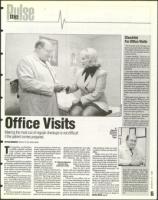
Dr.
Raymond
Weitzman:
Physicians
want to
listen.
RUTHAN BRODSKY SPECIAL TO THE JEWISH NEWS
T
he scenarios are familiar:
a stuffy, packed waiting
room, a one-hour wait in a
cold cubicle just large
enough for an examination table
and a few frayed Reader's Digests
dated 1995.
The scene switches to a patient
receiving a rushed medical exam -
by a harried physician assisted
by an officious technician, and
ends with a very frustrated pa-
tient showing signs of hostility
and resentment.
Today, growing numbers of us
are unwilling to accept this pic-
ture. And rather than just being
passive and complaining, we're
taking more responsibility for our
own medical care by collecting in-
formation and questioning our
doctors.
For the successful, the quest
for the best care is a doctor-pa-
tient partnership in which mu- great opportunities for us to take
tually respectful dialogue is the charge of our own health. And
rule and the growing range of tra- doctors who want to stay in prac-
ditional and alternative thera- tice will have to meet these ex-
pies is jointly explored.
pectations or they'll lose patients.
Big business has been mar- For patients, the problem is
keting this posture.
switching doctors
Now available to con- Dr. Raymo nd Weitzman may not be conve-
sumers are medical
exami nes Rose
nient or even smart.
reference books on CD-
Lieberm an's hands.
That doesn't mean
ROMS, Internet chat
that we can't work
rooms for medical information better with our long-time physi-
and health support groups, pa- cians and even retrain a few in
tient education videotapes and some of the more common com-
cable TV showing open heart plaint areas.
surgeries. Even the elaborate
"Think of your office visit as
two-page ads of pharmaceutical if you were attending a business
companies for prescription drugs, meeting," recommends Dr. Ray-
once assigned only to profession- mond Weitzman, a physician in
al medical publications, have Southfield specializing in inter-
made their way into consumer nal medicine and rheumatology.
magazines.
"Even if you have multiple com-
This growing emphasis on the plaints, be definite about your
patient's role in health care offers goals and priorities for that office
visit and know what you want
to achieve before you leave the
office.
"Make sure you tell your
physician everything up front
because my job as physician
is to analyze the information
patients provide, and tie that
data to the body's systems so
that I can diagnose their cause
and recommend treatment," Dr.
Weitzman says.
"What I hate most is at the end
of a check up when a patient tells
me, By the way, I have this oth-
er pain I didn't tell you about.'
That pain might have influenced
all my earlier analyses."
In a situation like this, both
the patient and physician have
lost time. That's not to say you
shouldn't tell your doctor a detail
or an incident that you forgot to
OFFICE VISITS page 66
tem, the urinary and repro-
_
ductive SYgtems, and the
, 1 -;)
digestive tract. Becoming fa: cr)
miliar with'your body and its
ftmctions will make discussions
with your doctor less intimi-
dating and more informative.
* Take responsibility for your
treatment. Discuss alternative .fc
options and do your homework
at the library or on the Inter-
net.
05