
4IDgency
fur
ew sh
uesting
illO ducat
STN Entertainment
uestioning
and learning opportunities
Rated PG-13
H
for adults
Jewish cultural
'Beverly Hills Ninja'
gorged one is now Tommy Boy
oly Shinto! Here comes a big with a Pink Belt.
fat guy from the "Saturday
What is truly remarkable is
Night Live"/SCTV comedy that despite the retread nature
machine with a mediocre
of Ninja, Farley brings home the
movie career.
bacon.
He is not the funniest of
Beverly Hills Ninja is the lat- the SNL/SCTV fat guys — now
est vehicle for the corpulent and known as the Cult of the Fat Men
quirky Chris Farley. On his
— but he is the funniest-
own this time around
looking of the group. We
MOVIES
(David Spade co-starred
like him; he's cute, rum-
in his first two movies),
pled and endearing. But if
the expansive one performs a 90- he values his career, he'll grow in
minute impression of John more areas than his beltline.
Belushi's old samurai character.
I would say that in this film
Gone is Belushi's subtle devilish genre — modern, big, funny, fat
style, replaced by loud physical guy movies — Beverly Hills Nin-
slapstick routines.
ranks below Uncle Buck and
Farley is cast as Ham, an ja
The Blues Brothers but well
American with a bad Moe
Disorderlies or Fatso.
Howard haircut. Raised by nin- above
jas in Japan, he
returns to Bever-
ly Hills to combat
an international
counterfeiter and
rescue a blonde
woman who diets
considerably
more than he
does.
As for the di-
recting, writing,
casting, acting
and plot develop-
ment, let me say
that the movie
features a man
being beaten
with two fish at a
Japanese steak-
house. The en-
n
Warning: Parents of young
children should think twice about
the appropriateness of this movie.
The hugely grotesque shots of
Farley's shirtless torso and par-
tially exposed right butt-cheek
could lead to extended night ter-
rors for young and old alike.
O
lbs
— Michael L. Drew
Michael L. Drew is an attorney
with a soft spot for American
subculture.
These great Yiddish classic films involve collaboration among some
of the outstanding artists of the Yiddish world, from Eastern Europe
to America. Each film will be preceded by a brief lecture that will
help to place it in historical context.
Admission $5.00 adults, $3.00 seniors and students
Sundays at 7:00 p.m.
Agency for Jewish Education's Auditorium
21550 W. 12 Mile Road, Southfield, MI 48076
February 9
THE DYBBUK
Boundaries separating the natural from the supernatural dissolve as
ill-fated pledges, unfulfilled passions and untimely deaths ensnare
two families in a tragic labyrinth of spiritual possession. "The
Dybbuk" reflects the shtetl's insightful appreciation of its hidden
spiritual resources. The film's exquisite music and dance interludes
evoke the cultural richness of both pre-World War I shtetl commu-
nities and Polish Jewry on the eve of World War II. Poland, 1937
ri , au March 2
TEVYE THE DAIRYMAN
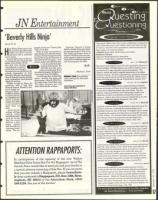
Chris Farley goes undercover in
Beverly Hills Ninja.
This classic of the Yiddish cinema, written by Sholom Aleichem
focuses on the story of Chava, one of Tevye's daughters, who falls
in love with a Ukrainian peasant who reads Gorky. The film
explores issues of assimilation and intermarriage, tradition and
modernity, as well as anti-Semitism and the future of Jewish
existence. Made in New York on the eve of World War II, the film
depicts a life that was already threatened. USA, 1939
GREEN FIELDS
iy15yo yr -u
March 30
A pastoral romance, about a young Hasidic scholar who leaves his
studies to search the countryside for common people and a
meaningful existence close to the land. He happens upon a family
of simple Jewish peasants who takes him in as a boarder and tutor
for their children. The restorative effect of the open country upon a
man who has known only classrooms and city streets is the
powerful theme of this Yiddish literary classic. USA, 1937
YIDL WITH A
FIDDLE
5 - 'o pin 51..
April 13
This classic Yiddish language musical-comedy has been called the
best Yiddish motion picture of all time. Molly Picon plays a 'shtetl
girl who, disguised as a boy, goes off with her father and a band of
traveling musicians into the Polish countryside. Made in pre-war
Poland, the film provides a warm rendering of Eastern European
Jewish life. Poland, 1936
EAST AND WEST
ATTENTION RAPPAPORTS:
In anticipation of the opening of the new Walter
Matthau/Ossie Davis film I'm Not Rappaport, we at The
Jewish News would like to send you and your family to
a special advance screening of this film. If you can prove
that you are, indeed, a Rappaport, please immediate-
ly drop a postcard to Rappaport, P.O. Box 1069, Birm-
ingham, MI 48012 or fax Attention: Beth, (810)
540-2124. See you at the movies!
ywn
nim
May 18
Good-natured comedy about worldly Jews encountering traditional
shtetl life. Morris Brown, a New Yorker better acquainted with his
checkbook than his prayerbook, returns to Galicia for a family
wedding. The bride, daughter of his traditionally observant
brother, and Morris's Mollie, whose exuberant antics fill the film,
could not be more different. But Mollie unexpectedly meets her
match, an engaging young yeshiva scholar who forsakes tradition
and joins the secular world to win her heart. Austria,1923
UNCLE MOSES
vytftn 5p3m
June 8
From bustling sweatshop to overcrowded tenement, this film
vividly portrays the lives of East European shtetl Jews transplanted
to turn-of-the-century New York's Lower East Side. Old-world
values clash with new-world dreams and the traditional Jewish
family unravels. Yiddish Art Theater founder Maurice Schwartz
initially plays benevolent despot and self-made patriarch, Uncle
Moses, with comic flamboyance. But, as romantic difficulties and
labor union struggles unfold, Schwartz's performance deepens into
a resonant, compassionate elegy. USA, 1932
For reservations and information on our other programs,
call Naomi Blumenberg ((i (810) 354 1050.
-
Scanned image of the page. Keyboard directions: use + to zoom in, - to zoom out, arrow keys to pan inside the viewer.
January 24, 1997 - Image 105
- Resource type:
- Text
- Publication:
- The Detroit Jewish News, 1997-01-24
Disclaimer: Computer generated plain text may have errors. Read more about this.