

Prime>.
TIME
Like
everything
else in Israel,
simply
watching
television
has become
a national
debate.
LARRY DERFNER
ISRAEL CORRESPONDENT
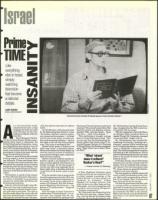
Controversial Israeli comedian Gil Kopatch appears on Israel Television Channel 1.
A
s a rule around the world,
conservatives have a deep
antipathy for state-run radio
and television as the free-
loading mouthpiece of the lib-
eral elite.
Since Margaret Thatch-
er's day in Great Britain, British conser-
vatives have tried to dismantle the
British Broadcasting Corporation. Amer-
ican Republicans are trying to turn off
the Public Broadcasting System. And in
Israel, some believe that the Netanyahu
government is trying to do away with the
Israel Broadcasting Authority.
"There is a sense that an all-out battle
is being waged to wreck the Broadcast-
ing Authority. If there are things about
the authority that need correcting, then
they should be corrected; but by no means
should the authority be privatized," said
the Third Way party's Emanuel Zisman,
chairman of the Knesset Education Com-
mittee.
Privatization is nearly a holy mission
for Prime Minister Binyamin Netanyahu,
and there is probably no government
company he would rather sell off than the
Broadcasting Authority.
Like the entire Israeli right-wing, Mr.
Netanyahu has long condemned the me-
dia in general, and state-funded televi-
sion and radio in particular. The claim is
that the media slants the news to the left
and views Israel through an elitist's lens.
Although the attitude can get a bit para-
noid, this doesn't mean that it's without
merit.
As Orit Shochat, a left-wing columnist
fol. the left-leaning daily Ha'aretz, wrote,
."Journalists, directors, satirists, produc-
ers, emcees and announcers — in Israel
and the rest of the world, on public sta-
tions and commercial stations — tend on
the whole to the left side of the political
map. This is just a sociological fact."
Hatred of the media in Israel by the
right-wing "street" is especially intense.
Scores ofjournolists have been beaten up
over the years by crowds of settlers or
young soccer-hooligan types, especially
after terrorist incidents.
Hebron's Jewish residents recently re-
fused to speak to journalists for a few
days in protest against what they saw as
hostile coverage. In the last couple of
months, the right-wing, especially the re-
ligious right-wing, or haredim, has found
a new focus for its attack: satire on pub-
lic TV.
First the haredim tried to pressure the
Israel Broadcasting Authority (IBA) into
cancelling the irreverent commentary on
the weekly Torah portion offered by co-
median Gil Kopatch. But IBA director-
general Mordechai Kirchenbaum — the
pioneer of TV political satire — fought off
the assault.
Now the target is Israel Television's
weekly satire "Cameri Quintet." In a re-
cent skit, they implied that Mr. Ne-
tanyahu had ordered the opening of the
Hasmonean Tunnel last year to prove his
manhood. The quintet's sexy Keren Mor
faced the camera and, feigning arousal,
pleaded, "Bibi, open the tunnel ... Open
it by force ... Open it from behind ..."
This performance brought outrage
down on Israel Television's head. "How
can you say that the Broadcasting Au-
thority reflects the Israeli 'street'?" de-
manded Knesset Member Zvi Weinberg
of Yisrael B'Aliya, the Russian immigrant
party. "What 'street' does it reflect? Hook-
er's Row?"
"What 'street'
does it reflect?
Hooker's Row?"
— Knesset member Zvi Weinberg
A Shas (Sephardi Orthodox) party
member petitioned the Supreme Court
to either suspend screenings of the
Cameri Quintet or at least compel it to
"moderate its crudeness." Justice
Theodore Orr decided, however, that
while the show may offend large portions
of the public, the court's tampering with
it would be "a far-reaching infringement
on freedom of expression."
Mr. Netanyahu has delegated gutting
the IBA to his chief aide, Avigdor Lieber-
man, who has likened the Israeli media
to Pravda. He has fought bitterly with
Mr. Kirchenbaum during Knesset hear-
ings, charging that the IBA is grievous-
ly wasteful with its money.
With the cooperation of powerful Knes-
set Member Rabbi Avraham. Ravitz of
Agudat Yisrael, Mr. Lieberman managed
to have the IBA's budget held up.
Mr. Kirchenbaum has accused Mr.
Lieberman of running a "campaign of in-
citement" against public broadcasting,
and of forging documents to smear his
name, a charge Mr. Lieberman has de-
nied. The Labor-led opposition has given
full backing to Mr. Kirchenbaum. And so
public broadcasting has become one more
piece in the puzzle of Israel's left-right
political schism.
Until this decade, Israel Television's
Channel One was the country's sole TV
station. Now it competes'with commer-
cial Channel Two and subscription cable
TV, whose shows are generally flashier,
shallower and more popular.
The real question is whether Israel still
wants a public broadcasting station that
can offer quality programming without
fear of low ratings. This, of course, has
been obscured by all the outrage.
The best the government has been able
to manage so far is a statement of prin-
ciple that it would like to privatize pub-
lic broadcasting in another two years. In
the meantime, the BBC is still around,
PBS is still around, and, for the foresee-
able future, so is Israel Television and
Radio. ❑
ti
CY)
C,
ti
>-
CC
67