
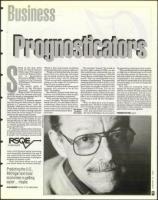

itting in his Ann Arbor
home, Dr. Saul H. Hymans
holds a copy of the report is-
sued by the Research Sem-
inar in Quantitative
Economics (RSQE), which
he directs at the University
of Michigan's Department
\‘; of Economics.
The report, which is
based on the Michigan
Quarterly Econometric
Model of the U.S. Economy
(MQEM), one of the foremost such mod-
els in the country, summarizes the U.S.
Economic Outlook for 1997-98.
"We've had the U.S. economy expand-
ing over the past three years at approx-
imately a 2 percent rate," says Dr.
Hymans. "And given the accuracy .with
which these numbers are measured, my
sense is that it's been a strong 2 percent
rate, more like in the range of 2-2.5 per-
cent over the past couple of years.
"My sense of looking ahead for the next
year is that we're in for another 2.5 per- -
cent growth year in 1997. And that's very,
very good for the economy, because that 2,
is, roughly speaking, the economy's ca-
pacity growth rate."
Dr. Hymans explains that if all phys-
ical and human resources were being ful-
ly utilized as they were meant to be, and
if people were working a normal work
3
.
,
CL
week, and if physical capital were being
used reasonably intensively the way it
was constructed to be used, under those
circumstances the economy would grow
at about 2.5 percent a year.
That's just about where we are, and
just about where we've been recently.
Predicting the U.S.,
Michigan and local
economies is getting
easier ... maybe.
ALAN ABRAMS SPECIAL TO THE JEWISH NEWS
Which is why most people are feeling
"For example," he says, "if you look at
pretty good about the economy right now. the first eight months of 1996, you see
"People are feeling that jobs are more that employment nationwide was in-
secure than a few years ago, that prices creasing at a rate in excess of 200,000
are not going up day-by-day every day more jobs per month than the previous
they go into a store," says Dr. Hymans. month. That's an unsustainable rate of
"Prices are actually reasonably stable, increase of employment. Unsustainable
going up in the range of 2.5-3 percent a meaning that if you tried to do that, you'd
year for most consumer goods. pretty soon be trying to add more jobs
"And the outlook is that a pretty good than there are people available in the
economy will continue as we go into United States to fill them. You can not
1997," he predicts. have employment expanding at over
How does Dr. Hymans reach these con- 200,000 jobs a month unless you're start-
clusions, and what factors does he take ing out from a situation in which there's
into account in making a projection? been a lot of unemployment and you're
'Well, basically we look at everything just trying to soak up that unemploy-
we can," he replies. "We look at where in- ment.
terest rates are, how the Federal Reserve
"Well, we don't have a lot of unem-
is behaving, what kind of price move- ployment now, We have a relatively low
ments we've had in recent months and rate of unemployment, roughly in the
recent weeks, and what kinds of Saul Hymans: range of about 5.25 percent nation-
employment circumstances there Computers wide, and somewhat even lower in
have been.
have helped. the state of Michigan. So you cannot
,
be expanding employment that rapidly.
"We were [doing that] in the beginning
of 1996, but it slowed down as we went
into the later period. In November, we
had only a little over 100,000 increase in
employment in that month nationwide,
and that's a sustainable level of increase
of employment, so we look at things like
that as well."
How does an economist "look" at
things? Dr. Hymans smiles. "We look at
them in two senses. We look at them with
our eyes as economists, and try to un-
derstand and absorb them, and under-
stand the connections between them. But
we also look at them in the sense that we
have what's known as an econometric
model, which is a set of mathematical
equations which are intended to describe
the behavior of the economy, to link the
parts of the economy together.
PROGNOSTICATORS page 54