

all have been maligned: Menachem Be-
gin, Yitzak Shamir and Binyamin Ne-
tanyahu.
In pre-state days, the struggle was be-
tween the socialist (today Labor) and re-
visionist (today Likud) camps. From 1935
to 1977, Jewish leadership in Palestine
and then Israel was dominated by so-
cialist Zionists.
They also dominated world Zionism,
the Jewish Agency for Palestine and the
powerful labor unions. Their political cul-
ture persists to this day: that socialist
Zionists represent Beautiful Israel while
the revisionist Zionists represent Ugly Is-
rael.
This powerful political culture lives de-
spite that between 1977 and 1992 (with
the exception of a brief National Unity
government) the Likud ran Israel's gov-
ernment.
In fact, the Israeli intellectual, acade-
mic, artistic, journalistic and media elites
are almost completely dominated by lib-
eral, left Zionism. For years the Israeli,
European and American press have iden-
tified with the Labor Party because it is
perceived as a liberal left party, while the
Likud is perceived as a right-wing an-
nexationist party.
To the media and world, the Likud
could do no right and Labor could do no
wrong. Yet, it was Prime Minister Golda
Meir of Labor who ignored
and rejected Palestinian na-
tionalism. In 1970, her gov-
ernment refused to accept
Egyptian President Anwar
Sadat's offer to make a deal
over the Suez. This certainly
would have spared Israel
from the costly 1973 Yom
Kippur War.
And in 1996, Shimon Peres'
Labor government launched
a major war in southern
Lebanon in an unsuccessful
attempt to uproot the Hezbol-
lah. This resulted in 400,000
Lebanese refugees and seri-
ous destruction of property.
After the 1994-95 murderous
llamas bombing of Israeli
buses in Tel-Aviv, Jerusalem,
Hadera and other places, the
Rabin-Peres government im-
posed draconian measures
against the Palestinians as
they were negotiating with
Mr. Arafat for peace.
No American president,
European head of state or Arab moder-
ate leader made a peep.
But the campaign of Mr. Netanyahu's
vilification began as soon as he was elect-
ed. The leaders of this effort were no less
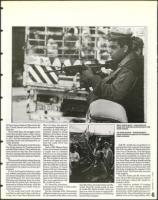
Above: Constant guard — Israel soldiers are
always at the ready while protecting Hebron's 500
Jewish residents.
Left: United we stand — Rallies by Hebron's
Jewish residents and supporters from throughout
Israel are common.
than Mr. Peres, the Labor Party and Mr.
Arafat. What Mr. Arafat would not dare
do under Mr. Rabin and Mr. Peres, he
does now with the hope of toppling Mr.
Netanyahu's government and blaming
him for Oslo's collapse.
And Mr. Arafat has succeeded in or-
ganizing the Arab camp for that purpose.
His first trip after the Netanyahu elec-
tion was to Damascus. Now the Egyp-
tians, who challenged the Rabin-Peres
government constantly on nuclear poli-
cies, have their Nasserite foreign minis-
ter, Amre Musa, acting as though nothing
was achieved between Sadat and Begin.
He has found it-convenient to continue
Egypt's pernicious anti-Israel policy with
the hope of getting the support of the
United States. The French also have lent
their support.
Only Mr. Rabin and Mr. Peres could
have slowed the Oslo process without
such challenge, without Mr. Arafat re-
sorting to arms.
Any objective student of strategy
realizes that some serious political
concessions made by the Rabin-Peres
government, which might have been cor-
rected by Mr. Peres himself had he been
elected, were not the responsibility of Mr.