
Your
Quest'
Mane
Fourth in a helpful new pet series
sponsored by Invisible Fencing of Birmingham.
PET CONTAINMENT
What is your suggestion for retaining a Golden Retriever who exhibits a lot of dog-to-dog ag-
gression?
Something
Beary
Delicious
A dog with an existing aggression problem of any kind is not a do-it-yourself project. This is ab-
horrent behavior for a Golden and the breeder should be informed.
• First, find and hire a good trainer or behaviorist to help you solve the problem.
• If it's a male, neuter the dog if he isn't already. I am assuming (always dangerous, I know) that
this is a male dog, as they exhibit these behaviors more often than females.
• Check diet and exercise levels. Inadequate or excessive diet and a lack of adequate exercise
contribute to many behavior problems. Fixing these may lessen the problem, but don't count
on a change in diet to solve the problem completely.
• Teach the dog the commands "Leave It" and "Let's Go" and use them. Demand that the dog
pay attention to you, not to the other dogs.
Remember to praise your dog for good behavior. Be careful not to soothe the dog before, af-
ter or during aggression with words I ike,"It's okay, or "He's not going to hurt you." Your dog
will mistake this as praise and the problem will get worse.
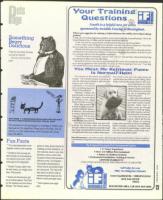
What do you think this bear
just had for dinner?
Can you color his fancy
shirt?
You Mean MY Re
is Normal
The woman on the phone sounded dis-
traught. "My Labrador puppy is jumping all
over me, chewing everything in sight and grab-
bing my arm in his mouth.
I yell at him — I've even hit
him, but nothing stops him.
What IS his problem?"
"Nothing," I replied, "He
sounds pretty normal for a
Lab puppy. No more hitting
or yelling at him, okay?
There are better ways."
What the woman de-
scribed is 100% normal for
youthful Labrador Retriev-
er behavior. Labs were bred
to retrieve dead birds from
water or land. This hunting
was ofter clone in freezing
waterAhroOgh heavy brush.
HoW does this history affect your own Lab?
Leaping into freezing water and breaking
through underbrush required a physically tough
dog. Dogs were selected for hunting who were
not frightened of the loud, sudden noise of gun-
* Donkeys were among the
first animals to be domesticat-
ed, trained more than 5,000
years ago by the Egyptians.
* Camels' humps, filled with
fat and water, can weigh more
than 100 pounds.
* Insects are the favorite deli-
cacy of three plants: The Pitch-
er, the Sundew and the Venus
Flytrap. The Pitcher, which
fire, which is why your Lab might stand and
wag his tail to you when you yell. Hitting, some-
thing we always discourage, doesn't make much
of an impression on a Lab.
For this dog, life is a loud and
vigorous contact sport. If he's
not bumping you, jumping
on you or mouthing you,
what's the point?
Labs were also selected
for their desire to pick things
up in their mouths. Conse-
quently, today most re-
triever pups go through
extensive chewing stages,
are often mouthy, and will
rip more than one sweater
— all in the best of fun, of
course. Add to all this the
Labs' history of working
closely with man and you have an intelligent,
highly trainable, exuberant, mouthy, stable
dog — a favorite for guide dogs, custom and
narcotics work, families and all kinds of ser-
vice work around the world.
Brian Kilcommons is one of the country's foremost dog trainers and the author of several widely ac-
claimed books on dog behavior and training. Brian is also the exclusive training consultant for Invisible Fenc-
ing.
Fun Facts
* The only animal able to dis-
tinguish colors is the monkey
er Puppy
fp!
grows in Asia, draws insects by
emitting a sweet substance. As
the creatures come to eat, they
fall down, down, down into
the plant where they become a
delicious meal. The Sundew
has hairlike attachments to
which insects stick before they
are consumed. The Venus Hy-
trap opens its leaves until an
unsuspecting fly stops by; the
fellow is then promptly eaten.
* Most spiders have eight
eyes.
The Originai Eiectronic Pet Containment System
• 17 Years' Experience
• Over 1/2 Million Pets Contained
• Indoor & Outdoor Systems
• Professional Installation, Training & Service
LIFETIME WARRANTY
ONE-YEAR MONEY-BACK PERFORMANCE GUARANTEE
Call Today for your
FREE, No-Obligation Estimate!
CE1
INVISIBLE tit'
31645
Southfield Rd. • BIRMINGHAM
(810) 646-WOOF
(9663)
ROCHESTER AREA: Call (810) 969-2600j
13
Scanned image of the page. Keyboard directions: use + to zoom in, - to zoom out, arrow keys to pan inside the viewer.
January 17, 1997 - Image 103
- Resource type:
- Text
- Publication:
- The Detroit Jewish News, 1997-01-17
Disclaimer: Computer generated plain text may have errors. Read more about this.