

Sinai - MC Merger
long the corridor of Sinai Hospital's
main lobby is a collection of
art-work drawn, painted or col-
ored by the children of Hillel Day
School.
Hilary Gorosh, a third-grader,
has painted a colorful, cosmic drawing of
the planets spinning around with Earth
as the focus. Next to it is a simpler, peace-
ful work by first-grader Jason Greenspan.
There are simply two smiling little men.
Above them is the word shalom, or peace,
in Hebrew.
Symbolism. Maybe.
In the mind of Rabbi Leonard A. Peri-
stein, Sinai's director of pastoral care, the
role of Sinai is central to the very exis-
tence of humankind, with neighborhoods
of black, Jewish, Catholic, white, Mus-
lim and Christian people revolving
around the hospital. The end product:
peace.
Rabbi Perlstein sees Sinai's future as
beautifully and vitally Jewish for the care
of metro and suburban Detroit.
Sinai, he said, will never compromise
in the message it stands for, said the rab-
bi. The hospital is not a building or a
group of facilities. It is, instead, an idea,
a concept, that "phenomenon of our iden-
tity," as he describes Sinai.
He tells the story of how an outside
consultant visiting Sinai once said, "The
one thing you can't do is destroy your
roots. Your roots are your identity."
Says Rabbi Perlstein, "Any hospital
from any faith has that sort of identity,
because it gives so much more than med-
ical care. You don't get that from
government hospitals in quite the same
way. They don't have the same sort of
roots.
"Sinai Hospital is an extraordinary
idea or concept that speaks to the world
at large," says the rabbi. "We are saying,
This is who we are.' You won't find that
same sort of message in a synagogue or
a church, where the relationship stays
with the members."
Rabbi Perlstein talks of Sinai in a qui-
et, modest way. Yet his message speaks
loudly of what he believes Sinai is all
about.
"When you go to an arena that talks
about the whole picture, you're talking
about a diverse, multiethnic and mul-
tiracial world. Your identity is created to
see and to show who you are. There are
people from all faiths and backgrounds
who come to Sinai and who are treated
by Jewish physicians, who see we're the
same as they are. Sinai is a bridge be-
tween the Jewish people and the world."
On any given moment, Rabbi Peristein
can be called to administer his pastoral
PHOTO BY GLENN TRIEST
The Go el Of Sinai
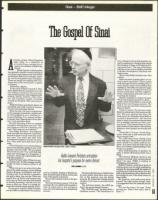
Rabbi Peristein: 20 years at his "pulpit" at Sinai.
Rabbi Leonard Perlstek gages
his hospital's puipose for metro lleiroit
PHIL JACOBS EDITOR
care to a Catholic, Baptist or Muslim pa-
tient. In his 20 years at Sinai, he has seen
tens of thousands of patients.
He can tell countless stories in his gen-
tle way:
The time the phone rang at 1:15 in the
morning. He was called to the hospital to
calm an angry man in the emergency
room who was behaving in a threatening
manner.
He interceded between a Catholic fam-
ily and a priest when there was a ques-
tion of the pastoral care the family
received. He visited the Catholic family
member at her home to provide further
comfort.
The still-born births, the AIDS pa-
tients, the people dying of cancer.
The "God bless you," he hears from a
Chaldean woman. "The Palestinian in-
tern working in the Jewish hospital say-
ing his experience is helping him amend
the situation in Gaza and his former feel-
ing toward Jews." The copy of the Koran
and the prayer rug he makes available
to Muslim worshippers in the Sinai med-
itation room.
This is what Rabbi Perlstein sees. This
is Sinai.
Sinai and other hospitals like it are so-
ciety's great equalizers. When people
walk through the door needing help, it
really doesn't matter what building they
worship in. The rabbi over and over again
refers to Sinai as a bridge between the
Jewish community and the neighbor-
hoods, communities and metro area sur-
rounding the hospital.
"Sinai's continuity is critical," he says.
"What this hospital stands for is faith —
people of the Jewish faith as well as the
faith of the entire human species. The
truth is, you can see God in every person
that's on Earth.
"Faith is innate. It's not man-made.
Belief is instinctual to the human condi-
tion. The more abstract the faith, the
more pure it is. All people share faith as
a common denominator. And the best
place to reach the common denominator
is in a hospital, because you have a hu-
man factor. That human factor in a hos-
pital reaches to the bottom of the human
existence, when [people] are hurting and
frail.
"The truth is," he says, "we are all pa-
tients. Some are in bed; some are wait-
ing to occupy a bed."
The rabbi then stops, wiping a tear
away and says, "We as Jews cannot live
alone. People of all faiths need one an-
other. You learn and see that here at
Sinai. It's a better understanding of who
we are as a people."
That understanding of peoples, he
adds, is better off because there was a
Sinai.
"The Detroit Medical Center is not
looking to cut back what we have here at
Sinai," he says. "DMC is looking to
strengthen and enhance."
Rabbi Peristein could have gone on
talking about how he holds orientation
sessions for incoming staff, his system of ti
notifying and referring clergy of every 0,
`"
faith to their patients, not to mention the —
knowledge he has of the basic tenets of O
these faiths.
He, however, won't talk much about c:> .
himself. The rabbi smiles, though, when ;t
it is suggested that his patients are his
pulpit.
"I'm not the story," he says. "Look
around you. This is the story, this is 53
Sinai." 0