
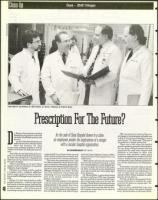

PHOTOS BY G LENN TREI ST
Left to right: Dr. Lyle Goldman, Dr. Marc Feldman, Dr. Steven L. Rabinowe, Dr. Robert E. Bloom
Prescription For The Future?
C/D
LLI
LLJ
CC
LLJ
48
r. Harvey Gass has been at Sinai
Hospital so long that he could walk
the halls blindfolded and not lose
his way.
As one of the first physicians on
staff and one of two who have been
there the duration, Dr. Gass
knows every winding corridor as well as
nearly every doctor on staff, past and cur-
rent.
And while he was fully behind the cre-
ation of a Jewish hospital from the get go,
he feels that things have changed and
there may not be a need so much anymore
for such a hospital.
"Time is marching on," he said. "Sinai
simply could not maintain its position
without a major change."
Whether or not there is still a need for
a hospital with a religious affiliation
doesn't really matter to many of the doc-
tors on stafrat Michigan's only Jewish hos-
pital.
Rather it is the loss of such an inde-
pendent presence — built by the hands
and hearts of Jewish doctors, staff and the
community to serve their family, friends
as well as others — that is the source of
mourning among the medical and non-
As the sale of Sinai Hospital draws to a dose,
its employees Fader the lill i ecaliolls of Illerg8T
with a secular hospital orgallizalloll.
JILL DAVIDSON SKLAR STAFF WRITER
medical staff. It is as if part of the very soul
of the Jewish community has been sold,
to be combined with a secular institution.
`The loss is the community's loss," said
Dr. Melvin Rubenfire, Sinai's former chair-
man of medicine who spent greater than
20 years at the Detroit hospital before leav-
ing seven years ago for the University of
Michigan Hospital in Ann Arbor. "It is the
loss of an institution whose being said
something. It was a commitment on the
part of the Jewish community to the
greater community."
Mixed with the sadness in the passing
of an era where Jewish hospitals thrived
independently is the anxiety that comes
when the details of the future have yet
to be released. Hanging in the balance is
the role Sinai doctors and staff will play
with the Detroit Medical Center (DMC),
the purchasers of the hospital they once
called home.
Others grieve the loss of camaraderie
between the staff and the board, a team
that worked together to make hospital pol-
icy and navigate the future of the hospi-
tal. More see the sale as the heralding of
a new age in health care where doll ar signs
drive decisions.
Dr. Manuel Sklar, a gastroenterologist
on Sinai's staff since 1956, has witnessed
the rise and fall of several Jewish hospi-
tals in other major cities over the past few
decades. While Sinai's sale does not come
as a surprise, he does view it as the herald-
ing of a time when even the sale of a Jew-
ish hospital comes down to an issue of
economic survival.
"My real concern in terms of the over-
all change in the philosophy of health care
is that it has become basically economi-
cally driven," Dr. Sklar said. 'The care of
the patients no longer comes first."
There was a time when the hospital
served a greater purpose for these doctors.
For one, many of the physicians who first
populated the staff were denied staff
positions or privileges at other area
hospitals that operated under quota
systems to regulate the number of Jewish
doctors. Simply being Jewish and a doc-
tor frequently meant referring patients to
non-Jewish staff doctors for hospitaliza-
tion.
"I remember way back when it was dif-
ficult for Jewish doctors," said Dr. Marcus
Sugarman, a primary care physician who
was on staff when the doors of Sinai
opened in 1953. "[Other hospitals] wouldn't
pick the Jewish fellows.
"We felt, at Sinai, the prospect of get-
ting an internship or residency for a Jew
would be the same as anyone else," Dr.
Sugarman said.
But as Jews assimilated more into
mainstream culture, the quotas dropped
away; discrimination on the basis of reli-