

Australian actor
Geoffrey Rush
is basking in
the glow of
critical acclaim
for his part as
David Helige
in Shine.
JULIE EDGAR
SENIOR WRITER
eoffrey Rush
likens his re-
cent spate of
movie roles to a
pioneer space-
craft that has hit
Jupiter's gravity
and been shot into
deep space.
Never mind his
transcendent turn as Aus-
tralian virtuoso classical pianist
David Helfgott in the just re-
leased Shine. The role — a
stretch for any actor — has al-
ready sent Rush into the heady
stratosphere of Hollywood adu-
lation.
He just snagged the coveted
"best actor" award for the
part from the New York
Film Critics Society,
which, Rush said, sent
him home "weeping."
"The acclaim from that
peer group really knocked
me sideways," he said last
week during a visit to
New York to promote
Shine.
And last week, Rush,
45, was placed in the run-
ning for the same acco-
lade from the Golden
Globes.
Within a few days of re-
ceiving the script from
film. director Scott Hicks,
who had only seen Rush
in stage roles — Rush was
thumbing through a
newspaper and noticed
that Helfgott was doing a
recital in Melbourne. He
saw the performance and gave
Hicks his answer, despite lim-
ited experience in front of the
camera. He didn't even audition
for the role.
Before the shooting of Shine
got under way, Helfgott, a 25-
year stage veteran, appeared
in a movie called On Our Se-
lection about a group of scrap-
py homesteaders in Australia
who are betrayed by a govern-
ment program meant to help
them. And he'll appear in the
forthcoming Children of the
Revolution with Judy Davis
and Sam Neill.
"I've sort of carved out my
niche in the Australian theater
and was doing quite well, and
all this happened. In the last
PHOTO BY LISA TOMASETTI three years I've
done three films,"
Rush said.
Playing the role
of Helfgott as an adult meant
extensive research into Helf-
gott's eccentric diction and
crabbed mannerisms — the af-
termath of a seizure he suffers
during a recital in his early 20s.
"My instincts in approaching
the role told me I didn't want to
pin him down like a butterfly
— butterflies are dead — so we
hung out together. But most of
my research came from audio-
tapes that [director Scott Hicks]
shi
S
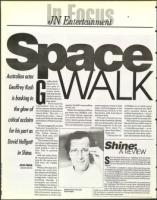
Geoffrey Rush as the adult
David Helfgott.
ARIEw
hine has been billed as an "uplifting" tale of a man's
neurological derailment and his triumphant re-
turn to semi-sanity and the concert stage through
the love of a good woman and a little help from his
friends.
It would be a mistake to reduce this marvelous psy-
cho-drama to a simple moral fable. Based on the life sto-
ry of David Helfgott, a virtuoso classical pianist raised
by a severe, possessive father who lost his family in the
Holocaust, the film is a rich and often painful portrait of
a child buffeted by forces beyond his control and his even-
tual descent into madness.
We see Helfgott, an Australian Jew, as a precocious
boy bending to his father's every whim, including being
bar mitzvah, as a young man freely exploring his tal-
ent at the Royal Academy of Music in London, and fi-
nally as an adult who has broken with reality, exiled by his family
for pursuing a musical education in Europe and reduced to a bum-
bling, chain-smoking lounge lizard.