
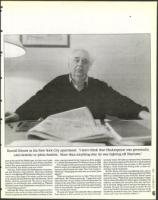

Harold Bloom in his New York City apartment: "I don't think that Shakespeare was personally
anti-Semitic or philo-Semitic. More than anything else, he was fighting off Marlowe."
sacre at the end of the Middle Ages, but that wasn't quite
true. Most of them were sent out, some of them remained.
Just as they were supposed to have been readmitted un-
der Cromwell, that wasn't quite true, either.
"Anyway, I don't think that Shakespeare was person-
ally anti-Semitic or philo-Semitic. More than anything
else, he was fighting of [Christopher] Marlowe, as he al-
ways was at that stage of his career, and he was trying
to do a better job than Marlowe did with Barabas, Jew of
Malta, which he certainly did. The play is, beyond any
question, an anti-Semitic play, profoundly so. Whether
Shylock is quite what Shakespeare intended him to be is
an interesting question."
Although Mr. Bloom does not forgive instances of anti-
Semitism in the works of -writers such as Eliot and Ezra
Pound, he generally abhors ideological readings of liter-
ature, arguing instead for the "autonomy of the aesthet-
ic," a stance that dominated The Western Canon in 1994.
Even though Jewish issues have pervaded much of Mr.
Bloom's career, he is ultimately a fierce individualist He
has never allied himself with other "New York Jewish in-
tellectuals," disparaging the mere term as so much "press
agentry."
"There -are no groups anyway, my dear. There are only
individuals," Mr. Bloom pronounces. "I guess that what
allies this book I've just written with everything else I've
written is the quite bitter insistence that there are only
individual selves, there are only individual achievements,
there is only solitude. Groups don't read. Groups don't
write. Groups don't think."
Of course, the "group" with which Mr. Bloom ultimately
finds alliance is still a Jewish one, but only on his idio-
syncratic terms. He balks at criticism from "normative
Jews" about his audacious The Book of J, which claimed
that the biblical author was a woman, or The American
Religion, which found him flirting with a rather un-
orthodox Jewish Gnosticism.
But Mr. Bloom will never stop fighting back, and an
anecdote about his similarly beleaguered friend Philip
Roth is as emblematic as any about Mr. Bloom's place
among the Jews: "Philip Roth came [backstage] to speak
with me about The Book ofJ before I gave a reading. The
audience was filled with normative Jews who were hos-
tile to the book. Philip came in and put his hand on my
shoulder. He said, 'You must accept my motto: We are
here to be insulted.' He meant, of course, that one can be
insulted by normative Jews, but I knew what he really
meant, and I was very touched, indeed." ❑
CO
0,
0)
1—.
ti
LU
co
2
U_I
C_D
LLJ
45