
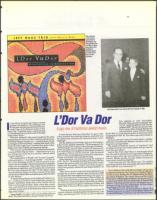

The music for
L'Dor Va Dor:
Generation to
Generation, by
the Jeff Haas Trio
and Marvin Kahn,
was drawn from
traditional
Hebrew prayer
and folk music,
jazz and the
universe.
Karl Haas with his son Jeff at Jeff's bar mitzvah in 1962.
L'Dor Va Dor
t was about 10 years ago when I started
putting it all together," says Jeff Hs as, who
for the past six years has produced the suc-
cessful Jazz at the Museum series in Tra-
verse City. "It started with a simple melody
I remembered from my dad's work at Temple
Israel called 'Faith.'
"The more I played it, the more I recognized the same
feelings that the music of John Coltrane and the music
of Charles Mingus brought out — mixed feelings of hope
and despair at the same time. I realized that much of the
music of Judaic origin that I loved had that same melan-
cholia, that same hopeful yet desperate feeling.
"This was not a premeditated or predetermined path;
I was just following my heart ... experimenting in my
own living room. It led me to a tune by Coltrane called
'Lonnie's Lament."
The combination of "Faith" and "Lonnie's Lament"
is the centerpiece — and closing number — of L'Dor Va
Dor. It is a haunting, nearly 17-minute musical rumi-
nation whose nostalgic, reminiscing quality is palpable
within the arrangement. Haas made it part of his live
performance repertoire, and it became the cornerstone
for what was to become the L'Dor Va Dor album, which
was recorded by Haas' trio (Haas, bassist Chuck Hall
and drummer Keith Hall) and special guest Marvin Kahn
on alto clarinet.
"I started researching a lot of traditional Hebrew mu-
sic — picking up books at used bookstores, going to li-
braries," says Haas, whose visits to New York to visit his
father and younger brother, Andy, who's also a musi-
cian, were filled with study time to authenticate the
melodies and to discover the historical context in which
they were written.
Gary Graff is the editor of the new book MusicHound
Rock: The Essential Album Guide (Visible Ink Press).
I
fore signing on with Schoolkids'
Records. Haas says that making L'Dor
Va Dor "really brought me back into the
religious fold." He and his second wife,
Kate (whose father helped liberate the
concentration camp Ordroff during
"I won't kid you; this was a tall order," he says. "A lot World War II), have become active at Traverse City's
of this material was relatively obscure; much of it was Congregation Beth El, the oldest operating temple in
two, three, four centuries old. Authenticating it was a Michigan.
He's also started work on his next album, another
challenge."
But the additional knowledge only gave the songs on collection of traditional Hebrew melodies with con-
temporary arrangements.
L'Dor Va Dor greater resonance. The arrangement for
The wealth 'of material, he says, is "enormous," and
"Sabbath Song," for instance, went through a metamor-
it's
likely his foray into Jewish music will go even be-
phosis as Haas traced it back to 1648 and discovered it
this next album.
was inspired by the slaughter of thousands of Jews by yond
And in New York, Karl Haas is enormously proud
Cossacks in Poland and the Ukraine. Like the rest of
that the seed he planted in the organ loft of Temple Is-
L'Dor Va Dor, his arrangement conveys the combination rael so many years ago has sprouted into such rich
of hope and despair that inspired the song.
Haas despaired a bit himself during the making of artistry. Maybe one day, he says, father and son can
even record something together.
L'Dor Va Dor. He started recording it during 1994 but
"I don't see why not," the father says. "It's possible
stopped the sessions after two days because he wasn't something could be done that meets each other halfway.
happy with the results. "I didn't want these [songs] to
❑
end up being simply vehicles for jazz improvisations," he That could be very interesting."
explains.
The Jeff Haas Trio with Marvin Kahn will provide
After more research and some rearrangements, he
background
music for the Community Singles Shabbat
brought the musicians together again during early 1995
service
at
8
p.m.
Friday, Dec. 20. Sponsored by the Michi-
for sessions that were sparked not only by the music but
The Jewish News and the Jewish
gan
Board
of
Rabbis,
also by the interactions of the players: Marvin Kahn, an Federation of Metropolitan Detroit, the service will be
octogenarian clarinetist and an atheist who contributed conducted by Rabbi Michael Moskowitz at Temple Shir
two of his own songs to the album; Chuck Hall, an African
American bassist and longtime collaborator of Haas'; and Shalom. Following services, the trio will perform in a cof-
feehouse setting. For more information, call Fern Hober-
Keith Hall, a 25-year-old born-again Christian drum-
man Kepes, (810) 642-4260, Ext. 253.
mer.
The Jeff Haas Trio will also perform on March 16 at
"The band represents three generations and very di- Temple
Israel and on April 6 at the Maple-Drake JCC
vergent religious and philosophical backgrounds," says
to
benefit
Michigan Protection and Advocacy Services.
on
his
own
label
be-
Haas, who released L'Dor Va Dor
A jazz mix of traditional Jewish music.