

El ectio n Ti me
Already?
Labor maneuvering
is in full gear as
intrigue and
subplots mount
before a June
leadership vote.
INA FRIEDMAN
ISRAEL CORRESPONDENT
he elections for Israel's
Labor Party chairman,
who is also the prime
minister candidate for the
scheduled year 2000 elec-
tions, are seven months away.
But the battle for the nomination
has been rolling for months.
And it moved up a notch when
leading contender Ehud Barak
won yet another round. The fight
that had been brewing prior to
a recent session of the party's
1,300-member Central Commit-
tee included a variety of oppo-
nents. But the spotlight centered
on the contest between Mr. Barak
and still-party-chairman Shimon
Peres. Months ago Mr. Peres con-
ceded that he would not run
again for the party leadership.
Yet, he was secretive about when
he would step aside.
The party's constitution pro-
vides for elections for a new chair-
man 14 months after the loss of
a national election. Late July
1997, then, is the prescribed date
for the change of guard.
In politics, however, rules are
made to be amended. Mr. Peres
strongly signaled his hopes to ex-
tend his leadership to anywhere
from the end of 1997 to 1999.
Mr. Barak was determined to
nip that notion in the bud. The
party, caught in the middle of the
two, was torn. On the one hand,
there is strong sentiment for the
73-year-old Mr. Peres and a de-
sire to avoid seeing him humili-
ated by the ambitious young Mr.
Barak after his defeat by the am-
bitious Likud leader Binyamin
Netanyahu. On the other hand is
a thirst to move beyond the long
era dominated by Mr. Peres and
Yitzhak Rabin, which would
hopefully rejuvenate the party
and confront Mr. Netanyahu with
a candidate who by virtue of his
age, style and outlook would pro-
vide a punishing combatant.
SeRsitive to all this, and loath
to be the subjects of a damaging
showdown, Mr. Peres and Mr.
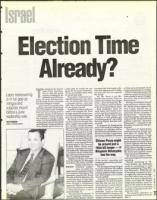
Barak worked out an
Ehud Barak 11th-hour compro-
mise. It robbed the
party central committee session
of its expected high drama. The
agreement assured Mr. Barak
that the critical leadership vote
would take place no later than
next June 3, while satisfying Mr.
Peres through a "gentleman's
agreement" that he would remain
Labor's top minister in a nation-
al unity government, if one is
formed by Sept. 15.
Not everyone was pleased. "A
stupid Mapainik' compromise,"
groused Chaim Ramon, who just
two years back was touted as Ra-
bin's heir-apparent and is today
not even sure he'll run against
Mr. Barak.
Yet, Mr. Peres is not Mr.
Barak's only obstacle. There re-
mains a line of other, far younger
rivals — from the dovish Mr. Ra-
mon, Uzi Baram and Yossi Beilin
to the more centrist Efraim Sneh.
Each challenger spent the
week before the Central Com-
mittee meeting snappishly por-
traying Mr. Barak, former chief
of staff, as a "rigid, ruthless, pis-
tol-packing paranoid" who suffers
fools just slightly less than poli-
tics itself.
In one sense, Mr. Barak got the
jump on his rivals by pushing his
campaign into high gear well be-
fore they had even decided to run.
He has moved like a juggernaut,
canvassing hundreds of members
Shimon Peres might
be around just a
little bit longer — if
Binyamin Netanyahu
has his way.
of the central committee and
mustering serious financial back-
ing abroad.
Yet, he enjoys being portrayed
as a naive politician who suffers
a distinct handicap against the
cunning politicos whose careers
have been forged in the crucible
of party politics.
"I ascribe his [suspicion of his
colleagues] to the fact that Barak
feels like the new boy in town
who's entering a contest with bat-
tle-seasoned veterans," said Yos-
si Beilin, himself a potential
contender. "Justly or otherwise,
he sees himself as someone who
has come from a very hard-head-
ed place and is now pitted against
a whole array [of people] whose
common denominator is intrigue
... [But] the fascinating ease with
which he wrested the party from
those schooled in power struggles
only shows that we are actually
the innocents."
Having established himself
early and almost without a fight,
Mr. Barak already appears the
man to beat. And for now, it
seems unlikely that his rivals will
catch him. Except, of course, if
Shimon Peres — with the back-
ing of those party rivals and the
tacit aid of Mr. Barak's ultimate
political opponent, Binyamin
Netanyahu — succeeds in the
formation of a national unity gov-
ernment.
The notion of a Likud-Labor
coalition has been floated, and
shot down, for weeks. Mr. Ne-
tanyahu has wielded it to keep
his right flank off balance. Mr.
Peres advocates to salvage the
peace process and mend Israel's
bruised relations with the Arab
states and Western governments.
Being Labor's "top dog" in such a
government would likely extend
Mr. Peres' active political career
well beyond next September.
Mr. Barak's prospects within
such an arrangement are far less
appealing.
Beyond remaining in Mr.
Peres' shadow, the challenger
would be subordinate to (and
closely monitored by) Prime Min-
ister Netanyahu. While the lure
of returning to positions of pow-
er might turn out to be stronger
than the Labor Party can with-
stand, how such a subordinate
position would affect Mr. Barak's
image and candidacy cannot be
ignored. He might be far better
off as the head of a hard-hitting
opposition, especially as the elec-
tions draw near.
The situation, therefore, re-
mains as open-ended as it is com-
plex. ❑