

s\c Zr's-
tR
XVIMMIOM MX= =M ks*M .1,,$ ),W.M .r..5,2* >:=M r.7.:a
hen I was an under-
graduate, stress would
come and go with final
exams.
A few weeks before
the tests that made up
most of my class grade,
the signs of stress would
appear: headaches, irri-
tability and sleeplessness.
Fortunately, my room-
mates were going through
the same thing, so we didn't kill each oth-
er.
Who would have figured that out in the
"real world" stress could become as sec-
ond nature as breathing, eating and sleep-
ing. Now, a day doesn't go by when I don't
feel some level of stress. Sometimes it's
triggered by something minor — like
which shoes match my outfit? Other
times, there are more serious concerns —
like finishing this story on time.
Financial concerns, family matters and
work problems can play havoc with our
lives, creating an immea-
surable burden. If there was
a magic de-stress pill, I think
it would be taken as often
and as commonly as aspirin.
Unfortunately, we have to
look to other methods to help
lower our stress-levels.
Biofeedback, aroma ther-
apy, massage therapy, hyp-
notherapy, yoga, meditation
and good old fashion exercise
can all be effective means of
stress reduction.
Next month I will be
starting law school — a
breeding ground for stress
(from what I've been told).
Over the last few weeks, I've
either tried various methods
of stress reduction or talked
about them extensively with
people who practice them.
Granted, you can't try some-
thing once and decide if it
works for you, but here's
what I found:
Biofeedback
Who knew that counting
backwards from 1,000 in
multiples of 13 could be so
stressful? During my session
with Michael Morris, a cer-
tified biofeedback therapist
in Novi, 'I had to perform
that daunting task. Mr. Mor-
ris wanted to test my reac-
',WOAKIMM ...X MIWZMAXM:`
,IM ON,W2i..,,r4M .ZZ ,,,M, 023MVAWAVA
( .4 ,0:W
`
ORZ. W.
tressed
tient to heighten his or her awareness
tion to stress.
"Biofeedback," he said, "is a form of self- of tension and then relax corresponding
regulation to help an individual gain con- muscle groups. The biofeedback machine
trol over bodily functions that are allows a client to see what tense and re-
normally beyond a person's level of aware- laxed muscles looks like by the way they
ness. It gives you information so you can register on the screen. Mr. Morris said it
learn to control the systems in your body, typically takes 10 sessions or less to be-
such as your breathing or level of muscle gin to master the technique.
Seated in a leather chair (with a foot
tension in areas that don't supply your
brain with good information, particular- rest) in his dimly lit, serene office, I was
ly your trapezius muscles (near your hooked up to five wire connections that
attached to his biofeedback machine — a
shoulders)."
Through biofeedback I was able to see small box connected to a lap-top comput-
my reactions to stress and a calm state er.
A wire was taped to my middle finger
charted on a computer screen. Because
most of us are not aware of our subcon- to measure my temperature, which rose
scious physiological functions, biofeed- under stress. Wiring, held in place by a
back creates a means for us to monitor narrow velcro strap, fit firmly around my
chest and abdomen. Two electrodes were
these states.
Using the biofeedback charts, Mr. Mor- placed on my shoulders to detect electri-
ris teaches his clients stress-reducing cal impulses from the trapezius muscles.
Mr. Morris took me through a series of
skills such as the proper way to breathe
(abdominally), so that each breath makes exercises — "Get as comfortable as you
your stomach rise and fall.
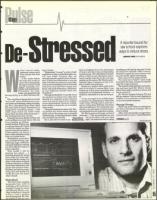
Michael Morris: can in the chair with your eyes
He is also able to teach a pa- Reading the body. open," he instructed before typing
./7140.0,i7M WAZWAW.,:rareSafae=7,=(arePAMZEWX4MW102
A reporter bound for
law school explores
ways to reduce stress.
JENNIFER FINER STAFF WRITER
something on his lap-top computer. It took
me about five minutes. Then I was in-
structed to repeat the same exercise with
my eyes closed. Again more typing.
Then came the big math exercise.
"You want me to what?" I said, ready
to run from the chair. Usually the reporter
asks the tough questions.
The charted measurements and breath-
ing exercises teach Mr. Morris' clients
about their body's reaction to stress and
how to control it.
Mr. Morris charges between $70 and
$90 per session. Cost, he said, depends on
whether it's an insurance covered claim
or an out-of-pocket expense.
Massage Therapy
Need I- saymore? There is nothing bet-
ter than a therapeutic massage. OK, al-
most nothing.
After what seemed like a longer-than-
normal week at work, I visited Madeline
STRESSED page 66
PHOTO BY DAN LIPPITT
CO
0)
0)
-
CO
CC
LU
2
LU
05