

Oft cuide
The Big Chill
There was one major excep-
tion to the signing — the Unit-
ed States (tsk, tsk!). That's why
some sparkling wines pro-
duced in this country are still
called champagne. However,
out of respect to the craft, most
producers of high-quality
sparkling wines voluntarily ad-
here to the agreement.
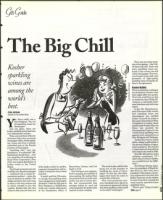
Kosher
sparkling
wines are
among the
worlds
best.
Kosher Bubbly
ETHEL HOFMAN
SPECIAL TO THE JEWISH NEWS
s, there really was a
Dom Perignon. Yes, not
all sparkling wines are
champagne.
And yes again, there are
kosher sparkling wines that have
won international acclaim.
Those are just three of the lit-
tle-known facts that surround
champagne which, strictly speak-
ing, comes only from a strictly
controlled area in the French
province of Champagne.
"Anything else," says Jay
Buchsbaum, Is a misnomer." Mr.
Buchsbaum should know — he's
vice president of marketing at
Royal Wine Corporation, New
York, the largest distributor of
kosher wines in the United
States.
The French province's rare mix
of chalky soil, climate and grapes
— combined with a unique fer-
mentation method — gives the
wine its distinctive sparkle. The
chalky soil allows the vines' roots
to drain in the rainy season and
to retain warmth in hot, dry
weather. Besides that, the wine
cellars in this area are hewn out
of the chalk so there is a perfect,
consistent temperature and hu-
midity to bring the wine to ideal
maturity.
It wasn't until the 17th centu-
ry, though, that sparkling wines
were recognized as being highly
drinkable. Credit for that goes to
Dom Perignon, a Benedictine
monk who was the cellarmaster
at the Benedictine Abbey of
Hautvillers, France, until his
death in 1715.
Dom Perignon was responsi-
ble for changing the methods of
wine-making. He realized that
the pressure built up in the wine
bottles was due to carbon diox-
ide, and recommended that
stronger bottles be used and
corks inserted in the bottle necks
instead of cotton wadding.
The monk is also credited with
being one of the pioneers in
blending the wines of Cham-
pagne. To this day, the cham-
pagne that bears his name is
revered the world over.
Most wine-producing coun-
tries, including Israel, signed an
international agreement stating
that their sparkling wines would
not be called "champagne."
There is absolutely nothing in
the production of kosher wine
that might affect the quality.
That's the word from no less
an authority than Philip Sil-
verstone, a nationally syndi-
cated television and radio wine
expert.
In fact, Mr. Silverstone in-
sists that some of the world's
best sparkling wines and
champagnes are certified
kosher. As proof, he points to
this year's International Wine
Competition in London, where
Israeli-made Yarden Blanc de
Blanc was awarded the
Schramsberg Trophy for the
world's finest sparkling wine
against such competitors as
Dom Perignon and Tattinger.
Yarden Brut was no slouch
either, taking a gold medal in
the general category of region,
price and flavor. Not bad for
a winery that only launched its
first wines to the world in 1983.
Says Mr. Silverstone, in the
ultimate compliment, "If I
didn't tell you they're kosher,
you wouldn't know the differ-
ence."
But Nathan Herzog, execu-
tive vice president of Royal Ke-
dem Wine Co. New York, has a
complaint. The kosher commu-
nity appreciates the many fine
kosher wines now on the market,
he says, but tends to overlook the
many equally splendid kosher
sparkling wines.
What a pity! Today's kosher
CHILL page 16