

Staying Alive
On Principle
A new national study on the Conservative movement's vitality reflects its
presence in the metropolitan Detroit Jewish community.
Semi-retired? Not a chance. Rudy Simons is more
involved than ever in social andpolitiCal causes.
JILL DAVIDSON SKLAR STAFF WRITER
FRANK PROVENZANO SPECIAL TO THE JEWISH NEWS
abbi David Nelson is
breathing a sigh of relief.
Although he has seen a
slight increase in his mem-
bership size and a growing num-
ber of children in his congregation,
Beth Shalom in Oak Park, there
has been a thought in the back of
his mind, a nagging doubt that has
been there since 1990.
Then, the Council of Jewish
Federations released its study on
the status of the Jewish popula-
tion in the United States. While
the news was good for some seg-
ments ofJewish society, the future
of the Conservative movement
was painted as bleak.
Seen as a denomination with
an aging population whose
younger members were flocking
toward a differently observant Re-
form or Orthodox movement, the
Conservative congregations were
being pinched into an increasing-
ly smaller space.
"We were beating up on our-
selves after that study," Rabbi Nel-
son said. "People were saying that
the older people were staying but
that the younger people were mov-
ing on. In a few years, there
wouldn't be much of a movement
left," he said. "It wasn't very op-
timistic."
But now Rabbi Nelson and oth-
er Conservative rabbis in metro-
politan Detroit are celebrating a
new study that affirms just what
he already knows; The Conserva-
tive movement is alive and well
and maintaining its membership,
if not growing.
The survey, conducted by re-
searchers at the Jewish Theolog7-.
ical Seminary in New York City
and released earlier this month,
was the first extensive and exclu-
sive study done on the member-
ship of movement.
Over the two years of the study,
researchers polled 1,700 congre-
gants at 27 randomly selected
Conservative synagogues in North
America as well as 1,500 teens
who had celebrated b'nai mitzvah.
Information on programs and
practices of 378 Conservative syn-
agogues was aLso collected and an-
alyzed.
The study was funded by a
$292,000 grant from the Pew
Charitable Triists, a Philadelphia-
based philanthrope
which supports nonprofit organi-
zations, as well as a $75,000
matching grant from the Jewish
Theological Seminary.
The study found that the ma-
jority ofJewish Conservative con-
gregations have grown or are
Maintaining membership levels.
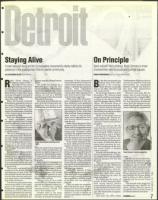
Rabbi David Nelson is building on the
future.
While 21 percent have remained
steady in their membership, 27
percent are slightly larger and 21
percent are dramatically larger.
Twenty percent are slightly small-
er and 11 percent are dramatical-
ly smaller.
Rabbi Nelson's congregation is
symbolic of the increases. His con-
gregants have grown in number
and arejargely younger. A build-
i ng addition and renovation cur-
rently,iiilirogress will include
more CtigkOOm space for a nurs-
ery schoollind educational activ-
ities for older children.
"All .you have to do is walk
around h-dre on a Saturday morn-
ing and see pregnant women, ba-
bies in strollers and children
running around," he said. "We
have a very healthy mix."
Another point in the study
showed a trend within the Con-
servative movement toward egal-
itarianism. In fact, 84 percent of
men and 85 percent of women fa-
vored women's equality in the syn-
agogue. A greater gap appeared,
however, when respondents
replied on the issue of hiring a
woman rabbi. Then, 65 percent of
men were in favor while 74 per-
cent of women approved.
While many of the 12 Conserv-
ative congregations in this area
have adopted a more egalitarian
stance on such issues as counting
women in the minyan and allow-
ing women to lead services, not all
have joined in. In fact, while their
West and East Coast counterparts
allow women to lead services,
some local congregations have
only recently allowed women to
open the ark.
Rabbi Aaron Bergman of Con-
gregation Beth Abraham Hillel
Moses said his congregation seems
to be moving toward a more egal-
itarian scene. Currently, women
read from the megillah and chant
the Haftorah but are not count-
ed in the minyan and do not read
from the Torah in the synagogue.
"It is a matter of doing it or not,"
he said, adding that board dis-
cussion continues on the subject.
Further, the study pointed to
the success of education programs
for the young as a possible base for
building a future filled with con-
gregants. More people under the
age of 35 have taken Jewish stud-
ies courses in college, attended
Camp Ramah, visited Israel be-
fore age 22 and attended Hebrew
school than their counterparts in
any other age category.
Rabbi Efry Spectre of Adat_
Shalom Synagogue knows this.
That is why_his congregation of-
fers as many learning opportuni-
ties as possible to children as well
as to those who are post-b'nai
mitzvah.
`That has been our concentra-
tion in the past few years," he said,
noting that Adat Shalom offers
study groups and nosh-and-drosh
sessions, as well as beefing up
nursery and Hebrew school pro-
grams."
❑
B
y the time most people are
taking their first coffee
break of the morning,
Rudy Simons is just get-
ting to the office. But don't call
him a late arrival.
At the break of dawn in mid-
November, Mr. Simons stood
alongside striking newspaper
workers at the downtown De-
troit Newspaper Agency (DNA)
offices. He followed along as
picketers chanted protest slo-
gans. And he stood in the brisk
temperatures to listen to fami-
lies tell him how they have been
torn apart by the strike.
Those in the crowd were in
good company. Mr. Simons, 67,
a Bloomfield Hills resident, is a
veteran of social and political
struggles.
As a social activist, Mr. Si-
mons has been involved in civil
rights, poverty and peace issues
since the early 1960s, when he
returned from a trip to Indone-
sia to find U.S. Vietnam War
policy at odds with what he felt
were American and humanitar-
ian values. At that time, like on
many other occasions, he real-
ized the worthiness of the anti-
war cause before it became
widely accepted.
Humble and self-effacing, Mr.
Simons conceded that, at times,
he wonders if he's had any effect
battling injustice over the last
40 years.
"The only thing I can't do is to
do nothing," he said. "Most of us
involved in these issues — since
we were children — have be-
lieved in what we heard about
what was right and wrong.
Some things are as clear as
black and white."
The difference for many, of
course, is that knowing right
from wrong doesn't always
mean taking a stand. But since
he first learned the details of the
Holocaust when he was a teen-
ager, Mr. Simons felt an urgency
to speak out.
Last year, the office along
Northwestern Highway that he
uses for his political work was
fire-bombed. An unexploded
Molotov cocktail was found on
the floor. The perpetrators
haven't been found.
Nearly a year later, Mr. Si-
mons, who is semi-retired, is
working out of a cramped office
a few miles away, still waiting
for the insurance reimburse-
ment. Ever the optimist, he con-
tends that through the years he
hasn't suffered any personal at-
PHOTO BY DA NIEL L IPPITT
•
Rudy Simons: A global perspective.
tacks.
For the last several decades,
Mr. Simons' positions on a range
of social issues could be read inc
newspaper op-ed pieceS anti'
heard in radio commentaries
and lectures delivered in tem-
ples, churches and union halls.
(s"
He is a secretary for the Michi- cr,
gan Coalition for Human Rights
and is active in New Jewish -
Agenda and the Jewish Peace
Lobby.
'The reward is the people I've
met along the way," said Mr. Si-
>
mons, noting that he serves Lu
alongside social activists from o
all denominations and races.
:
STANDING page 8
7