

MOP■=11•11.•• "NMI
•
Community Views
Reporter's Notebook
Building The Partnership:
What It Really Means
There's No Single
Reason Not To Help
ALAN D. GOODMAN SPECIAL TO THE JEWISH NEWS
JENNIFER FINER STAFF WRITER
The summer of windows during the day and close
1996 will always them at night."
We were also told that our chil-
be remembered
by me and my dren would not be able to work on
family. For my the kibbutz together with the
wife Susan and youngsters from the kibbutz be-
me, this was our cause of insurance issues.
While the first problem was
opportunity to
make a dream quickly and easily resolved, the
come true, to live second problem (resulting in dec-
and work in Israel for two months larations from all three children
and expose ourselves and our chil- that they wanted to go back home)
dren to modern-day Israel — the required more diplomacy, tact, pa-
culture, the people, the realities. tience and perseverance to work
For our three teen-agers, this through.
Notwithstanding these chal-
would be a social experiment "par
excellence," of developing rela- lenges, in a relatively short time
tionships and acclimatizing to a my family and I developed friend-
new language, culture and social ships on the kibbutz and within
communities in the region. We be-
norms.
I was invited by the Jewish came well-acclimatized and able
Federation of Metropolitan De- to find our way around with little
troit to represent our community effort.
My professional assignment
under the auspices of the Part-
nership 2000 Project. hi
addition to matching
communities in the
United States with
communities in Israel,
this initiative provides
an opportunity for pro-
fessionals to develop re-
lationships with their
counterparts in Israel.
As the executive direc-
tor of the Jewish Fam-
ily Service in Detroit, I
was provided with rare
insight into the work-
ings of the social system
in a development region
in the Central Galilee.
During the seven
weeks of my visit, we
were housed on Kibbutz
Ramat David, equidis-
tant from Nazareth
Elite and Emek Jezreel.
We were met at the
front gate of the kibbutz
by Yona, who showed
us to our modest apart-
ment and gave us keys
and computer cards so
that we, like other res-
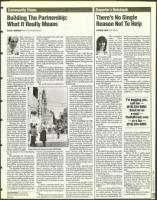
idents, could be charged A view of the main street in the town of Beit Sahur.
for the meals we ate in the dining was to understand the social ser-
vices structure, programs and ser-
room.
The next day we were given a vices in three municipalities in the
tour of the kibbutz, including the Partnership 2000 region. I was
fully stocked grocery store, pro- asked to focus on those areas that
duce market, clinic, dining room, most clearly relate to programs
post office, swimming pool and offered by the Jewish Family Ser-
health-care facility for the aged. vice of Detroit: refugee resettle-
The bubble of euphoria which ment, services to the elderly,
surrounded us was popped one services to families and children,
day later when we requested blan- domestic violence. I was asked to
kets for the beds for the cool exchange ideas and share exper-
evenings and a fan for the apart- tise in these areas and to identify
ment for the stifling daytime heat. potential opportunities for re-
The mazkirah, secretary, of the gionalization of services in that
kibbutz advised us that there region.
I spent approximately two
were neither spare blankets nor
fans, and that a viable solution to weeks working with the staff of
our problem would be to "open the the department of social services
in each of the three municipali-
ties.
Alan Goodman is executive
While each community had its
director of Jewish Family
own special flavor and population
Service.
mix, there were certain issues
which all had in common because
of their mandates and the social
realities of Israel today. In each
community, depending on the
needs and the local priorities, an
emphasis is placed on a different
mix of services.
During my stay, I had the op-
portunity to take an "in-depth"
look at several distinct cultural
groups and their issues. These in-
cluded Ethiopians, Georgians and
Bedouins.
Living on a kibbutz and work-
ing in the Jezreel Valley also pro-
vided me with a special insight
into the social, cultural and fi-
nancial issues facing kibbutzim
and settlements in the region. The
"aging" of the Jewish community
is made particularly evident to
people who live on kibbutzim and
settlements.
As the founding members
have aged and become de-
pendent, a large percentage
of the children did not choose
to remain, and the anticipat-
ed influx of young people did
not occur. Consequently,
there is an ever-shrinking
nucleus of kibbutz members
who are able to do productive
work, keep the kibbutz fi-
nancially viable and take
care of those who need care
and support. The problem is
reminiscent of what is hap-
pening on a broader front in
our community.
While completing my work
in the agencies, I was im-
pressed by the strong com-
mitment displayed by the
professional staff, at all lev-
els, toward their own com-
munities. They displayed a
level of compassion and car-
ing which I did not expect to
I find, considering their large
caseloads and, at times, dif-
ficult working conditions.
"'LI They were also interested in
learning more about how our
Jewish Family Service pro-
vides service and about our
agency's structure. The concept of
a Jewish community providing a
whole range of social services for
its residents in addition to what
the government provides was a
new one for them.
We had many spirited and
stimulating exchanges of ideas
and all emerged from these dis-
cussions with a sense of mutual
respect, a broader understanding
of how our separate communities
operate and with new ideas for
service provision.
I am extremely grateful to the
Jewish community of Detroit for
choosing me as its representative,
and I hope that this will be the
first of many future opportunities
for this type of professional ex-
change between Israel and the
Detroit Jewish community.
L
❑
OK, confession
time. How
many of you
read the back
part of this pa-
per? No, rm not
talking about
the obituaries.
I'm wondering
about the Peo-
ple Connector ads.
It's actually a rhetorical
question because I know the
answer. If you're a young adult
— and it doesn't matter if you
are single — you skim through
the ads. I know, I know. You're
not looking; you just want to
see what's out there.
Next question — how many
of you answer or place a People
Connector ad? Again, it's a
rhetorical question because we
know the answer.
You probably grab The Jew-
ish News and open the ads
when you are sure no one is
looking. You may joke about
the sensitive guy who likes to
take long walks on the beach.
And how many people are go-
ing to keep bringing up the fact
that they wadi "Seinfeld"?
You may even find someone
who sounds appealing, but
the pursuit ends before it be-
gins because you wouldn't be
caught dead trying to meet
someone through an ad. For
whatever reason, many of us
give a negative stigma to these
ads. It would have to snow in
July before we actually re-
sponded.
Of course, we can't forget the
engagements. When I first
started working at The Jewish
News (and even now) my
friends were never really
interested in reading my arti-
cles. Who is getting married
or who got married? That's
what they want to know. Who
stood up at the wedding and
what did his or her fiance look
like?
So what's my point, you ask?
My point is that although the
ads and engagements provide
a service to a segment of the
community, there isn't much
left in the paper that is specif-
ically for young, single Jews.
So, instead of doing what we've
done in the past, devoting a
page or two to young adults
each month, we want to try
something new.
We are hoping for something
fun, something hip and some-
thing a little more frequent.
But; we need your help. Let me
repeat that: WE NEED YOUR
HELP!
We are in the midst of some
serious planning for a biweek-
ly singles section. We're look-
ing to profile young singles. You
don't have to volunteer 50 mil-
lion hours a week or have some
really exciting job to see your
profile in the paper. You just
have to be young (20s and 30s),
single, and willing to hear a few
hundred people come up to you
and say, "Hey, I saw your pic-
ture in The Jewish News." And,
if you happen to get a date out
of the deal, then consider it an
added bonus.
I wish I had a dollar for every
single person I've interviewed
who has asked, "Can you
say rm single and put my num-
ber in the paper?" We're also
looking to write about out-of-
the-ordinary young singles (if
you're older, don't feel left out,
you'll be included, too. It is just
that the focus is on younger sin-
gles).
The section will include a
column written by almost any-
one who has something to say
about being single. Columnists
will include Jewish News
staffers, a national singles
I'm begging you,
call me
(810) 354-6060.
Send me an
e-mail
TheDJN@aol.com
or a fax
(810) 354-6069.
columnist, young professionals
and even people you have gone
out with (in other words, al-
most anyone and everyone).
We will also have a monthly
singles calendar and a regular
list of topics ranging from bad
pick-up lines to some of the
most romantic date places in
metro Detroit.
We're off to a really good
start, but in order for this sec-
tion to work, and I cannot
stress this enough, we need
your help. Call me with your
ideas, names of people to pro-
file, your own name and
anything else you want to sug-
gest.
This new section has the po-
tential to be really great. It
could be something you look
forward to reading on a regu-
lar basis. But I can't fill it un-
less you help me. Yes, I'm
begging you, call me — (810)
354-6060. Send me an e-mail
— TheDJN@aol.com — or a fax
— (810) 354-6069.
Help make our new endeav-
or something really great. ❑