
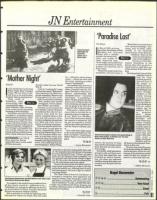

PHOTO BY JOE BERLINGER
SIN Entertainment
'Paradise Lost'
Not Rated
Howard Campbell
(Nick Nolte) and
Helga Noth
(Sheryl Lee) in
Mother Night.
'Mother Night'
Rated R
I
n his introduction to the book
Mother Night, Kurt Vonnegut
writes, 'We are what we pre-
tend to be, so we must be care-
ful about what we pretend to be."
These words in
themselves come
MOVIES
across simply. After
viewing the film adap-
tation of Mother Night, however,
these words become power-fully
haunting in their simplicity.
Nick Nolte portrays Howard
Campbell Jr., an American raised
from boyhood in Germany, where
his father's job brought the fami-
ly. Growing up to become a suc-
cessful young playwright in his
adopted language, Campbell in
his marriage to a beautiful Ger-
man actress (Sheryl Lee), his
success and his youthful roman-
ticism is fairly oblivious to the war
Lynne Konstantin is our Out &
About columnist. See her
related Film story in this week's
JN Entertainment.
literally under his nose: World
War II.
Until he "accidentally" meets
an American agent ("Roseanne's"
John Goodman) who offers him a
pivotal proposition: Become a spy
for the good ol' U.S. of A.; mean-
while, live the life of a German
Nazi, publicly spew hateful
propaganda, win the admira-
tion of Hitler, and so forth.
Of course, no one can know his
true "identity," and he will receive
no assistance from the U.S. gov-
ernment when tried for war
crimes. Campbell takes on this
role, and what ensues is a har-
rowing investigation into good and
evil, black and white, and ab-
solutely everything in between.
First-time director Keith Gor-
don has acted in such gems as
Rodney Dangerfield's Back to
School and Stephen King's Chris-
tine. His directorial debut, how-
ever, is proof that acting truly
wasn't his calling. He guides some
beautiful and original directorial
moves, with a little help from the
cinematographer. Robert Weide,
too — although a veteran screen-
writer — leaves his mark with
this script, adapting an author
deemed "unadaptable."
One problem area, however, is
apparent in the initial scene be-
tween Campbell and the U.S.
agent. The scene is vital to the au-
dience's understanding that
Campbell's stance — even if less
than hearty — is nonetheless, a
stance. The film portrays the char-
acter as more ambiguous than the
book, hindering our insight as to
why he agreed to the "less than
attractive" offer in the first place.
Nolte gives a better perfor-
mance than he has had the op-
portunity to give in a long time —
if ever. Sheryl Lee (Backbeat,
Twin Peaks) continues to display
her capacity to mesmerize, and
the pair are assisted in smaller
roles by Alan Arkin and Interview
with the Vampire's Kirsten Dun-
st.
Even with these slight lapses
in the script and despite any "the
book was better" comparisons,
Mother Night is way ahead of the
game.
—Lynne Konstantin
assumptions about the cooking skills of the read-
er. One example is the instructions in the recipe
for Oven-Braised Fennel: "Using a serrated
knife, slice the fennel as thinly as possible." For
the seasoned cook, this is easy enough to figure
out. For the novice who has never prepared fen-
nel, the instructions may be too vague.
If you're the kind of cook who likes to see pic-
tures of each recipe before you make it, this may
not be the book for you. Although there is some
food photography, the book is light on individ-
ual recipe photos.
The Great Chefs of America Cook Kosher is
arranged in categories, from appetizers and
Idee Grerman Schoenheimer and Ruth Madoff are the editors of th e soups to entrees, pasta and grains, salads and
Great Chefs of America Cook Kosher.
side dishes, and desserts, and will soon be avail-
able in bookstores. To order, call (800) 889-4414.
For readers in the mood for some traditional Jew-
ish fare, there's a touch of — deliberate or not — A single copy is $36 plus $7.65 for shipping and
Yiddishkeit, too. Among the offerings are the Ital- handling; additional copies are $29.95 plus $5.65
ian Jewish-Style Pot Roast, Nectarine Blueberry shipping and handling.
Blintzes and several versions of latkes.
Q. k . ) 43(e)
This is probably not a book for beginning cooks.
—Annabel Cohen
Although the recipes are simple, they also make
What follows is a trial that is
both heartwrenchingly emo-
n May of 1993, and ever
tional, and, at times, other-
since then, the citizens of West worldly in its hysterical
Memphis, Ark., have been demonization of the three de-
faced with a horrific
fendants. Some of the
episode: the sexual muti-
turns are truly bizarre,
MOVIES
lation and murder of
such as the sudden in-
three 8-year-old boys
volvement of the film-
whose bodies were pulled from makers themselves in the
a water-filled ditch not three- drama when they are given a
quarters of a mile from one of bloody knife as a gift from one
their homes.
of the parents of the slain chil-
Thrust into a pain most of us, dren.
thankfully, will never have to
Having gained remarkably
intimate access to
both the trials
and the personal-
ities and lives of
the people in-
volved, documen-
tary filmmakers
Joe Berlinger and
Bruce Sinofsky
(Creators of the
award- winning
documentary
Brother's Keeper)
have recorded an
event shocking in
both its subject
matter and its
subjects. This is
no
gruesome
news
drama
though; Sinofsky,
Berlinger and
their cinematog-
rapher Douglas
Cooper have tak-
en great pains to
integrate them-
selves into this
small town and
Damien Echols awaits a verdict in the satanic killings of
create a film that
three 8-year-old boys, in Paradise Lost: The Child
fairly covers a
Murders at Robin Hood Hills.
highly emotional
situation and lets
endure, the parents of these all those involved present them-
boys and the community around selves as they are.
them demand not only justice,
Paradise Lost should be seen
but revenge.
for its honest telling of a difficult
Eventually, amid speculation and brutal story; brutal not only
of satanic cults and ritual sacri- because of its monstrous central
fice, three teen-aged boys, one event, but also in a people's re-
bordering on mental retarda- action to a force they can't see.
tion, the other two awkward
c. ) s.t)
outsiders among their peers, are
.1/2
arrested and charged with the
murders.
—Jeffrey Hermann
I