

The
organized
Jewish
community's
response to
the AIDS
epidemic
remains
distant and
removed, as
Jews die of it.
JAMES D. BESSER
PHOTO BY GLENN fRIES1
WASHINGTON CORRESPONDENT
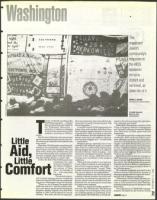
The AIDS Memorial
Quilt has many
Jewish panels.
Little
Little
T
he Oct. 19-20 full unveiling of the
AIDS Memorial Quilt — a display
that stretched from the Capitol to
the Washington Monument —
pointed to a national awakening
to the human dimensions of the
epidemic, according to AIDS ac-
ple in our community who won't admit it, be-
cause they're scared of being shunned. Talk
about being alone ..."
A handful of small AIDS organizations in
major cities, and countless individual Jews,
have brought a Jewish dimension to the care
of people with AIDS, according to planners
tivists.
of the conference. But the response by main-
But for many of the Jews who came to view stream communal and religious organiza-
panels commemorating loved ones, the Jew- tions has been sluggish and — in some cases
ish community's response to the epidemic has — nonexistent.
been mixed.
Religious groups, especially but not ex-
More than 750,000 people viewed the quilt, clusively in the Orthodox world, have steered
mostly in stunned silence, including Presi- clear of any too-visible AIDS programming,
dent Clinton and Vice President Gore and fearing charges they support a so-called al-
their wives. Among the symbols sewn into ternative lifestyle. That's changing — but
the 3-by-6-foot panels were a number of Jew- only slowly, according to Norman L. Sanfield,
ish ones: a kippah, Stars of David, Hebrew co-chair of the Jewish AIDS Network of
text, bar mitzvah photos, a cantor's robe.
Chicago and a coordinator of the weekend
In fact, the first of the 40,000 panels now conference.
comprising the quilt-
"More and more, people in our communi-
honored a Jewish vic- ty are willing to discuss it and confront it,
tim: Marvin Feldman, and actively support people with AIDS —
the partner of Cleve but mainly as individuals," he said. "Most-
Jones, the founder of ly what we see are one or two people in every
the ever-expanding city who are taking on the responsibility."
memorial.
Despite resistance, he said, the growing
The Jewish commu- number of Jewish families who have been
nity's mixed response was the underlying touched by the disease has gradually pro-
theme of a Jewish AIDS activism conference duced a critical mass of volunteers and pro-
that came to Washington along with the quilt. fessionals who are pushing the community
"There is a lot of support for people with to a more active response.
AIDS who look for it," said Jim Popkin of De-
"AIDS is no longer the headline grabber it
troit, who came to see the panel honoring his once was," Mr. Sanfield said. "But there are
daughter, Shelley Zagacki, who died of the more people who are doing the work, one by
disease in 1995, leaving behind two young one, of getting people to understand, of car-
children. "But there are still so many peo- ing for people with AIDS from a Jewish per-
Comfort
spective. So we're moving in the right direc-
tion, although very slowly."
Rabbi Marc Blumenthal, a member of the
Union of American Hebrew Congregations
and Central Conference of American Rabbis
Joint Task Force on AIDS, agrees with that
assessment.
"I get good support from within the Jewish
community, from inside the Reform move-
ment, although even there I see a tremendous
amount of awareness that still needs to be
taught," said Rabbi Blumenthal, one of two
rabbis in the nation known to have the dead-
ly virus. "Outside the Reform movement, I see
some very fine individual responses, but very
little institutional response. That's something
I'd like to see change
Rabbi Blumenthal brings his message on
AIDS prevention and:compassion for its vic-
tims to Jewish high-SChool students around
the country. But his .a'Udiences are generally
limited to students in Reform congregations;
so far, he has neverbeen invited to speak to
an Orthodox group./ ',-
The weekend conference, sponsored by the
National Jewish AIDS Network, focused on
sharing programs and techniques for breach-
ing that wall of rejection and denial:
* Baltimore's Jewish Family Services pro-
vides an ambitious program of support ser-
vices to AIDS patients and their families,
including support groups and assistance with
daily living.
* On Long Island, an "AIDS Talk" outreach
program, developed by the F.E.G.S. Jewish
COMFORT page 72