

,
►
•
•
2r.r 4 11t;4110if
-
_
. 01
.
.
.
.Y1, re.,
•
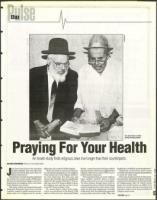
Two Jews share a siddur
during morning prayers.
Praying For Your Health
An Israeli study finds religious Jews live longer than their counterparts.
MELINDA GREENBERG SPECIAL TO THE JEWISH NEWS
ews have long known the spiritual
benefits of prayer. But what about the
physical rewards that come from re-
_ ligious observance?
Ili
Researchers in Israel recently published
the results of a 16-year study of kibbutzim
life that concluded that religious Jews live
longer than non-religious Jews, even when
their lifestyles are similar.
The study, which was conducted through
Hadassah Hospital's department of social
medicine, looked at health records and mor-
tality rates at 11 religious and 11 secular
kibbutzim, for a total of 3,900 subjects.
Those who lived on the secular kibbutz-
im were almost all agnostic or non-religious,
while almost all on the religious kibbutz-
im were observant. For both men and
women, the mortality rate was significantly
higher for the secular kibbutzim. The sec-
ular men were 1.67 times as likely to die as
the religious men and the secular women
were 2.67 times as likely to die.
Dr. Jeremy Kark, author of the study,
which was published in the March 1996
edition of the American Journal of Public
Health, noted that these findings confirm
previous studies which have suggested that
religious observance carries with it a pro-
tective health component.
"It's important that our work confirms
other studies," said Dr. Kark, a South
African native who now lives in Jerusalem.
"In other studies, though, there were al-
ways questions about whether the findings
could be explained by other factors that
might not have been adequately controlled
in the study. But the kibbutzim presented
a very unique arena for study. They are
egalitarian, socialistic and homogeneous."
Kibbutzim, on the whole, have a lower
mortality rate than the general population
in Israel, Dr. Kark said.
Previous studies looked at Mormons,
Seventh-Day Adventists and the Chinese,
using church attendance as the barometer
for religiousness. But, Dr. Kark's study
points out, health status can affect one's
ability to attend a house of worship and
therefore might not be sound evidence of
religious observance.
PRAYING page 64