

ISO
'Good Friday'
'Letters In The Dirt'
Chuck Brodsky; Red House Records
ere are plays, like newborns,
that have just sprung from
their mother playwrights'
imaginations, if not their
loins. Such is Good Friday, by Su-
san Arnold, at the Attic Theatre,
and we gathered at the first show-
ing to see the newborn, hoping
that it would be a beauty.
She is a pretty thing, and one
can only hope that her mother
will give her some more time to
mature. Good Friday has a good
first act folding into a good sec-
ond act but stops short of being
complete. Just when we are cer-
tain that Arnold's imagination
has captured the story of a
charmingly odd child in a dys-
functional family from preschool
to high school, Arnold's imagina-
tion abandons her baby. And us.
Quite simply, the play is pre-
mature. Still, there are wonder-
ful, funny and touching moments.
The play echoes that American
genre of coming-of-age literature
which stretches to include The
Glass Menagerie as well as To Kill
a Mockingbird, and even shares
with the latter a narrator who
tells us about her feelings. She is
Lizbeth, played admirably by
Kate Peckham, who observes and
comments on the action of her
Michael H. Margolin has
performed professionally in
theater and dance and is a
freelance critic.
progenitors, especially her moth-
er as a child and as a young
woman.
The observations are nicely
prosed by Arnold for her narra-
tor and, in fact, all the dialogue
has a tangy, new sound, like a
playwright who has listened to
her family as she was growing up.
I'll bet Arnold is a terrific mim-
ic.
THEATER
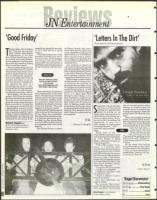
Chris Ann Voudoukis, Robyn
Lipnicki and Kate Peckham
are among the
dozen actors appearing in the
Attic Theatre's Good Friday.
There are dozens of characters,
very well played by a neat dozen
actors. The spirit and ensemble
of these twelve who play young,
old, in-between, mothers, teach-
ers, preachers, clearly has the
benediction of a director who loves
actors and the play. That also
happens to be Susan. Arnold.
Each and every performance is
right and true, but two stand out
for me: Chris Ann Voudoukis,
who played the duplicitous Car-
ol in Oleanna last season at De-
troit Rep, is a fine, strong Mina,
a woman suffering from mutism
but inspiring song in the young
heroine.
She, Emilee Whitton, is played
by Robyn Lipnicki who, just a
short while ago but light years
away, played the annoying court
clerk in Sly Fox at U of D-Mercy.
Here, Lipnicki covers a tremen-
dous range and is fearfully hon-
est as a child, preadolescent and
conflicted teen.
One could go on about our
community of actors who go from
one role to another: From Purple
Rose to Jewish Ensemble Theatre
to the Attic, Detroit is like one
great repertory company. What
a great pool of talent there is here.
Which brings us back to Susan
Arnold, herself an actress of mer-
it; as director she is skilled, as
playwright she's got ideas, an-ear
for dialogue and a gift for writing
terrific character parts. In this
production, Paul Bruce's original
music is a great plus; Reid
Downey's scenic design is not.
Rick Frederick's costumes are
evocative, but John Woudstra's
light design veers from good ef-
fects to lighting upthe whole
house along with the stage, there-
by obliterating the third wall, de-
stroying that essential device
which keeps the audience and ac-
tors separate.
cA-
- Michael H. Margolin
Chuck B rods K,
ongwriter Chuck Brodsky like an acoustic guitar with a
has done everything from twang), is evidence that his
working as a migrant fruit acoustic music is anything but
_ picker to driving an ice boring and pensive. Ditto the
cream truck, laboring on an Is- gritty, bluesy "No More Mr. Nice
raeli kibbutz and putting in a Guy."
There are thought-provoking
stint as a bank courier. In Let-
ters in the Dirt, he utilizes his tracks, including "Bill & Annie."
experiences to give us a The song takes us into the mind
wide variety of high-quality of an older man whom Brodsky
and his friend Anne met on the
acoustic/folk/roots rock
road; the man owns a
tunes with well-conceived
peach stand: "He said
lyrics.
CDs
Annie was the one and
While some of his
only true love of his life/
songs address important issues
such as racism and social equal- They met at his wedding, but by
ity ("The Ballad of Eddie then he had a wife." Did he mar-
Klepp"), others are just plain en- ry the wrong woman? We'll nev-
er know.
tertaining and fun..
All the songs were written
"Talk to My Lawyer," for in-
stance, is a satirical, light- and performed by the North
hearted track about ambulance- Carolina-based Chuck Brodsky,
chasing lawyers and would-be in this, his first nationally re-
plaintiffs looking for the prover- leased album. Letters in the Dirt,
bial hot cups of coffee to spill on is, all in all, a fine CD. .
their laps. After a little fender-
bender with a Mercedes, and af-
ter being offered $1,000 by the
other driver, Brodsky's protag-
10
onist in the song says:
"I've got to talk to my lawyer
— Steve Tapper
— I might have whiplash/
I might have trauma — let's
not talk petty cash/
I've got a witness to put a
hand on the Bible/
Jury, jury, hallelujah, you
might be liable."'
Outstanding
The up-tempo "She's Gone,"
laced with staccato drums, bass,
Very Good
fiddle, and dobro (which sounds
S
-
Q.,-)
Bagel Barometer
Steve Tapper is an Atlanta-
based music writer.
Good
Fair