

Paul Wellstone, also a Jew and the man who beat him six
years ago. Mr. Boschwitz dubbed the incumbent "Sena-
tor Welfare." But his last-minute charge that Sen. Well-
stone had participated in flag burnings, later retracted,
contributed to his defeat.
"Boschwitz ran a nasty campaign, which always seems
O
to backfire in Minnesota," said a Republican political con-
sultant. "And it looked too much like a replay of the race
six years ago; it's very hard to ask voters to admit they were
wrong."
In Michigan, three-term Democrat Sen. Carl Levin eas-
ily turned back a challenge by Republican Ronna Rom-
ney, a former radio talk-show host.
In a particularly nasty race in New Jersey, Rep._Robert
G. Torricelli, a Democrat, beat Rep. Dick Zimmer, a Jew-
ish Republican, in the fight to replace the retiring Sen.
Bill Bradley. Some 74 percent of Jewish voters chose Tor-
•
ricelli, according to the American Jewish Congress exit
poll, helping prevent Zimmer from becoming the eleventh
Jew in the Senate.
In New Hampshire, Sen. Bob Smith, a one-term Re-
publican, edged out former Rep. Dick Swett, a fiscally con-
servative pro-Israel Democrat and the son-in-law of Rep.
Tom Lantos (D-Calif ), a leading member of the Jewish del-
egation.
The race produced controversy in Jewish political cir-
cles because many pro-Israel political action commit-
tees gave to Smith, despite what most agreed was a
disappointing record on Israel.
Sen. Jesse Helms (R-NC), the chair of the Senate For-
eign Relations Committee, beat back a second challenge
by former Charlotte Mayor Harvey B. Gantt, who is black.
The race, one of the most expensive in the nation, at-
si) tracted little pro-Israel money, despite Helms' conversion
to the hard-line pro-Israel cause; many Jewish donors
were simply too uncomfortable with the incumbent's con-
servative positions on a host of domestic issues and his
close association with Christian Right forces.
In Georgia, former Veterans Administration head Max
Cleland, a Democrat with strong ties to the pro-Israel com-
munity, defeated Guy Millner, a Republican, in the race
to replace the retiring Sen. Sam Nunn, a Democrat.
And in a contest that attracted significant Jewish in-
terest, Democrat Mary Landrieu, a former state treasur-
er and a moderate, apparently beat State Rep. Woody
Jenkins, one of the most conservative Republicans in this
year's races, by a razor-thin margin.
House Races
In the House, it appeared the Jewish delegation sur-
vived intact. Some Jewish Democrats who have tradi-
tionally faced tough races fared well this week; Rep. Sam
Gejdenson (D-Conn.), Rep. Sander Levin (D-Mich) and
Rep. Jane Harman (D-Calif.) all ran better than in 1994.
Republican Michael Benjamin, who is Jewish, failed to
unseat Democrat Jerrold Nadler, a Jewish Democrat from
New York; in Washington, Jewish challenger Jeff Coop-
ersmith failed to unseat Rep. Rick White, a Republican.
In Michigan, challenger Morris Frumin lost to Rep. Joseph
Knollenberg.
In Georgia, House Speaker Newt Gingrich turned back
a spirited challenge by Michael Coles, the Jewish cookie
king.
•
Rep. Cynthia McKinney (D-Ga.) apparently held on to
her seat by a narrow margin in a campaign marred by ac-
cusations of anti-Semitism. But a number of pro-Israel
__LT-coups quietly supported McKri iney and spurned Repub-
lican John Mitnick, who is Jewish.
Jewish activists were watching two races as bellwethers
of the fate of the most conservative members of the fresh-
man class of 1994; at press time, it appeared that both Rep.
Helen Chenoweth (R-Idaho) and Rep. Steve Stockman (R-
Texas) had survived, although Stockman's race was still
officially too close to call. Both legislators have close ties
to right-wing, pro-gun groups.
All tolled, there will be more than 70 newcomers wan-
dering the halls of Congress in January, a fact that will
pose a major challenge to pro-Israel activists.
Gridlock Fatigue
Despite a handful of dramatic results and a long list of
retirements, the 105th Congress will look
remarkably like its controversial prede-
cessor — promising more grueling bat-
tles with Bill Clinton over a wide range
of foreign and domestic issues of concern
to the Jewish community.
The House appears to have edged a lit-
tle to the center; the Senate will have a
younger, more conservative and more
combative cast. "A lot depends on
whether legislators remember the mes-
sage they were getting in the last few weeks of the cam-
paigns — that voters are tired of extremes and tired of
gridlock," said Reva Price, chief lobbyist for B'nai B'rith.
"There may be more pressure to compromise on budget
and social welfare issues. But the Republicans will still be
the committee chairs, so their agenda — including issues
like school prayer and immigration restrictions — will still
get major play."
Domestically, Jewish activists expect President Clinton
to move quickly to blunt some of the worst excesses of
the 104th Congress.
Jewish groups are already making plans to press the
president to make good on his promise to repair some of
the damage created by the Republican welfare bill he signed
in September; Tuesday's congressional results will make
that battle much harder. Jewish lobbyists are already brac-
ing for new Republican initiatives on immigration and a
new battle over tax cuts that will affect the bottom line
of the budget for years to come.
But the continuing GOP grip on Capitol Hill means that
the downward pressure on government spending and on
social safety net programs will continue unabated.
Time is running out for serious changes in the Medicare
program; the 105th Congress may have no choice but to
tackle the hugely controversial issue, which affects the live
of countless elderly Jews and the financial health of Jew-
ish agencies around the country.
Eyes On The Middle East
The partisan split between Congress and the White
House is likely to result in an intensified administration
focus on the Middle East, according to American Univer-
sity historian Allan J. Lichtman, an expert in presidential
politics who predicted the strong Clinton victory more than
a year ago.
"Second term presidents generally focus more on foreign
policy," he said. 'That tendency is even more pronounced
when the White House and Congress are controlled by dif-
ferent parties. Clinton would like nothing better than to go
down in history as the one who brought
peace to the region."
That, he said, could translate into
intensified pressure on both the gov-
ernments of Israeli Prime Minister
Binyamin Netanyahu and Palestinian
leader Yassir Arafat.
Marshall Breger, a leading Jewish
Republican, agreed, but predicted that
the Clinton administration will move
cautiously in trying to reenergize the
peace process.
"I don't think Clinton will throw a
gauntlet down; it's not in his nature,"
he said. "But a lot will depend on who
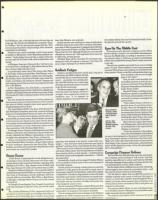
Above: Robert G.
he chooses as secretary of state; it could
Torricelli, a New
be someone like (former Assistant Sec-
Jersey Democrat,
retary of State Richard) Holbrooke or
won his Senate
(retiring Sen. Sam) Nunn, who would
race.
be more forceful than Christopher."
Left: N.J. Gov.
Most observers agree that Ameri-
Christine Todd
can Mideast policy will be driven more
Whitman consoles
the loser, Dick
by developments in the region than by
Zimmer.
ideology or personnel.
"Given the situation in the negotia-
tions, the administration will be forced
to react to developments on the ground," said Gail Press-
berg, Washington director of Americans for Peace Now.
"Right now is the calm before the storm in Gaza and the
West Bank; if the situation deteriorates, administration
policy will be shaped by events, not by who gets appoint-
ed to what positions."
Campaign Finance Reform
The fact that the 1996 elections were the most expen-
sive in history, and the deluge of "soft money" and inde-
pendent expenditures by unions and business interests,
will make campaign finance reform a hot issue for the Clin-
ton administration and the 105th Congress.
But the battle will be a difficult one as newly elected leg-
islators begin to worry about the next election cycle — and
the need for almost continuous fundraising.
"I'm the first to admit that the $64,000 question is
whether anybody really wants to talk bout this issue to-
morrow, or next week," said Sen. Russ Feingold (D-Wisc.),
author of a tough reform measure that would ban or re-
strict political action committees (PACs) and place new
controls on soft money.
The success of their efforts, he said, will depend large-
ly on President Clinton's willingness to press hard for mean-
ingful campaign finance legislation.
The stakes in that debate will be enormous for pro-Is-
rael groups.
❑