

The president is free to pursue his real agendas
in a second, term, but worries persist that he'll
return to his unfocused and inconsistent ways.
ournalists by the
score are spending
the week writing
about what to expect
in a second Clinton
administration. The
story is a good one, but the
script is still murky; Bill Clin-
ton's energetic but undetailed
campaign rhetoric revealed lit-
tle of what he really believes or
what he really hopes to ac-
complish in his second four
years.
eign policy.
At the same time, the return of a Republican Congress
will likely result in a domestic policy gridlock — another
factor pushing him in the direction of the international
arena.
That means a heightened interest in the Middle East
peace talks, until recently the most dramatic and suc-
cessful component of the Clinton foreign policy.
The major advances of the past three years — the two
Oslo accords and the peace treaty with Jordan — occurred
with only minimal direct American involvement. But the
administration played an indispensable role in keeping
the parties at the table when things got tough.
Now, with a hard-line government at the reins in Is-
rael and the Oslo framework looking increasingly tattered,
the administration will have to play a far more active and
directive role if it wants the peace process to survive.
Don't look for heavy-handed, one-sided pressure on the
Israeli government; do look for a subtler but still power-
ful squeeze on both Israel and the Palestinians, and a
more active American role in pushing new ideas to break
through the impasses on top of impasses.
The Clinton administration will move quickly to im-
prove its troubled relations with the new Israeli govern-
ment, but there is no expectation that they can recreate
the warm personal bonds that dominated U.S.-Israel re-
lations during the Rabin-Peres years. That fact will com-
Conservatives argue that Mr. Clin-
ton is, at heart, a traditional liberal who
will return to that agenda after the elec-
tion; progressives tend to see Mr. Clin-
ton as the avatar of a new brand of
conservatism.
Mr. Clinton fuels the confusion. He
signed a welfare reform bill considered
outrageous by almost every major Jew-
ish group, then promised to repair it
during a second term. But while cam-
paigning through the South, he told au-
diences that the bill represented a real
highlight of his administration.
The Jewish right accuses him of
pressuring the new Israeli government;
the left says he hasn't pressured them
enough in the interests of a workable
Mideast peace process. The president's
intentions, so far, remain a mystery.
Supporters have attributed many of
the president's abrupt changes in direction in the past two
years to the arrival of a Republican Congress, and then
to the demands of winning re-election in 1996.
Now, as a second-term president, Mr. Clinton will not
C
have that excuse to hide behind. He will either be liber-
ated to pursue his real agendas, domestic and
international — or he will turn out to be as un-
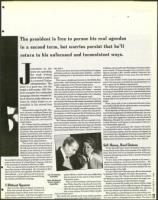
Left: The victorious
focused and as changeable as he seemed during
incu mbents.
the endless presidential campaign.
plicate efforts to resolve the many difficulties
that lie ahead on the road to a final Israeli-
Palestinian peace.
Above: B ob Dole and
This country's dealings with Syrian Presi-
his wife, Elizabeth,
dent Hafez Assad have produced much criti-
say g oodbye.
cism and few results; a new secretary of state
Here are a few things to expect in Clinton II.
after the January inauguration is almost cer-
Like most second-termers, Mr. Clinton will
tain to stop playing President Hafez Assad's
undoubtedly begin to think more about ensur-
bait-and-switch game.
ing his place in history. And when thoughts turn to the
The results may include much more explicit pressure
history books, presidents almost invariably turn to for- on Syria to come to the peace table without crippling pre-
A Mideast Squeeze
conditions, and an end to the Washington-Damascus diplo-
matic shuttle. If those strategies do not produce unam-
biguous changes in Mr. Assad's stubborn behavior, the
administration is likely to turn away from the Syrian-
Israeli track entirely.
But a host of other world crises that threaten to boil
over in the next year could limit the administration's ef-
fort to speed up the Mideast negotiations.
Mr. Clinton has enjoyed a run of remarkable good luck
on the world scene. That luck seems to be changing; Africa
is lurching toward bloody chaos on an unprecedented scale,
China is a burgeoning menace that may be emboldened
by weak, indecisive American policy and the Bosnia
tragedy still has the potential to produce unwelcome sur-
prises.
Those, along with a host of potential domestic crises,
may make it harder for the administration to invest heav-
ily in the Middle East as a result.
Much depends on Clinton's choice as secretary of state.
A hard-driving diplomat like Richard Holbrooke, the man
who negotiated the Dayton accords on Bosnia, may sig-
nal a much more aggressive American role; the choice of
Madeleine Albright, the current U.S. Ambassador at the
United Nations, could signal a continuation of the low-
key Christopher approach.
As a second-term president, Mr. Clinton will be bet-
ter positioned to exert a forceful, constructive American
role in the peace process. But his success will depend on
formulating clear, far-sighted American proposals for the
talks, and on his willingness to stay the course in nego-
tiations that will become progressively more difficult.
Soft Money, Hard Choices
On the domestic front, look for President Clinton to try
to ameliorate some of the worst excesses of the 104th Con-
gress. But there will be no outright reversal of the gov-
ernment downsizing process that is already fraying the
social safety net.
To save some of the programs dearest to his heart —
education initiatives, environmental protection — Mr.
Clinton will probably accept even more cuts in critical so-
cial programs as the center in American political life con-
tinues to edge to the right.
A more conservative Senate and a House dominated
by Speaker Newt Gingrich will add to the pressure.
Sooner or later, Mr. Clinton will be forced to confront
the Medicare crisis; the results are sure to be hugely con-
troversial and draining of administration energy.
Modest proposals for health care reform will be a high
priority, but progress will be difficult because of budgetary
constraints and the furious lobbying efforts by opposing
forces that health-care debates invariably unleash.
Most pundits are predicting that the most striking out-
come of the 1996 elections, the most expensive ever, will
be a new push for campaign finance reform. The rise of
CO
C)
C)
-
CO
CC
UJ
CO
LLJ
21