
VOTER page 109
test, 77 percent of New York's
700
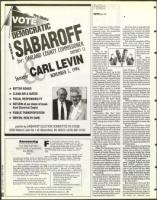
C00 D\ S VA CI
• BETTER ROADS
• CLEAN AIR & WATER
• FISCAL RESPONSIBILITY
• RETURN of our share of taxes
from Governor Engler
• PUBLIC TRANSPORTATION
• MENTAL HEALTH CARE
paid for by SABAROFF ELECTION COMMITTEE #C-91598
6283 Walnut Lake Rd. • W. Bloomfield, MI 48323 • (810) 661-5150
Announcing
THE BRONFMAN
YOUTH FELLOWSHIPS
IN ISRAEL
1997
or the eleventh consecutive summer, a group
of outstanding Jewish teenagers in the U.S. and
Canada, coming from a wide variety of backgrounds
and entering the twelfth grade of school, will be
recipients of the Bronfman Youth Fellowships*. They will
spend five fulfilling weeks of study, dialogue and travel in
Israel.
F
The Bronfman Fellows will be selected on the
basis of character, intellectual interests, special talents
and leadership qualities. Merit, not financial need, is the program's selection standard. Fellowship
activities begin on June 30, with a return from Israel on August 5. All meals will be kosher, and
Sabbath activities will be in the spirit of the day.
Based in Jerusalem, the Fellows will engage in an intense interaction with a diverse rabbinic
faculty and counselors, representing a wide range of Jewish perspectives. They will explore Jewish
texts against the background of Israel's land, culture and customs ... take part, at a time of rapid
change, in seminars with some of the country's leading political and cultural figures ... debate ideas
and search for insights, on the different ways to
For a descriptive brochure and application form,
define oneself as a Jew today, all in an atmosphere
please call or write at once to:
of mutual respect and open dialogue.
The Bronfman Youth Fellowships in Israel
The purpose: to return home with a new
understanding of the myriad issues facing the
Jewish people and the Jewish state, and a new
appreciation of the need for dialogue among Jews.
17 Wilbur Street Albany, NY I 2202
Telephone: (518) 465-6575
Fax: (518) 432-8984
E-mail: YFIgmcimail.com
Webpage: http://www.bronfman.org/byfi
* Fellowships cover all expenses including roundtrip transportation between
New York and Israel, room and board, travel in Israel and incidentals.
Completed applications must be postmarked by January 31, 1997
A PROGRAM OF THE SAMUEL BRONFMAN FOUNDATION, INC.
Jews voted; in the 1994 guber-
natorial race, the proportion
dropped to 58 percent.
That meant that some 230,000
Jews who voted in the presiden-
tial contest didn't bother to go to
the polls two years later in an
election that swept longtime Gov.
Mario Cuomo out of office by a
margin of
170,000.
Part of the
drop-off is gener-
ational: younger
Americans feel
less of an invest-
ment in a politi-
cal system they
often see as cor-
rupt and out of
touch with their needs.
"People who grew up in the
shadow of Roosevelt feel that gov-
ernment makes a difference, and
they're very much invested in the
voting process," said David Pol-
lack, associate director of the New
York Jewish Community Rela-
tions Council and another ac-
knowledged expert in Jewish
voting behavior. "People who
grew up in the aura of Watergate
and Vietnam are much less in-
vested. And that's a universal
phenomenon. We don't think
Jews are immune. In my last
study, in 1985, we found that only
50 percent of Jews under 45 were
registered, while 95 percent or
more of the Jews over 60 were
registered."
Numbers like that have
spurred Jewish organizations
around the country to crank up
efforts to convince younger Jews
that voting does make a differ-
ence.
AIPAC has worked with local
college groups to register more
than 10,000 students in the past
few years. Jews, according to
AIPAC director Howard Kohr,
"have to be disproportionately in-
volved, because our numbers are
so small. We risk not merely hav-
ing a lower voice, but no voice at
all in many states. Consider this
a wake-up call."
Other Jewish groups such as
Hadassah and the National
Council of Jewish Women have
conducted voter registration dri-
ves focusing heavily on domestic
issues. Recently, Orthodox, Con-
servative and Reform religious
groups came together in an un-
usual demonstration of solidari-
ty to produce a voter registration
manual that was another tacit
acknowledgment of the depth of
the problem.
These efforts have produced
thousands of new registrations,
but it remains to be seen how
many new voters will actually
turn out on Nov. 5 for what is
seen by many to be an unexcit-
ing election.
Another factor in the declining
Jewish presence in the voting
booth is the community's grow-
ing geographic dispersion.
It's true that in presidential
contests, Jews are still overrep-
resented in a number of states
with big blocks of electoral votes:
New York, New Jersey, Penn-
sylvania, Illinois, Ohio, Califor-
nia and Florida.
But with the exception of New
York, Jews are still a small
enough proportion of the popu-
lation in those
states to swing
the vote in only
the closest con-
tests.
"As Jews
have begun to
disperse, their
vote has become
less concentrat-
ed," said Mar-
shall Breger, a White House
liaison to the Jewish community
during the Reagan administra-
tion and now a professor of law
at Catholic University. "While we
live in more states than ever be-
fore, the states in which you must
have the Jews to win are fewer
and fewer."
And the Jewish community is
becoming more independent and
politically diverse, despite the
continuing tendency of Jews to
vote heavily for Democratic can-
didates.
"What's different is that the
Jewish vote isn't as predictable
as it once was," said political sci-
entist Amos Perlmutter of Amer-
jean University. "There's a
greater independence by the
younger generation, as well as
the diminished connection to po-
litical parties. Israel is no longer
such an emphasis; Jewish voters
are more interested in issues like
crime and taxes."
Highly energized bloc voting
based on one or two clear-cut is-
sues has traditionally been a way
for minorities to increase their
political power far beyond their
numbers. Yet the Jewish vote is
no longer "deliverable" in the way
it once was, Mr. Perlmutter said,
despite the ongoing preference
for Democrats.
At the same time, it's growing
less clear whether most Jews ac-
tually vote as Jews, or whether
their behavior inside the voting
booth is determined by the same
variables that guide the voting of
their non-Jewish neighbors.
"In the past, Israel was a top
issue," said Mr. Pollack, the New
York JCRC's political expert.
"But most candidates now know
how to get Israel off the table
right away by saying the right
things. Right behind that are per-
sonal freedom concerns. When
Jews see a danger that the gov-
ernment will start telling us what
to do, they react."
But American Jews see few
threats to their personal free-
doms coming from politicians in
Washington. That is a key rea-
son why Jewish groups, eager to
provide issues around which Jew-
ish voters can coalesce, have
Scanned image of the page. Keyboard directions: use + to zoom in, - to zoom out, arrow keys to pan inside the viewer.
November 01, 1996 - Image 116
- Resource type:
- Text
- Publication:
- The Detroit Jewish News, 1996-11-01
Disclaimer: Computer generated plain text may have errors. Read more about this.